
As an intergovernmental space agency, ESA engages with countries well beyond those of its member states. A key partnership is with Argentina, one of South America’s most space-connected countries.
Elu, loodus, teadus ja tehnoloogia
As an intergovernmental space agency, ESA engages with countries well beyond those of its member states. A key partnership is with Argentina, one of South America’s most space-connected countries.

Together with the London Science Museum and top European fashion schools, ESA is harnessing next-generation technology and exploring the future of fashion
ESA is in partnership with top European fashion schools to harness next-generation technology and explore the future of fashion.
ESA is in partnership with top European fashion schools to harness next-generation technology and explore the future of fashion.
These worlds have sizes and temperatures similar to those of Venus and Earth and are the best targets found so far for the search for life outside the solar system.
A team of scientists has now shown that even though water that emerges onto the surface of Mars immediately begins to boil, it creates an unstable turbulent flow that can eject sediment and cause dry avalanches.
From asteroid belt to Oort Cloud, C/2014 S3 may be an important relic of the early solar system.

ESA astronaut Tim Peake and his crewmates Yuri Malenchenko and Tim Kopra will return to Earth on 18 June, giving them almost two more weeks more in space than their original mission.
Each International Space Station crew flies as a trio to the outpost and back to Earth in a Soyuz spacecraft. About every three months, a crew returns to Earth shortly before a new one arrives, often leaving a few days when only three astronauts look after the Station.
Tim, Tim and Yuri will stay longer in space because ground control aims to keep the Space Station operating at full capacity with six astronauts.
Tim Peake says: “Although I am looking forward to being back on Earth and seeing friends and family again, each day spent living in space is a huge privilege and there is much work to do on the Station.
“This extension will keep the Station at a full crew of six for several days longer, enabling us to accomplish more scientific research.
“And, of course, I get to enjoy the beautiful view of planet Earth for a little while longer!”
Our week through the lens: 25-29 April 2016
The XMM-Newton satellite has discovered gas streaming away at a quarter of the speed of light from bright X-ray binaries in two nearby galaxies.

Europe’s latest navigation satellites, launched last December, have been officially commissioned into the Galileo constellation, and are now broadcasting working navigation signals.
NASA is developing new technologies to help astronomers capture the shine of Earth-like worlds and ultimately look for evidence of life elsewhere in our galaxy.
Less than three days after it was launched, Sentinel-1B has delivered its first radar image of Earth
Explore the International Space Station’s Tranquility module from all angles on your mobile phone or headset
Launched on 25 April from Europe’s Spaceport in French Guiana, Sentinel-1B has produced its first images only two hours after the radar was switched on – a record time for a space radar.

Join us Friday, 29 April, at 10:00 CEST for the ‘Earth from Space’ video programme. This week features a Sentinel-2A image of Namibia
NASA’s Fermi Gamma-Ray Space Telescope helped astronomers connect a blazar’s outburst to Big Bird, one of the most powerful neutrino events ever detected.
A giant star that exploded 30 million years ago in a galaxy near Earth had a radius prior to going supernova that was 200 times larger than our sun, according to astrophysicists at Southern Methodist University, Dallas.
The sudden blast hurled material…
NASA’s Curiosity Mars rover has nearly finished crossing a stretch of the most rugged and difficult-to-navigate terrain encountered during the mission’s 44 months on Mars.
How instruments called coronagraphs might help us ultimately find Earth-like worlds.
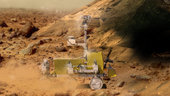
In a live space-to-ground test of human–robot cooperation, ESA astronaut Tim Peake will control a rover on Earth on Friday from the International Space Station, helping prepare for future exploration missions.
In a tweet, the company says it’s prepared to send a Dragon to Mars within the decade.
NASA’s Curiosity Mars rover has nearly finished crossing a stretch of the most rugged and difficult-to-navigate terrain encountered during the mission’s 44 months on Mars.
The rover climbed onto the Naukluft Plateau of lower Mount Sharp in early March …

Following liftoff on 25 April from Europe’s Spaceport in French Guiana, Sentinel-1B has opened its large solar wings and radar antenna.
Saturn’s largest moon is covered in seas and lakes of liquid hydrocarbons – and one sea has now been found to be filled with pure methane, with a seabed covered by a sludge of organic-rich material, and possibly surrounded by wetlands.
Of all th…
Once a lonely ice block, now it seems the dwarf planet may have a close-in companion.
Astronomers used echoes of light to determine the distance from a star to the inner wall of its surrounding protoplanetary disk.
A new study finds that a large sea on Saturn’s moon Titan is composed mostly of pure liquid methane, independently confirming an earlier result.
Technology image of the week: the eerie blue exhaust trail of a T6 ion thruster, a quartet of which will transport BepiColombo towards the innermost planet

Human spaceflight and robotic exploration image of the week: Growing blood vessels in space – tissue culture ready for the International Space Station
Researchers stacked and matched images taken from orbit to reveal objects at a resolution up to five times greater than previously achieved.
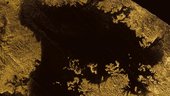
Saturn’s largest moon is covered in seas and lakes of liquid hydrocarbons – and one sea has now been found to be filled with pure methane, with a seabed covered by a sludge of organic-rich material, and possibly surrounded by wetlands.
The 3 student Cubesats launched with Sentinel-1 on 25 April have phoned home. Follow their progress
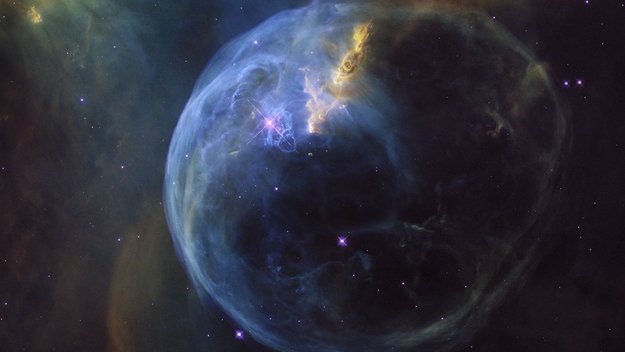
Space science image of the week: A massive star has blown a giant bubble in space – and Hubble has finally seen it all

From ESA’s ESRIN centre for Earth observation in Italy, watch the replay of the event celebrating Sentinel-1B

Watch the replay of the Sentinel-1B launch coverage from Europe’s Spaceport in French Guiana on 25 April

The second Sentinel-1 satellite – Sentinel-1B – was launched today to provide more ‘radar vision’ for Europe’s environmental Copernicus programme.
Sentinel-1B lifted off on a Soyuz rocket together with three Fly Your Satellite! CubeSats and the CNES Microscope satellite
NASA satellites help the City of Los Angeles monitor Santa Monica Bay during wastewater treatment plant repairs.
The spacecraft is now ready for science operations, officially starting K2’s new gravitational microlensing campaign, known as Campaign 9.
The Dawn probe is currently in orbit around Ceres after a visit to Vesta. Now, its researchers want to visit a third world to finish out the mission.
Following an anomaly observed during the countdown for the launch of Soyuz flight VS14 carrying Sentinel-1B, the countdown on 24 April was halted.
The latest meteorological observations indicate a ‘red’ weather conditions for the time of liftoff, initially set for Saturday 23 April 2016, therefore Arianespace has decided not to undertake final fueling operations with the launcher.
T…
Explore the why and how of lunar exploration in this comprehensive web documentary
This Earth Day, join NASA in a behind-the-scenes look at all we do in Earth science — and the people working to better understand our home planet, every minute of every day.
This Earth Day, join NASA in a behind-the-scenes look at all we do in Earth science — and the people working to better understand our home planet, every minute of every day.
During the technical review prior to the start of Soyuz fueling, the availability of the launcher, satellites, ground facilities and the launch base was confirmed.
Our week through the lens: 18-22 April 2016
Discover how the Sentinel-1 mission uses its radar to make our lives safer
This Earth Day, we can remember one of the catalysts: an image of the entire Earth taken from above.
Astronomers have discovered that the central 2,000 light-years within the Milky Way Galaxy hosts an ancient population of stars.
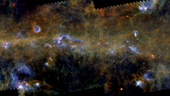
This new video from ESA’s Herschel space observatory reveals in stunning detail the intricate pattern of gas, dust and star-forming hubs along the plane of our Galaxy, the Milky Way.

As Earth Day is celebrated across the globe, discover some of the aspects satellites can ‘see’
Cosmic rays pelting the upper atmosphere are evidence of a recent supernova in the cosmic neighborhood.
New maps of the seafloor around Greenland help scientists understand which glaciers are at increased risk for melting.
NASA has selected Aerojet Rocketdyne, Inc. to design/develop an advanced electric propulsion system for deep space exploration missions like NASA’s Asteroid Redirect Mission.
NASA is soliciting ideas from U.S. industry for designs of a Mars orbiter for potential launch in the 2020s
Operations image of the week: Asteroid named after space debris expert Heiner Klinkrad

A final, full rehearsal has confirmed that teams at ESA’s mission control are ready for tomorrow’s launch of the Sentinel-1B radar satellite.
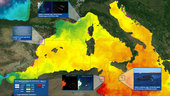
Images from the Sentinel-1A satellite are being used to monitor aquaculture in the Mediterranean, in another example of the mission’s contribution to food security, as fisheries become the main source of seafood.
Scientists have identified a free-floating planetary-mass object within a young star family, called the TW Hydrae association.
Technology image of the week: ESA’s veteran Proba-1 minisatellite images Europe’s most northerly satellite ground station

Explore Japan’s Kibo space laboratory with your mobile phone or VR headset in this panorama

With just two days to liftoff, the next Sentinel for Europe’s environmental monitoring programme in now poised high in the launch tower at Europe’s Spaceport in Kourou, French Guiana.

Live from ESA’s Earth observation centre in Italy: follow the event to celebrate the launch of Sentinel-1B. Streaming begins at 19:00 GMT (21:00 CEST)
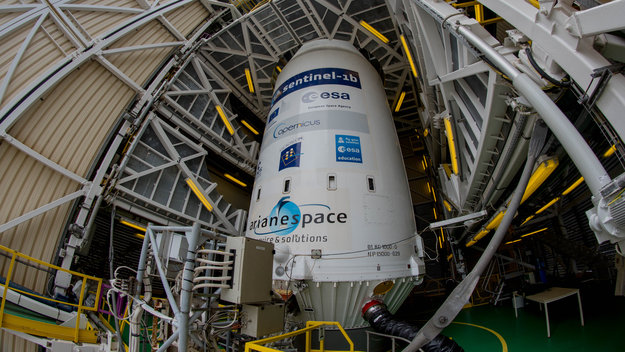
Follow the Sentinel-1B launch live from Europe’s Spaceport in French Guiana on 25 April. Streaming begins at 20:40 GMT (22:40 CEST), with liftoff scheduled at 21:02 GMT (23:02 CEST)
ESA, in partnership with Ars Electronica, is announcing art&science@ESA, a new art residency to explore the fertile ground between art and space science.
Scientists want to pin down the processes that create solar flares and even some day predict them before our communications can be interrupted.
Why does Earth need an asteroid-deflection test? Queen guitarist Brian May, ESA astronaut Luca Parmitano, UK Astronomer Royal Sir Martin Rees and Canadian astronaut Chris Hadfield share their thoughts

If you have a smart idea for a novel application using Europe’s Galileo satnav system, here’s your chance to turn it into a business
Sitting all by itself in space, a newfound object may help answer mysteries about planets without parent stars.
Craters with bright material on dwarf planet Ceres shine in new images from NASA’s Dawn mission.
Human spaceflight and robotic exploration image of the week: Umberto Guidoni, the first European to visit the International Space Station

With rigorous training complete, satellite operations teams are ready to assume control of Sentinel-1B – and for any problems that might come along.
Venus may be boiling hot, but its poles are very, very cold.
MARINER SCIENTIFIC EXPERIMENTS
MARINER 2 FACT SHEET
Mariner 1, the first of the series of spacecraft designed for planetary exploration will be launched within a few days (no earlier than July 21) from the Atlantic Missile Range, Cape Canaveral, Florida, by the National Aeronautics and Sp…
The Mariner spacecraft contains six scientific experiments representing the efforts of scientists at nine institutions: The Army Ordnance Missile Command, the California Institute of Technology, the Goddard Space Flight Center, Harvard C…
MARINER SCIENTIFIC EXPERIMENTS
The boost portion of the Mariner mission consists of three phases: ascent into a circular parking orbit of approximately 115 miles, coast in the parking orbit to a pre-determined point in space, and burning out of the parking orbit to gr…
National Aeronautics and Space administration officials are preparing the Mariner D spacecraft for launch on a Mars trajectory within the current launch opportunity. The launch of Mariner D, now undergoing final checkout at Cape Kennedy,…
MARINER FACT SHEET
Man’s first chance to obtain information from another planet will come on December 14 when the Mariner II spacecraft passes approximately 21,000 miles from Venus.
Mariner II carried two experiments designed to measure the charged-particle radiation in space, including galactic cosmic rays and streams of high-energy particles which are released intermittently from the sun. Virtually continuous meas…
Mariner II’s fly-by of Venus on December 14 has produced the most accurate estimate yet of the mass of our sister planet, two scientists from the California Institute of Technology Jet Propulsion Laboratory reported today. This informati…
The Mariner IV spacecraft, which made the first close-up photographs of Mars last July 14, took more television pictures late yesterday–this time of black space–the National Aeronautics and Space Administration reported today.
Telemetry from the Mariner IV spacecraft, now en route across interplanetary space to the planet Mars, indicates that one of its eight experiments has ceased to function.
A series of commands were radioed 16-1/2 million miles to NASA’s Mariner IV spacecraft early today by JPL engineers from the Mariner spaceflight operations center to check out spacecraft equipment that will be used if Mariner is still op…
Appointment of project managers for the two forthcoming Mariner-series deep space exploration mission to Venus and Mars has been announced by Gen. A. R. Luedecke, Deputy Director of the Jet Propulsion Laboratory of the California Institu…
Changes in the performance of two scientific instruments aboard NASA’s Mars-bound Mariner IV spacecraft were reported here today by a Jet Propulsion Laboratory engineer.
The areas on Mars that are expected to be photographed by the single television camera aboard Mariner IV have been determined by the National Aeronautics and Space Administration.
The Mars-bound Mariner IV spacecraft early today established a new United States and world communications distance record when it reached a point in space more than 66 million miles from Earth, the Jet Propulsion Laboratory reported.
…
The Mariner IV spacecraft, during the past week, reached a number of milestones along its 228-day scientific mission to the planet Mars, the National Aeronautics and Space Administration reported today.
The National Aeronautics and Space Administration is making final plans for processing the pictures Mariner IV will take of Mars as it flys within 5600 miles of the planet on July 14.
For 204 days the Mariner IV spacecraft has been charting the vast expanse between the planets Earth and Mars on the longest deep space mission in history.
The Mariner IV spacecraft, having achieved its mission objectives and now in its 300th day of flight, will receive a command from Earth next week, concluding–but possibly only temporarily–the National Aeronautics and Space Administrati…
An attempt to take pictures of empty, black space with Mariner IV’s television camera was scrubbed today after the transmission of the first of a series of commands from Earth, the National Aeronautics and Space Administration and the Je…
The target area for Surveyor A is a circle 62 miles in diameter in Oceanus Procellarium. The center of the circle is 3 degrees South latitude, 44 degrees West longitude. The area is a potential landing site for Apollo.
The Mariner IV spacecraft, which took the world’s first closeup pictures of Mars last year, is once again in contact with Earth reporting on the space environment and its own operating performance after 18 months of flight.