The National Aeronautics and Space Administration’s Surveyor I spacecraft made a perfect low-speed, three-point landing on the moon on June 1, 1966, after a 63-hour, 36-minute flight from Cape Kennedy.
Second Series Surveyor Launch
The second of a series of Surveyor spacecraft, designed to soft land on the moon, will be launched from Cape Kennedy during a launch period beginning Tuesday, September 20, and ending Friday, September 23.
Computer Process Brightens Surveyor Moon Pictures
The sparkling success of Surveyor I in taking television pictures of the Moon’s surface has been further enhanced by a computer process developed at Caltech’s Jet Propulsion Laboratory.
Surveyor I Mission
The National Aeronautics and Space Administration’s Surveyor I spacecraft made a perfect low-speed, three-point landing on the Moon on June 1, 1966, after a 63-hour, 36-minute flight from Cape Kennedy.
Surveyor II Loses Communication
The Surveyor II spacecraft, which was to soft-land on the moon tonight, lost communications with Earth tracking stations at 2:35 a.m. PDT today–45 hours and three minutes after it was launched from Cape Kennedy.
Surveyor II Will Impact Copernicus Crater
Surveyor II will impact southeast of the crater Copernicus at 8:18 p.m. PDT tonight. The landing time and zone is based on analysis of the flight path prior to loss of contact.
1966 Release 424
Mariner IV, launched two years ago today on its historic Mars photo mission, has flown more than one billion miles in space and continues to operate properly, reporting its condition to Earth three times each week.
Surveyor II Impacts Moon
The National Aeronautics and Space Administration’s Surveyor II spacecraft impacted the moon near the crater Copernicus on September 22, 1966.
Surveyor I Switched On
Surveyor I, on its 220th day on the moon since it landed in the Ocean of Storms June 1, 1966, was turned on last Friday and communicated with Earth stations for approximately twelve hours. The objective for activating the transmitters ab…
Three Surveyors Eliminated from Program
The National Aeronautics and Space Administration has eliminated three Surveyor soft lunar landing spacecraft from current budget planning.
Fourth Series Surveyor Launch
The fourth of a series of Surveyor spacecraft, designed to soft land on the moon, will be launched from Cape Kennedy during a launch period beginning Thursday, July 13, and ending Monday, July 17.
Mariner V Mission
Mariner V, now in the tenth day of its four-month flight to Venus, will fly by the planet at an altitude of about 2500 miles, project officials of the National Aeronautics and Space Administration and the Jet Propulsion Laboratory report…
Fifth Series Surveyor Launch
The fifth of a series of Surveyor spacecraft, designed to soft land on the moon, will be launched from Cape Kennedy during a launch period beginning Friday, September 8, and ending Wednesday, September 13.
Two Mariners to Combine in NASA-JPL Solar Plasma Study
The Mariner Venus spacecraft of 1967 may combine with the Mariner Mars spacecraft, vintage 1964, in a novel experiment planned for this summer and fall by Caltech Jet Propulsion Laboratory scientists for the National Aeronautics and Spac…
Mariner V to Probe Venus Atmosphere, Heat
Venus, the cloud-shrouded mystery planet, may yield some of her secrets in mid-October to Mariner V experimenters at Caltech’s Jet Propulsion Laboratory and several allied installations.
Mariner IV Crosses Path with Micrometeoroids
The Mariner IV spacecraft last night was buffeted about in interplanetary space between the orbits of Earth and Mars when it apparently crossed the path of a stream of micrometeoroids.
Surveyor VII to Combine Digging, Chemical Testing of Surface of Moon’s Highlands
Surveyor VII will both dig and analyze the Moon’s surface if all goes well next month in the last and probably most difficult of the United States’ series of lunar surface probes.
Commands Sent to Both Mariner Spacecrafts
Commands were transmitted from Earth yesterday to two Mariner interplanetary spacecraft operating at widely-separated points in the solar system, the National Aeronautics and Space Administration reported today.
Venus Air Pressure
The surface air pressure on the planet Venus may be 75 or 100 times that on Earth–or four to five times greater than the Venus pressure reported recently by Soviet scientists–Jet Propulsion Laboratory researchers have revealed.
Mariner VII Launch
The second Mariner ’69 spacecraft, Mariners VII, will be launched on fly-by missions to Mars on Monday, March 24, at about 2 p.m. The first spacecraft Mariner VI, was launched February 24.
Correction to Mariner Mars 1969 Press Kit (released February 14, 1969)
Correction to Mariner Mars 1969 Press Kit (Released February 14, 1969).
Mariner ’69 Fact Sheet

The National Aeronautics and Space Administration will launch two Mariner spacecraft, F & G, on fly-by missions to Mars in 1969. Project responsibility is assigned to the Jet Propulsion Laboratory of the California Institute of Technology. NASA’s Lewis Research Center, Cleveland, is responsible for the launch vehicle. Tracking and communication will be provided by the Deep Space Net stations operated by JPL for NASA.
Mariner 7 to Complete Star Acquisition Sequence
Commands were transmitted from Earth to the Mars-bound Mariner 7 today to complete the star acquisition sequence begun shortly after the spacecraft was launched on March 27.
Mariner G Launch Postponed
The launch of Mariner G toward Mars, originally scheduled for 1:58 p.m. PST Monday, March 24, has been postponed for at least 3 days because of problems with the spacecraft’s on-board computer and one of its science instruments. Project …
Mariner Television Cameras Experiment
Some aeons-old secrets of Mars could be unveiled by spectrometers, television cameras and radiometers aboard Mariner VI and VII in the next week or so when the space- craft fly by the red planet at a distance of only 2,000 miles. Scienti…
Viking Orbiter Office Formed
Formation of the Viking Orbiter Office at the California Institute of Technology Jet Propulsion Laboratory was announced today by JPL Director Dr. William H. Pickering.
Earth from Space

Join us Tuesday, 19 April, at 14:00 CEST as ESA’s Sentinel-1 Mission Manager Pierre Potin joins the show to discuss the radar vision mission for Copernicus
Pensive comet
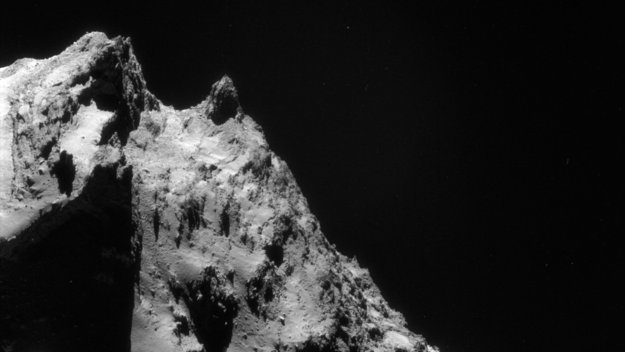
Space Science Image of the Week: Suggestive of a face immersed in deep thoughts, this view reveals the complex terrains around Anuket on Rosetta’s comet
Sentinel-1 sees rice paddy drop in the Mekong Delta

Europe’s Sentinel-1A satellite has shown that the Mekong River Delta – one of the world’s major rice-growing areas – saw a significant drop in productivity over the past year, illustrating the effect of El Niño on food security.
Saturn spacecraft samples interstellar dust
NASA’s Cassini spacecraft has detected the faint but distinct signature of dust coming from beyond our solar system.
Comets in the “X”-treme
Scientists have determined that comets produce X-ray emission when particles in the solar wind strike the atmosphere of the comet.
Week In Images
Our week through the lens: 11-15 April 2016
Irish mosaic
Earth observation image of the week: a Sentinel-1A image of Ireland, also featured on the Earth from Space video programme
A Space Spider Watches Over Young Stars
A nebula known as “the Spider” glows fluorescent green in an infrared image from NASA’s Spitzer Space Telescope and the Two Micron All Sky Survey (2MASS).
Saturn Spacecraft Samples Interstellar Dust
NASA’s Cassini spacecraft has detected the faint but distinct signature of dust coming from beyond our solar system.
Interstellar dust intercepted at Saturn
The international Cassini spacecraft has detected the faint but distinct signature of dust coming from outside our Solar System.
Comet relay

Operations image of the week: ESA’s deep-space tracking station in Argentina seen while relaying signals from Philae in 2014
Nansen gives birth to two icebergs

Multiple satellites, including Europe’s Sentinels, have captured images of two large icebergs that broke away from Antarctica’s Nansen ice shelf on 7 April.
Earth from Space
Join us Friday, 15 April, at 10:00 CEST for the ‘Earth from Space’ video programme. This week features a Sentinel-1A image of Ireland
Station 360: Columbus
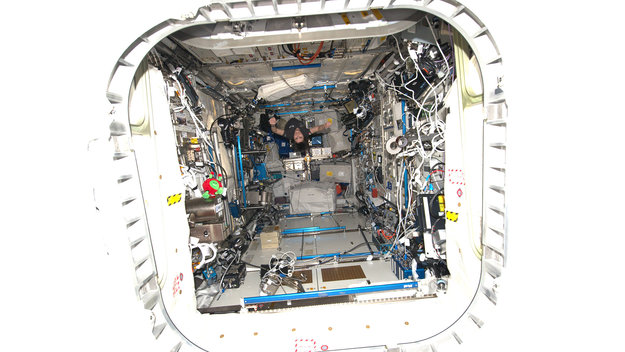
Explore Europe’s Columbus space laboratory with your mobile phone or VR headset in this panorama
Dwarf dark galaxy hidden in ALMA gravitational lens image
This discovery paves the way for ALMA to find many more such objects and could help astronomers address important questions on the nature of dark matter.
Gaming the system
Technology image of the week: Clean Space’s new board game helps educate engineers about the environmental impacts of space missions
First light for ExoMars

The ESA–Roscosmos ExoMars spacecraft are in excellent health following launch last month, with the orbiter sending back its first test image of a starry view taken en route to the Red Planet.
Tim Peake Live from ISS
Watch ESA education in-flight call with astronaut Tim Peake on 14 April, streaming starts at 14:00 CEST, with Tim live at 14:40 CEST
New hypervelocity binary star challenges dark matter, stellar acceleration models
While all previous hypervelocity stars are single, PB 3877 is the first wide binary star found to travel at such a high speed.
NASA Invests in Two-Dimensional Spacecraft, Reprogrammable Microorganisms
NASA has selected 13 proposals, including four from JPL, for a program that invests in transformative architectures through the development of pioneering technologies.
Road to the stars

Human spaceflight and robotic exploration image of the week: ESA astronaut Tim Peake reading Yuri Gagarin’s biography in space for Cosmonaut day
Kepler recovered from emergency and stable
Mission operations engineers have successfully recovered the Kepler spacecraft from Emergency Mode.
Prepare for an explosion of gravitational wave detections
Based on the signals seen so far and the sensitivity of LIGO’s detectors, scientists estimate that they’ll see between 10 and 100 black hole mergers during the instrument’s next observing run, which begins in late summer.
Tracking ice
The Sentinel-1 mission is allowing institutes to provide a better service to users needing reliable information on sea ice, which is key to living and working safely in Arctic regions
JPL Debuts ‘A Ticket to Explore JPL’
JPL has a new approach to its annual public weekend. To ensure a safe, enjoyable experience, the event formerly called “Open House” will require tickets in 2016.
Space for Migration
Keeping you posted on new developments in space applications that help tackle migration issues
500 000
@esa has reached half a million followers on Twitter, thank you for connecting with us
Past and present moons

Space science image of the week: Did Saturn’s rings form from a moon that broke apart?
Saturn spacecraft not affected by hypothetical planet 9
While the proposed planet’s existence may eventually be confirmed by other means, mission navigators have observed no unexplained deviations in the spacecraft’s orbit.
Black holes mysteriously align
Deep radio imaging has revealed that supermassive black holes in a region of the distant universe are all spinning out radio jets in the same direction.
Searching for Far Out and Wandering Worlds
NASA’s Kepler mission will begin a search for planets orbiting far from their stars by using gravitational lensing.
NASA Study Solves Two Mysteries About Wobbling Earth
New data on how water moves around Earth answer old questions about the planet’s rotation.
Saturn Spacecraft Not Affected by Hypothetical Planet 9
Contrary to recent reports, NASA’s Cassini spacecraft is not experiencing unexplained deviations in its orbit around Saturn, according to mission managers and orbit determination experts at NASA’s Jet Propulsion Laboratory in Pasadena, C…
Busy spacecraft and experiment schedule on Space Station
With less than two months left aboard the International Space Station, ESA astronaut Tim Peake has been exceptionally busy with experiments and arriving spacecraft. Tonight, the third supply vessel for the space laboratory in three weeks w…
Week In Images
Our week through the lens: 4-8 April 2016
Principia
ESA astronaut Tim Peake shares the views from space and highlights of his Principia mission so far
Europe at night
A slideshow of ESA astronaut Tim Peake’s views of Europe at night from the International Space Station
Ready for orbit

On 22 April, Sentinel-1B is set to join its identical twin, Sentinel-1A, in orbit to provide more radar views of Earth for Copernicus – hear all about it
An artificial comet holds secrets to Earths life
By simulating the evolution of the interstellar ice making up comets, French research teams have successfully obtained ribose, a key step in understanding the origin of RNA — and therefore of life.
Bernese Alps
Earth observation image of the week: a Sentinel-1A image of the Bernese Alps, also featured on the Earth from Space video programme
Searching for Far Out and Wandering Worlds
NASA’s K2 mission is on the hunt for planets floating alone without stars.
Space Station 360: Harmony

Explore the International Space Station’s Harmony module in this full panorama with your mobile phone or VR headset
Satellite touchdown in run up to Galileo launch

The latest pair of navigation satellites has reached Europe’s Spaceport in French Guiana, beginning a new Galileo launch campaign, which will culminate in a launch on 24 May.
The colour-changing comet

Rosetta’s comet has been seen changing colour and brightness in front of the ESA orbiter’s eyes, as the Sun’s heat strips away the older surface to reveal fresher material.
Tiny CubeSat tracks worldwide air traffic

Since its launch six months ago, a satellite small enough to fit in an airline passenger’s carry-on bag has been tracking aircraft in flight across the entire globe.
Earth from Space
Join us Friday, 8 April, at 10:00 CEST for the ‘Earth from Space’ video programme. This week features a Sentinel-1A image of the Bernese Alps in Switzerland
Young super-Jupiter found wandering without a parent
A team of astronomers has discovered one of the youngest and brightest free-floating, planet-like objects within relatively close proximity to the Sun.
Supernova showered Earth with radioactive debris
An international team of scientists has found evidence of a series of massive supernova explosions near our solar system, which showered the Earth with radioactive debris.
Vote for Us: NASA Receives Webby Nominations
NASA’s principal website received its eighth Webby Award nomination for government website, and NASA’s social media team has received its second nomination for social media presence.
Sentinel-3A feels the heat
Despite only being in orbit a matter of weeks, Sentinel-3A has already delivered some impressive first images. With the thermal-infrared channels now turned on, the satellite completes its set of firsts with a view of ocean features off th…
Volcano island
Technology image of the week: Hawaii, home to Earth’s largest volcano, as imaged by Proba-V, among ESA’s smallest Earth-observing satellites
Gravitational wave search provides insights into galaxy evolution and mergers
Given scientists’ current understanding of how often galaxies merge, limits point to fewer detectable pairs of supermassive black holes than previously expected.
Behemoth black hole found in an unlikely place
Astronomers have uncovered a near-record-breaking supermassive black hole weighing 17 billion Suns.
Asteroid-Hunting Spacecraft Delivers a Second Year of Data
NASA’s NEOWISE spacecraft discovered 72 near-Earth objects and characterized 439 others in its first two years of operations.
Mars Longevity Champion Launched 15 Years Ago
The NASA spacecraft that was launched 15 years ago this week carried the name 2001 Mars Odyssey and the hopes for reviving a stymied program of exploring the Red Planet.
Asteroid cleaner
Human spaceflight and robotic exploration image of the week: Testing ways of taking samples from dusty, low-gravity moons and asteroids
Opportunity’s devilish view from on high
From its perch high on a ridge, the rover recorded an image of a martian dust devil twisting through the valley below.
Early Mars bombardment likely enhanced life-supporting habitat
A massive impact could have temporarily increased the planet’s atmospheric pressure, periodically heating Mars up enough to “re-start” a dormant water cycle.
Sending crude oil into space to study Earth’s depths
New NASA Web Portal Shines Beacon on Rising Seas
Sea level rise is a global issue affecting millions. Now, a JPL-developed Web portal gives researchers, decision makers and the public alike a new resource to stay up to date.
Opportunity’s Devilish View from on High
From its perch high on a ridge, NASA’s Mars Exploration Rover Opportunity recorded an image of a Martian dust devil twisting through the valley below.
A cosmic trick of the eye
Space Science Image of the Week: The Hubble Space Telescope snapped this view of a beautiful, but deceptive, planetary nebula
Fast radio burst “afterglow” was actually a flickering black hole
New research shows that the radio emission believed to be an afterglow actually originated from a distant galaxy’s core and was unassociated with the fast radio burst.
Andromeda’s first spinning neutron star has been found
While the precise nature of the system remains unclear, the data imply that it is unusual and exotic.
NASA, Japan Make ASTER Earth Data Available At No Cost
Beginning today, all Earth imagery from a prolific Japanese remote sensing instrument on NASA’s Terra spacecraft since 1999 is now available to users everywhere at no cost.
Week In Images
Our week through the lens: 28 March – 1 April 2016
An oasis in the brown dwarf desert
Astronomers report a wellspring of new brown dwarf stellar companions, throwing cold water on the entire idea of the “brown dwarf desert,” the previously mystifying lack of these sub-stellar objects around stars.
ESA intouch
Competition to develop the next generation interactive Space App with ESA, deadline 15 April
NASA Satellite Images Uncover Underground Forest Fungi
A new way to detect underground forest fungi from space could help researchers predict how climate change will alter forest habitats.
Rover Takes on Steepest Slope Ever Tried on Mars
NASA’s long-lived Mars rover Opportunity is driving to an alternative hillside target after a climb on the steepest slope ever tackled by any Mars rover.
Rover Takes on Steepest Slope Ever Tried on Mars
NASA’s long-lived Mars rover Opportunity is driving to an alternative hillside target after a climb on the steepest slope ever tackled by any Mars rover.
Going to space

Operations image of the week: Teams at ESA’s mission control in intensive simulation training for Sentinel-1B liftoff
Found: Andromeda’s first spinning neutron star
Decades of searching in the Milky Way’s nearby ‘twin’ galaxy Andromeda have finally paid off, with the discovery of an elusive breed of stellar corpse, a neutron star, by ESA’s XMM-Newton space telescope.
Earth from Space
Join us Friday, 1 April, at 10:00 CEST for the ‘Earth from Space’ video programme. This week features a Sentinel-3A image of the River Nile and surroundings