These latest pictures are part of a sequence taken near New Horizons’ closest approach to Pluto, revealing features less than half the size of a city block on the diverse surface of the distant planet.
ALMA spots monstrous baby galaxies cradled in dark matter
These findings are important for understanding how monstrous galaxies form and evolve.
Artificial eclipse
Space Science Image of the Week: SOHO is still going strong after two decades in space, sending back impressive images of the Sun and its varying bursts of activity
Engineering Made Fun: JPL’s Annual Invention Challenge
Los Angeles High School teams win big at the annual competition at JPL.
To Jupiter with JunoCam!
Scientists on NASA’s Juno mission are preparing to receive some stunning images of Jupiter, and they need your help.
Talking climate
Discover more about the importance of glaciers as an Essential Climate Variable to understand our changing world
Week In Images
Our week through the lens: 30 November – 4 December 2015
Curious “inkblot” star outed for trolling the astronomers
In just a couple of years, the red giant star CW Leonis has changed its appearance completely, meaning a whole set of carefully constructed models have been abandoned.
Mars mission team addressing vacuum leak on key science instrument
The seismometer is the prime science payload that will help answer questions about the interior structure and processes within the deep martian interior.
Tim Peake to run London marathon from space
Get ready, set, go! As the thousands of runners start the London Marathon in April, ESA astronaut Tim Peake will run the full 42 km distance on a treadmill aboard the International Space Station.
LISA Pathfinder Carries Advanced NASA Thruster Tech
The LISA Pathfinder spacecraft is on its way to space, having successfully launched from Kourou, French Guiana (Dec. 3 local time/Dec. 2 PST).
NASA Space Telescopes See Magnified Image of Faintest Galaxy from Early Universe
Astronomers harnessing the combined power of NASA’s Hubble and Spitzer space telescopes have found the faintest object ever seen in the early universe.
Mars Mission Team Addressing Vacuum Leak on Key Science Instrument
A key science instrument for NASA’s InSight spacecraft, being prepared for a March 2016 launch, is experiencing a leak in the vacuum container carrying its main sensors.
JPL CubeSat Clean Room: A Factory For Small Spacecraft
JPL CubeSat clean room is doing big things for space explorations smallest inhabitants.
Earth from Space

Join us Friday, 4 December, at 10:00 CET for the ‘Earth from Space’ video programme. This week features a Sentinel-1A image of the Netherlands
Sentinel-2 moves on
The story so far of the second Copernicus satellite and what it will do next
Couture in Orbit: from spacewalk to catwalk

ESA and the Science Museum in London are working with four leading fashion schools around Europe to design clothes for the space age with their ‘Couture in Orbit’ project.
Hawaii Supreme Court revokes permit for massive telescope
Native Hawaiians have won their court challenge against an observatory that could one day be the world’s largest.
How LISA Pathfinder will “hear” the universe
The European Space Agency hopes its LISA Pathfinder mission will allow scientists to observe the universe outside the electromagnetic spectrum for the first time.
Liftoff for LISA Pathfinder
For the 100th anniversary of Einstein’s general relativity, LISA Pathfinder will demonstrate how to observe gravitational waves in space.
Why LISA Pathfinder?
Press briefing replay: mission experts describe how LISA Pathfinder will test-drive the technologies needed to detect gravitational waves from space
LISA Pathfinder en route to gravitational wave demonstration
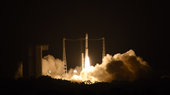
ESA’s LISA Pathfinder lifted off earlier today on a Vega rocket from Europe’s spaceport in Kourou, French Guiana, on its way to demonstrate technology for observing gravitational waves from space.
A new frontier
LISA Pathfinder is on its way to test the extraordinary technology needed to observe gravitational waves from space
Launch – full replay

Watch LISA Pathfinder launch into low-Earth orbit, with commentary from experts at Europe’s Spaceport in Kourou
Launch replay

Watch LISA Pathfinder launch from Europe’s Spaceport in Kourou
ESA station tracks Earth flyby mission

An ESA deep-space ground station will lend a helping ear as Japan’s Hayabusa-2 asteroid mission visits Earth on Thursday.
Cosmic filaments exposed near huge cluster

ESA’s XMM-Newton X-ray observatory has revealed three massive filaments of hot gas flowing towards a cluster of galaxies, uncovering a portion of the cosmic skeleton that pervades the entire Universe.
LISA Pathfinder launch

Follow the launch of our LISA Pathfinder mission on 3 December. Coverage from Kourou starts 03:44 GMT; a press briefing from ESA’s space operations centre starts at 05:30 GMT
Talking climate
Discover more about the importance of land cover as an Essential Climate Variable to understand our changing world
Happy birthday, SOHO!
The Sun as seen today by the ESA-NASA SOHO observatory on the 20th anniversary of the pioneering satellite’s launch
Astronomers spy nursery of baby exoplanets
Astronomers report that this system, surrounding a star known as HD 100546, is giving us a glimpse back in time to see what other more developed exoplanet systems looked like in their adolescence.
“Fast radio burst” sheds new light on origin of these extreme events
Research indicates that the burst originated inside a highly magnetized region of space, possibly linking it to a recent supernova or the interior of an active star-forming nebula.
Fits like a glove
Human spaceflight an operations image of the week: Testing pressure suits for Principia launch in two weeks
Farmers benefit from satellite coverage
Farmers can now call on the latest satellite information using the unique TalkingFields service to get the best from their land while cutting the environmental cost.
Are you a doctor with the right stuff?

ESA is looking for a medical doctor to live for a year in Antarctica at the French–Italian Concordia research station. Your job is to run experiments in the Antarctic wilderness that help to prepare for future spaceflight beyond Earth orbit.
Rover versus rocks
Technology image of the week: Robotic navigation testing with artificial rocks on beach next to ESA’s technical heart
SOHO celebrates 20 years of discoveries

Originally planned for a two-year mission, the ESA–NASA Solar and Heliospheric Observatory, SOHO, is today celebrating two decades of scientific discovery.
ESA wastewater recovery picked as key climate technology

An ESA-developed water treatment system has been chosen as one of a hundred top climate technologies to mark this week’s COP21 climate change summit in Paris.
Launch postponed
The launch of LISA Pathfinder has been postponed
Exoplanet kicked into exile
A star’s lopsided comet belt indicates a disturbed system
Could life exist on other planets?
With a little help from planetary neighbors, perhaps life could exist, according to new research.
Launch media briefing
Follow a live webcast from LISA Pathfinder mission control on 2 December, when managers, scientists and experts brief the media, starting at 05:45 GMT (06:45 CET)
LISA Pathfinder launch
Follow the launch of our LISA Pathfinder mission on 2 December. Coverage from Kourou starts at 03:55 GMT (04:55 CET), with liftoff due at 04:15 GMT (05:15 CET)
Media on the move
Access our press releases, media calendar and ESA TV information for media professionals via the new media section on our mobile ESA website
More Galileo satellites broadcasting navigation signals

Having completed their rigorous checks in space, two more of Europe’s Galileo satellites are now fully operational, broadcasting navigation signals and, from today, relaying search and rescue messages from across the globe.
Tim arrives in Baikonur on his last stop before space
ESA astronaut Tim Peake, NASA astronaut Tim Kopra and Roscosmos commander Yuri Malenchenko arrived at the Baikonur Cosmodrome in Kazakhstan today ahead of their launch to the International Space Station.
Set for launch on 15 December, the…
LISA Pathfinder launch timeline

On Thursday, a Vega rocket will boost LISA Pathfinder into space to pave the way to a future mission for detecting gravitational waves. Once aloft, ESA’s mission control teams will pace the ultra high-tech spacecraft through the critical first days of the journey to its final destination.
Talking climate
Discover more about the importance of sea ice as an Essential Climate Variable to understand our changing world
Sneak preview
Space Science Image of the Week: ESA’s LISA Pathfinder gravitational wave demonstrator getting ready for launch at Europe’s Spaceport in Kourou
Hungary and ESA

2015 is a special year: the Hungarian space community is celebrating Hungary’s accession to ESA as 22nd full Member State
Supermassive black hole spotted snacking on a star
The supermassive black hole was found to have faint jets of material shooting out from it and helps to confirm scientists’ theories about the nature of black holes.
Supercomputer simulates collapse of massive stars
This simulation demonstrates that as a rotating star collapses, the star and its attached magnetic field spin faster and faster, revving the magnetic field to a million billion times the magnetic field of Earth.
Space for climate
While leaders from around the world meet at COP21 to reach an agreement on climate change, learn how satellites provide essential information about the health of our planet
Week In Images
Our week through the lens: 23-27 November 2015
Sudanese fields
Earth observation image of the week: a Sentinel-2A image of south Khartoum in Sudan, also featured on the Earth from Space video programme
Flight teams prepare for LISA Pathfinder liftoff
Following months of intensive training, mission controllers for the LISA Pathfinder gravitational wave detection testbed will complete a final rehearsal tomorrow, ensuring that all is ready for the journey to space.
German Chancellor Merkel welcomes ESA astronaut to her home region
German ESA astronaut Alexander Gerst and ESA Director Thomas Reiter joined German Chancellor Angela Merkel recently in her home region of Mecklenburg-Vorpommern, in the very northeast of Germany.
Earth from Space
Join us Friday, 27 November, at 10:00 CET for the ‘Earth from Space’ video programme. This week features a Sentinel-2A image of south Khartoum in Sudan
Timelapse from space reveals glacier in motion
Animations that compress 25 years of satellite images into just one second reveal the complex behaviour and flow of glaciers in the Karakoram mountain range in Asia.
Testing gravity
Find out how LISA Pathfinder will test-drive technologies to detect gravitational waves from space
ExoMars prepares to leave Europe for launch site
The two ExoMars spacecraft of the 2016 mission are being prepared for shipping to the Baikonur Cosmodrome in Kazakhstan ahead of their launch in March.
Comet fragments, not aliens, best explain mysterious dimming star
Just what caused the dimming of star KIC 8462852?
A blue Neptune-sized exoplanet around a red dwarf star
Astronomers have detected light scattered by tiny particles through the atmosphere of a Neptune-sized transiting exoplanet, which suggests a blue sky on this world that is only 100 light-years away.
Let there be light
Technology image of the week: James Webb’s NIRSpec and other space optical instruments highlighted to mark the UN Year of Light
Strange Star Likely Swarmed by Comets
New clues emerge in the mystery of a star with odd light patterns.
Loss of Carbon in Martian Atmosphere Explained
A process involving ultraviolet light from the sun helps explain the ratio of heavier to lighter carbon in Mars’ atmosphere and resolve a dilemma about “missing” carbon.
Loss of Carbon in Martian Atmosphere Explained
A process involving ultraviolet light from the sun helps explain the ratio of heavier to lighter carbon in Mars’ atmosphere and resolve a dilemma about “missing” carbon.
Strange Star Likely Swarmed by Comets
New clues emerge in the mystery of a star with odd light patterns.
The Demon Star shines bright tonight
The variable star Algol in Perseus makes a fine target tonight, as it increase more than one magnitude in brightness over the course of the evening. The cycle repeats nearly every 3 days.
Where Alice in Wonderland meets Albert Einstein
Gravitational lensing provides astronomers with a way of probing extremely distant galaxies and groups of galaxies in ways that would otherwise be impossible.
Oodles of faint dwarf galaxies in Fornax shed light on a cosmological mystery
The discovery of numerous faint dwarf galaxies in Fornax suggests that the “missing satellites” are now being found.
Mix as needed
Human spaceflight image of the week: how to keep liquids from mixing during a rocket launch
Tracking new missions from down under

For beachgoers, Australia’s pristine west coast is an ideal location to catch some rays. It is also ideal for catching signals from newly launched rockets and satellites, which is one reason why ESA is redeveloping its tracking capabilities down under.
Earth Might Have Hairy Dark Matter
Dense filaments of dark matter particles, called “hairs,” are sprouting from Earth, according to a new study based on computer simulations.
NEOWISE Identifies Greenhouse Gases in Comets
Data from NASA’s NEOWISE mission are giving new insights into comet dust, nucleus sizes, and production rates for difficult-to-observe gases like carbon dioxide and carbon monoxide.
New Earth Explorer
ESA announces the chance for scientists to submit their proposals for the next potential Earth Explorer satellite mission
New arrivals in Antarctica
The next crew to live and work at the Concordia Antarctic research station has arrived in the white desert. ESA-sponsored medical doctor Floris van den Berg will take over experiments for future spaceflight from Beth Healey, who has been a…
A day on Pluto, a day on Charon
The New Horizons spacecraft captured Pluto rotating over the course of a full “Pluto day.”
Earth might have hairy dark matter
A new study proposes the existence of long filaments of dark matter, or “hairs.”
Schiaparelli’s namesakes
Space science image of the week: What do a 19th-century astronomer, an impact basin and a mission to Mars have in common?
STEREO-A is back in full communications
NASA’s solar observatory recently emerged from behind the Sun, allowing full monitoring of our star’s activity to resume.
Principia overview
ESA astronaut Tim Peake introduces his six-month Principia mission to the Internatioanl Space Station and what he will be doing in space
Sentinel-3A on its way

The latest satellite for the European Commission’s Copernicus environmental programme has left France bound for the Plesetsk launch site in Russia and launch late next month.
Week In Images
Our week through the lens: 16-20 November 2015
Spanish mosaic
Earth observation image of the week: a Sentinel-2A image of Merida, Spain, also featured on the Earth from Space video programme
2015 and 1997 El Ninos: Deja vu, or Something New?

Forecasters say this year’s El Niño looks just like the giant event of 1997-98. But when it comes to El Niños, there are no identical twins.
Satellite Sensors Would Deliver Global Fire Coverage
Wildfires can wreak havoc on human health, property and communities, so it’s imperative to detect them as early as possible.
New satellite to measure plant health

ESA plans to track the health of the world’s vegetation by detecting and measuring the faint glow that plants give off as they convert sunlight and the atmosphere’s carbon dioxide into energy.
A witness to a wet early Mars

Vast volumes of water once flooded through this deep chasm on Mars that connects the ‘Grand Canyon’ of the Solar System – Valles Marineris – to the planet’s northern lowlands.
Earth from Space
Join us on Friday, 20 November, at 10:00 CET for the “Earth from Space” video programme. This week features a Sentinel-2A image of Merida, Spain
Dark matter dominates in nearby dwarf galaxy
By measuring the mass of a nearby dwarf galaxy called Triangulum II, a researcher may have found the highest concentration of dark matter in any known galaxy.
Dwarf star packs a magnetic punch
The star’s extraordinary magnetic field could cause a constant flurry of solar flare-like eruptions.
Superflares might make “most Earth-like exoplanet” uninhabitable
The atmosphere of exoplanets Kepler-438b is thought to have been stripped away as a result of radiation emitted from its superflaring red dwarf host star.
Observing the birth of an alien planet
The newly found protoplant LkCa 15 b orbits a star 450 light-years away and appears to be on its way to growing into a world similar to Jupiter.
3D-printed alien
Technology image of the week: materials specialist Tommaso Ghidini showing unearthly-looking 3D-printed part at TEDxESA
“Chemical Laptop” could search for signs of life outside Earth
Like a tricorder from “Star Trek,” the Chemical Laptop is a miniaturized on-the-go laboratory, which researchers hope to send one day to another planetary body such as Mars or Europa.
Curiosity roves toward active dunes
The rover will get its first close-up look at these dark “Bagnold Dunes” which skirt the northwestern flank of Mount Sharp.
The Right Stuff

Human spaceflight and operations image of the week: ESA’s operations managers are team leaders, motivating people and managing complex systems and situations on the cutting edge of human exploration
‘Chemical Laptop’ Could Search for Signs of Life Outside Earth
A small laptop-sized device is being developed at JPL to look for amino acids and fatty acids, with potential applications in space.
NASA’s Curiosity Mars Rover Heads Toward Active Dunes
The NASA Mars rover that is studying layers of a Martian mountain will soon get its first taste of the “Bagnold Dunes,” a dark sea of sand along the mountain’s base.