
Displaying the essential role satellites play in monitoring our changing world, the Climate Cube on the Champs-Elysées in Paris was inaugurated in the presence of ESA’s Director General Jan Woerner
Week In Images
Our week through the lens: 19-23 October 2015
Last of Pluto’s moons — mysterious Kerberos — revealed by New Horizons
Pluto’s moon Kerberos appears to be smaller than scientists expected and has a highly reflective surface, which suggests it’s coated with relatively clean water ice.
Reentry data will help improve prediction models

A rare reentry of a suspected rocket body from a very high orbit next month offers an excellent opportunity to gather data to improve our knowledge of how objects interact with Earth’s atmosphere.
NASA Teleconference to Preview Historic Flyby of Saturn Moon
NASA’s Cassini spacecraft will sample an extraterrestrial ocean next week when it flies directly through a plume of icy spray from Enceladus. A news telecon on Monday, Oct. 26, will preview the event.
NASA Calls for American Industry Ideas on ARM Spacecraft Development
NASA, through JPL, has issued a call to American industry for innovative ideas involving the Asteroid Redirect Robotic Mission.
Earth from Space

Join us Friday, 23 October, at 10:00 CEST for the ‘Earth from Space’ video programme. This week features a Sentinel-2A image of Mexico City
Cosmic “death star” is destroying a planet
Astronomers have spotted a large rocky object disintegrating in its death spiral around a distant white dwarf star.
Final kiss of two stars heading for catastrophe
The two stars in the extreme system VFTS 352 could be heading for a dramatic end, during which the two stars either coalesce to create a single giant star or form a binary black hole.
African high point
Technology image of the week: the glacier topping Africa’s Mount Kilimanjaro, imaged by Proba-V minisatellite
Navigation winners
Starting with 515 ideas from 40 countries in this year’s European Satellite Navigation Competition, 37 winners were announced in Berlin
NASA’s K2 Finds Dead Star Vaporizing a Mini ‘Planet’
A tiny, rocky object is likely being torn apart as it spirals around a white dwarf star.
NASA Spots the ‘Great Pumpkin’: Halloween Asteroid a Treat for Radar Astronomers
NASA scientists are tracking the upcoming Halloween flyby of an asteroid with optical observatories and radar capabilities of the Deep Space Network at Goldstone, California.
Borneo on Fire
Thick smoke from the worst forest fires in nearly two decades blankets the island of Borneo in an Oct. 14 satellite image from NASA’s MISR instrument.
Landing site recommended for ExoMars 2018
Oxia Planum has been recommended as the primary candidate for the landing site of the ExoMars 2018 mission.
First discovery of a magnetic field in a normal delta Scuti star
These stars are pulsating stars, some of which show signatures attributed to a second type of pulsations.
Scientist gives “outlaw” particles less room to hide
Scientists used a giant particle detector at the South Pole to test whether the highest-energy neutrinos violate Einstein’s relativity theory by traveling faster than light.
Knee problems
Human spaceflight and operations image of the week: Scanning knees to reveal cartilage health in space and on Earth
NASA Study Improves Understanding of LA Quake Risks
A new NASA-led analysis of a moderate earthquake that shook Greater Los Angeles in 2014 offers new insights into the potential for future earthquakes in the region.
30 million views
We’re proud to have passed a big milestone on our YouTube channel – thanks for watching!
Climate Cube in Paris

The Climate Cube sitting on the Champs-Elysées focuses on how vital satellites are for understanding climate change, and how space is playing a major role in climate research and climate change mitigation
Most Earth-like worlds have yet to be born, according to theoretical study
When our solar system was born 4.6 billion years ago, only eight percent of the potentially habitable planets that will ever form in the universe existed.
The IBEX spacecraft sets the “gold standard” for understanding the interstellar material surrounding our solar system
Data confirm that the local interstellar flow of helium atoms is significantly hotter than believed previously and provide insight into the direction the heliosphere is moving, as well as how fast it is traveling.
JPL Launches Enhanced Education Website
JPL’s education office has relaunched its website with new capabilities and offerings for formal and informal educators, K-12 students and aspiring JPL interns and fellows.
News and Features – NASA's Jet Propulsion Laboratory 2015-10-19 22:10:00

NASA satellite observations are giving scientists a comprehensive suite of tools to analyze the evolving El Niño and its global impacts as never before.
Saturn and Dione
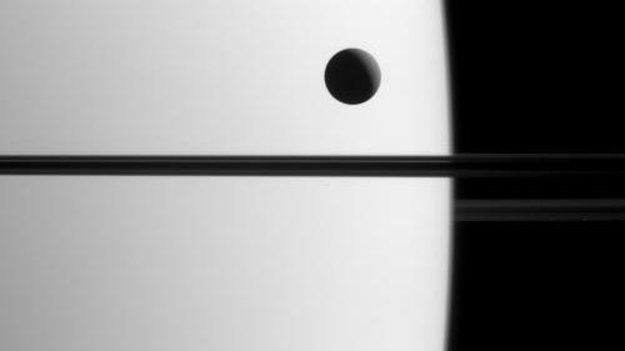
Space Science Image of the Week: Saturn’s moon Dione, viewed from the Cassini orbiter, crossing the face of its parent planet
Study questions dates for cataclysms on early Moon, Earth
Zircons are used to date some of the earliest and most dramatic cataclysms of the solar system, but a study of zircons from a gigantic meteorite impact in South Africa casts doubt on the methods used to date lunar impacts.
Dust particles from afar
25 years ago, the Ulysses spacecraft was launched into space and now, for the first time, its complete set of measurements of interstellar dust has been analyzed.
Hubble Maps Show Jupiter Changes and Prepare for Juno
New Hubble Jupiter views are helping scientists monitor the giant planet and prepare for NASA’s Juno mission, which will arrive there next year.
Week In Images
Our week through the lens: 12-16 October 2015
Closest northern views of Saturn’s moon Enceladus
The Cassini spacecraft has begun returning its best-ever views of the northern extremes of Saturn’s icy ocean-bearing moon.
Mound near lunar south pole formed by unique volcanic process
The formation, known as Mafic Mound, stands in the middle of a giant impact crater known as the South Pole-Aitken Basin.
ESA’s first technology nanosatellite reporting for duty

ESA’s first technology-testing CubeSat, released last week from the International Space Station, is in good health and is set to start work on its six-month mission.
Closest Northern Views of Saturn’s Moon Enceladus
NASA’s Cassini spacecraft has begun returning its best-ever views of the northern extremes of Saturn’s icy, ocean-bearing moon Enceladus.
Earth from Space
Join us Friday, 16 October, at 10:00 CEST for the ‘Earth from Space’ video programme. This week features a Sentinel-2A image of the Red Sea
Sentinel-3A shows off
Before the latest satellite for Copernicus is packed up and shipped to the Plesetsk cosmodrome in Russia for launch at the end of the year, the media and specialists were given the chance to see this next-generation mission centre-stage in…
Rover school
Technology image of the week: prototype rovers and landers in ESA’s test environment ‘Mars Yard’
What smacks into Ceres stays on Ceres
Experiments suggest the surface of Ceres could consist largely of a mish-mash of meteoritic material collected over billions of years of bombardment.
To save on weight, a detour to the Moon is the best route to Mars
For a piloted mission to Mars, fueling up on the Moon could streamline cargo by 68 percent.
Flash floods in Mangala Valles
Catastrophic flooding triggered by ice melting from the heat of volcanic activity is thought to be responsible for the chaotic scenery depicted in this region of the Mangala Valles channel network.
Space on your mobile
Access our top news stories, videos and images, as well as news in your language, via our new mobile ESA website
Jupiter’s changing spot

Looking into Jupiter’s turbulent atmosphere and its famous Great Red Spot with the Hubble telescope
Cassini begins series of flybys with close-up of Saturn moon Enceladus
Images are expected to begin arriving one to two days after the flyby, which will provide the first opportunity for a close-up look at the north polar region.
Cassini begins series of flybys with close-up of Saturn moon Enceladus
Images are expected to begin arriving one to two days after the flyby, which will provide the first opportunity for a close-up look at the north polar region.
Hubble’s planetary portrait captures new changes in Jupiter’s Great Red Spot
The images revealed a rare wave just north of the planet’s equator and a unique filamentary feature in the core of the Great Red Spot not seen previously.
Famous exoplanet scientist steps down after sexually harassing students
A Berkeley investigation found astronomer Geoff Marcy to have sexually harassed students over the course of a decade or more.
Cassini Begins Series of Flybys with Close-up of Saturn Moon Enceladus
NASA’s Cassini spacecraft will wrap up its time in the region of Saturn’s large, icy moons with a series of three close encounters with Enceladus starting Wednesday, Oct. 14.
AIMing a light across millions of kilometres

Imagine beaming a light across millions of kilometres of empty space, all the way back to Earth. ESA’s proposed Asteroid Impact Mission is intended to do just that: demonstrate laser communications across an unprecedented void.
VLA reveals spectacular “halos” of spiral galaxies
A study of spiral galaxies seen edge-on has revealed that “halos” of cosmic rays and magnetic fields above and below the galaxies’ disks are much more common than previously thought.
Blast waves in the Sun’s atmosphere
A unique observational geometry of two solar probes uncovers a new solar phenomenon: large-scale waves accompanied by particles emissions rich in helium-3.
Nalla, the persuader
Human spaceflight and operations image of the week: Nalla, a female peregrine falcon, persuades other birds to nest away from our beautiful deep-space tracking dish
Spotlight on BepiColombo
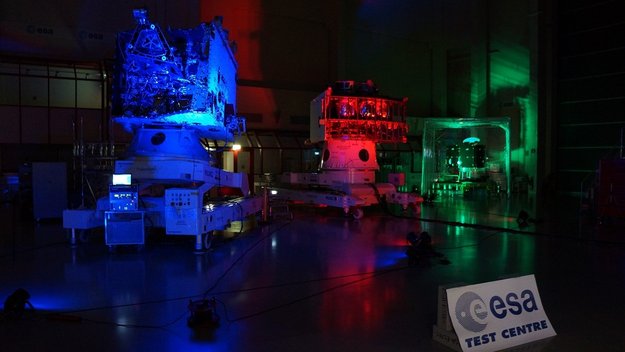
Space Science Image of the Week: ESA’s BepiColombo, a mission to explore planet Mercury, seen in a different light
New Horizons finds blue skies and water ice on Pluto
The first color images of Pluto’s atmospheric hazes, returned by NASA’s New Horizons spacecraft last week, reveal that the hazes are blue.
Week In Images
Our week through the lens: 5-9 October 2015
Sporting Italy uses satellites to share more goals
Satcoms are enabling smaller football clubs in Italy to broadcast their matches in high quality from 60 stadiums, via the Internet.
Wet paleoclimate of Mars revealed by ancient lakes at Gale Crater
Mars appears to have had a more massive atmosphere billions of years ago than it does today, with an active hydrosphere capable of storing water in long-lived lakes.
Banking X-ray data for the future
Saving information from today that people will want to access and study in the future is a critical function of all archives, but it is especially important when it comes to storing data from today’s telescopes.
NASA’s Curiosity Rover Team Confirms Ancient Lakes on Mars
A new study from NASA’s Mars Science Laboratory/Curiosity team confirms that Mars was, billions of years ago, capable of storing water in lakes over an extended period.
NASA Eyes on Earth Aid Response to Carolina Flooding
NASA is using data from Earth-observing satellites in space to aid in the response to the devastating flooding affecting the Carolinas.
Astronaut brains as beacons for researchers

How astronauts adapt to the stresses of living in space is helping researchers to pinpoint the causes of common disorders on Earth.
From the brain’s point of view, living in space is very stressful. The signals from an astronaut’s body in space go haywire as they float in weightlessness. The inner ear reports that it is falling, but the eyes show that nothing is moving.
Earth from Space
Join us Friday, 9 October, at 10:00 CEST for the ‘Earth from Space’ video programme. This week features a Sentinel-1A image of the Azore Islands in Portugal
How did you do that?

Human spaceflight and operations image of the week: NASA astronaut Terry Virst demonstrates how he took ESA astronaut Samantha Cristoforetti’s picture in space
Arizona State University’s Mars images star in “The Martian”
THEMIS images and mosaics appear briefly in a few scenes.
Mars Science Laboratory team confirms a wet ancient Mars
These results have led to the conclusion that the ancient climate on Mars was warmer and wetter than previously assumed.
Testing asteroid camera
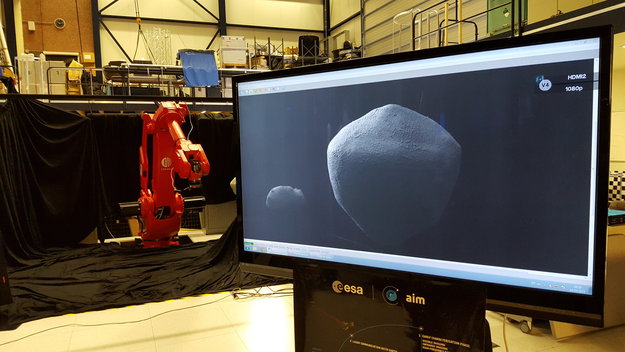
Technology image of the week: practical testing of the navigation camera planned to guide ESA’s proposed Asteroid Impact Mission around its double-asteroid target
Nobel Prizes in physics awarded for neutrino discoveries
The discovery has changed our understanding of the innermost workings of matter and can prove crucial to our view of the universe.
Mysterious ripples found racing through planet-forming disk
The fast moving, wave-like structures are unlike anything ever observed in a circumstellar disk.
Geology Award Going to Mars Landing Site Expert at JPL
A prestigious geology award will be presented in early November to a leader in selecting landing sites on Mars: Matt Golombek of JPL.
Exoplanet Anniversary: From Zero to Thousands in 20 Years
October 6 marks the 20th anniversary of the first discovery of a planet orbiting a normal star.
Aliens observed
Space Invader art has arrived at ESA’s Earth observation centre in Italy
NASA Orbiter Views Sites of Fiction Film’s Mars Landings
Images from a NASA Mars orbiter’s telescopic camera reveal details of regions on Mars that serve as the setting for the new Hollywood movie, “The Martian.”
JPL’s Role in Making ‘The Martian’ a Reality
NASA’s Jet Propulsion Laboratory plays an important role in the novel and film “The Martian.”
ESTEC’s Open Day
Snapshots from the Sunday 4 October 2015 Open Day at ESA’s technical heart, the most popular one yet
A Lunar Pox

Space Science Image of the Week: ESA’s SMART-1 captures Moon’s pockmarked pole with stunning clarity
New way to weigh a star
Researchers have developed a new method for measuring the mass of pulsars, even if a star exists on its own in space.
Curiosity’s Drill Hole and Location are Picture Perfect
NASA’s Curiosity Mars rover drilled its eighth hole on Mars this week.
Week In Images
Our week through the lens: 28 September – 2 October 2015
Rosetta’s first peek at the comet’s dark side
As formerly dark southern polar regions receive more sunlight, Rosetta starts to resolve their curious composition.
Rosetta’s First Peek at the Comet’s Dark Side
Using the Microwave for Rosetta Orbiter (MIRO) instrument aboard Rosetta, scientists have studied the southern polar regions of its target comet at the end of their long winter season.
Earth from Space
Join us Friday, 2 October, at 10:00 CEST for the ‘Earth from Space’ video programme. This week features a Sentinel-2A image of the city of Berlin, in Germany
NASA narrows the field for future key planetary missions
The selected proposals would study Venus, near-Earth objects, and a variety of asteroids.
Pluto’s big moon Charon reveals a colorful and violent history
The New Horizons spacecraft has returned the best color and the highest resolution images yet of Pluto’s largest moon, Charon.
Fifth mission for Ariane 5 this year

This evening an Ariane 5 delivered two telecom satellites into their planned orbits after lifting off from Europe’s Spaceport in Kourou, French Guiana.
Dawn Team Shares New Maps and Insights about Ceres
Mysteries and insights about Ceres are being discussed this week at the European Planetary Science Conference in Nantes, France.
NASA Selects Investigations for Future Key Planetary Mission
Three proposed science investigations with JPL project management have been chosen by NASA for further investigation.
Dawn team shares colorful new maps and surprising observations
Ceres continues to amaze, yet puzzle scientists, as they examine the multitude of images, spectra, and now energetic particle bursts.
A fresh perspective on an extraordinary cluster of galaxies
New observations of the Phoenix Cluster at X-ray, ultraviolet, and optical wavelengths are helping astronomers better understand this remarkable object.
SMOS meets ocean monsters

ESA’s SMOS and two other satellites are together providing insight into how surface winds evolve under tropical storm clouds in the Pacific Ocean. This new information could to help predict extreme weather at sea.
Space for visitors
Technology image of the week: Visitor centre Space Expo will be participating in Sunday’s ESTEC Open Day with a bargain admission offer
NASA: Background Ozone a Major Issue in U.S. West
New technique more accurately determines the sources of ozone in a given area.
Comet Feature Named After Late NASA Scientist Claudia Alexander
Scientists from the European Space Agency’s Rosetta mission honor their deceased colleague, Claudia Alexander of JPL, by naming a feature after her on the mission’s target comet.
Space portrait
A unique portrait of ESA astronaut Andreas Mogensen made for the Cupola observatory on the International Space Station by visual artist Vhils
How Rosetta’s rubber ducky comet got its shape
Scientists have shown that the shape arose from a low-speed collision between two fully fledged, separately formed comets.
Searching for orphan stars amid starbirth fireworks
The Herbig-Haro 24 complex contains no less than six jets streaming from a small cluster of young stars embedded in a molecular cloud in the direction of the constellation Orion.
NASA Confirms Evidence That Liquid Water Flows on Today’s Mars
New findings from NASA’s Mars Reconnaissance Orbiter (MRO) provide the strongest evidence yet that liquid water flows intermittently on present-day Mars.
How Rosetta’s comet got its shape

Two comets collided at low speed in the early Solar System to give rise to the distinctive ‘rubber duck’ shape of Comet 67P/Churyumov–Gerasimenko, say Rosetta scientists.
When black holes collide
Space science image of the week: A simulation of gravitational radiation rippling away from a pair of colliding black holes
Black hole is 30 times expected size
Thought to be at least 9 billion years old, it contains an active galactic nucleus, an incredibly bright object resulting from the accretion of gas by a central supermassive black hole.
Liquid water still flows on Mars
Researchers detected signatures of hydrated minerals on slopes where mysterious streaks are seen on the Red Planet.
Improve the Station tour
Have you been exploring the International Space Station in our panoramic tour? Tell us what you think and how it could be improved