The flags are raised at the new Roy Gibson building at ESA ECSAT in UK, 9 July
Chameleon satellite to revolutionise telecom market
Telecom satellites are set to enter a new age, as ESA, Eutelsat and Airbus Defence & Space begin designing the most flexible payload ever.
Earth from Space

Join us Friday, 10 July, at 10:00 CEST for the ‘Earth from Space’ video programme. This week features the sandy and rocky terrain of the Sahara desert as seen by Sentinel-2
A “heart” from Pluto as flyby begins
The New Horizons mission has officially begun the flyby sequence of science observations that will culminate with closest approach July 14.
Huge new survey to shine light on dark matter
The first KiDS survey results show how the characteristics of the observed galaxies are determined by the invisible vast clumps of dark matter surrounding them.
Radio astronomers see black hole come to life
A new study shows convincing evidence of the “switching on” of the active phase in a black hole at the center of galaxy NGC 660.
Cutting through martian history
This colourful image resembles an abstract watercolour, but it is in fact a colour-coded topographic map of one of the most geologically diverse regions on Mars.
ESA teams ready for Europe’s next weather satellite

Ground control teams are ready to shepherd Europe’s next weather satellite through its critical first days in orbit, ensuring it is working and healthy in the harsh environment of space.
Searing Sun Seen in X-rays
A bouquet of colors highlights X-rays streaming off our sun.
Reentry rockers
Technology image of the week: UK band Public Service Broadcasting examine a reentry capsule during a recent visit to ESA’s technical heart
New Horizons map of Pluto: The whale and the doughnut
While the new maps gives mission scientists an important tool for deciphering the patterns of bright and dark markings on the distant planet’s surface, they are holding off on making any interpretations of features for now.
Some long-duration gamma-ray bursts are driven by magnetars
A new study reveals that a supernova discovered after a gamma-ray burst must have been powered by a highly magnetic neutron star.
Neptune’s badly behaved magnetic field
New computer simulations show that the distant planet’s magnetic field is constantly rotating and changing.
With One Year to Jupiter, NASA’s Juno Team Prepares
With one year remaining in a five-year trek, NASA’s Juno mission team is preparing for the spacecraft’s expedition to the solar system’s largest planet.
NASA Selects Leading-Edge Technology Concepts for Continued Study
NASA has selected seven technology proposals for continued study under Phase II of the agency’s Innovative Advanced Concepts (NIAC) Program, including one from JPL.
Station Moon transit
Human spaceflight and operations image of the week: the International Space Station crosses the Moon seen from Australia
Rings and loops in the stars: Planck’s stunning new images
The new maps show regions of the sky that produce anomalous microwave emission.
Pluto dark spots continue to intrigue
These regularly spaced patches are each hundreds of miles across.
Cosmology looks beyond the standard model
A special session at the National Astronomy Meeting has been convened for astronomers to take stock of the evidence and stimulate further investigation of cosmology beyond the standard model.
Pluto: The “other” red planet
Pluto’s reddish color has been known for decades, but New Horizons is now allowing scientists to correlate the color of different places on the surface with their geology and soon with their compositions.
NuSTAR Stares Deep into Hidden Lairs of Black Holes
The high-energy X-ray eyes of NASA’s NuSTAR have peered into some of the most heavily buried supermassive black holes known.
Opportunity Rover’s 7th Mars Winter to Include New Study Area
NASA’s Opportunity rover has resumed driving after Mars emerged from behind the sun. Plans call for the rover to examine sites in Marathon Valley during the upcoming winter.
Dawn Holding in Second Mapping Orbit
NASA’s Dawn spacecraft is healthy and stable, after experiencing an anomaly in the system that controls its orientation.
Share the Sun
Share your summer pictures with the crew in Concordia research station in Antarctica, who have not seen the Sun since 4 May
Astronomers use cosmic gravity to create a ‘black-hole-scope’
The Integral, Fermi and Swift space observatories have used the magnifying power of a cosmic lens to explore the inner regions of a supermassive black hole.
Europa’s blood-red scars

Space Science Image of the Week: The criss-crossing scars marking the surface of Jupiter’s icy moon Europa in this Galileo image look disturbingly biological
NASA’s New Horizons to return to normal science operations after spacecraft anomaly
Preparations are ongoing to resume the originally planned science operations July 7 and to conduct the entire close flyby sequence as planned.
Astronomers see pebbles poised to make planets
Although scientists thought this is how planets form, this is the first time they’ve actually seen the process in action.
Universe’s hidden supermassive black holes revealed
A team of scientists using NuSTAR detected high-energy X-rays from five supermassive black holes previously clouded from direct view by dust and gas.
Luca Parmitano: this year’s Captain NEEMO

ESA astronaut Luca Parmitano is to lead NASA’s 20th underwater astronaut training mission this month. Starting on 20 July, the 14-day NASA Extreme Environment Mission Operations sortie, or NEEMO, will see a team of four living and working in the Aquarius underwater research station off the coast of Florida, USA.
Week In Images
Our week through the lens: 29 June – 3 July 2015
Counting stars with Gaia

This image, based on housekeeping data from ESA’s Gaia satellite, is no ordinary depiction of the heavens. While the image portrays the outline of our Galaxy, the Milky Way, and of its neighbouring Magellanic Clouds, it was obtained in a rather unusual way.
Northwest Sardinia
Earth observation image of the week: a false-colour image from Sentinel-2A over part of the Italian island of Sardinia, also featured on the Earth from Space video programme
Stellar Sparklers That Last
A new image containing data from NASA’s Spitzer and Chandra space telescopes shows a cluster of young stars expected to burn for billions of years.
Earth from Space
Join us Friday, 3 July, at 10:00 CEST for the ‘Earth from Space’ video programme. This week features an image over northwest Sardinia – one of the first from the Sentinel-2 mission
Rosetta spacecraft sees sinkholes on comet
These circular pits on Comet 67P/Churyumov-Gerasimenko likely formed when ices beneath the surface turned directly to gas.
Spots on Pluto fascinate as New Horizons gets the all clear
Not finding new moons or rings is a bit of a scientific surprise, but as a result, no engine burn is needed to steer clear of potential hazards.
NASA’s Curiosity Mars Rover Studies Rock-Layer Contact Zone
As Mars emerges from passing nearly behind the sun, NASA has resumed full operations of the Curiosity rover, which has reached a site where at least two rock types meet.
NASA Takes to Kansas Skies to Study Nighttime Thunderstorms
In most of the U.S., summer thunderstorms form on hot days. In the Great Plains, they often form at night. NASA is joining a multi-agency field campaign to learn why.
NASA Maps Beach Tar from California Oil Pipeline Spill
When an oil spill sullied beaches near Santa Barbara, California, in May, a JPL airborne instrument tested new techniques that may help responders after future oil spills.
Comet sinkholes generate jets
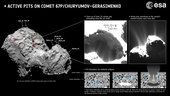
A number of the dust jets emerging from Rosetta’s comet can be traced back to active pits that were likely formed by a sudden collapse of the surface. These ‘sinkholes’ are providing a glimpse at the chaotic and diverse interior of the comet.
Buried in the heart of a giant
NGC 2367 is an infant stellar grouping that lies at the center of an immense and ancient structure on the margins of the Milky Way.
Unexpectedly little black hole monsters rapidly suck up surrounding matter
Such “supercritical accretion” produces powerful outflows in the form of a dense disk wind coming from these ultra-luminous X-ray sources.
Ice mountains
Technology image of the week: original technology demonstration mission Proba-1 images the site of Antarctica’s first zero-emission base
My first day at ESA
First blog post by Jan Woerner, on taking up duty as ESA Director General
Director General
Meet Johann-Dietrich Woerner
NASA Explains Why June 30 Will Get Extra Second
The day will officially be a bit longer than usual on Tuesday, June 30, 2015, because an extra second, or “leap” second, will be added.
Surrounded by Gaia
Human spaceflight and operations image of the week: Gaia avionics model settles into new home
Increasingly active comet
Space Science image of the week: Rosetta is monitoring the ever-increasing activity of the comet as they move closer to the Sun
Helping Europe prepare for asteroid risk
Each year, astronomers worldwide discover over 1000 new asteroids or other space rocks that could strike our planet. And if one is spotted heading towards Earth, experts working in ESA and national emergency offices need to know who should…
Life on Mars?
As the 2016 spacecraft nears completion, mission scientists explain how the ExoMars programme will help in the search for life on Mars
Speak to Peake
Watch a replay of the hangout with ESA astronaut Tim Peake
Expert asteroid answers
Your asteroid questions answered by ESA experts, for World Asteroid Day
New Horizons sees Pluto’s “bright fringe,” Charon’s “dark pole”
Scientists on the New Horizons team have found that the “close approach hemisphere” on Pluto has the greatest variety of terrain types seen on the planet so far.
Exposed water ice detected on Rosetta comet’s surface
Scientists have identified 120 bright regions on the surface of Comet 67P/Churyumov-Gerasimenko.
Bang goes an asteroid
ESA’s proposed Asteroid Impact Mission in pictures – for World Asteroid Day
Telescopes focus on target of ESA’s asteroid mission

Telescopes around the globe recently homed in on one point in the sky, observing the paired Didymos asteroids – the target for ESA’s proposed Asteroid Impact Mission.
The 800 m-diameter main body is orbited by a 170 m moon, informally dubbed Didymoon. The duo were more favourably placed from March until early June for studies.
Monster black hole wakes up after 26 years
Since June 15, the black hole/star system V404 Cygni has featured repeated bright X-ray flashes on time scales shorter than an hour.
Can planets be rejuvenated around dead stars?
New research from NASA’s Spitzer Space Telescope has identified one such candidate, seemingly looking billions of years younger than its actual age.
Sentinel-2 delivers first images

Just four days after being lofted into orbit, Europe’s Sentinel-2A satellite delivered its first images of Earth, offering a glimpse of the ‘colour vision’ that it will provide for the Copernicus environmental monitoring programme.
First ‘colour vision’

A first glimpse of the Sentinel-2A satellite’s capabilities over northwestern Italy and the French Riviera
The info on iriss
Read about the next ESA astronaut to head to the International Space Station: Andreas Mogensen’s iriss mission starts September
Sentinel-2A completes critical first days in space
Last night marked the end of Sentinel-2A’s first three days in space, which saw teams on the ground working around the clock to ensure the spacecraft is ready for its ‘colour vision’ mission.
Week In Images
Our week through the lens: 22-26 June 2015
New supercomputer model shows planet-making waves in nearby debris disk
The spiral waves around Beta Pictoris appear to account for many observed features in the planetary system.
M87 has swallowed an entire galaxy in the last billion years
A large sector of the giant elliptical galaxy’s outer halo now appears twice as bright as it would if the collision had not taken place.
Can Planets Be Rejuvenated Around Dead Stars?
An older planet may have reclaimed its youthful glow, according to new evidence from NASA’s Spitzer Space Telescope.
Under-Ice Rover Chills With Fish at Aquatic Exhibit
An under-ice rover prototype was tested at the California Science Center this week.
Beijing Quadrupled in Size in a Decade, NASA Finds
Using a NASA satellite-based technique to measure urban growth, researchers found that Beijing, China, quadrupled in physical size between 2000 and 2009.
NASA, Microsoft Collaborate to Bring Science Fiction to Science Fact
NASA and Microsoft are teaming up to develop Sidekick, a new project using commercial technology to empower astronauts aboard the International Space Station (ISS).
Monster black hole wakes up after 26 years
Over the past week, ESA’s Integral satellite has been observing an exceptional outburst of high-energy light produced by a black hole that is devouring material from its stellar companion.
Earth from Space
Join us Friday, 26 June, at 10:00 CEST for the ‘Earth from Space’ video programme. Discover the San Andreas Fault – horizontally shifting parts of California at up to 5 cm a year – in this week’s edition
ALMA detects first traces of carbon “smog” permeating interstellar atmospheres of early galaxies
The find suggests that even though normal galaxies in the early cosmos were already brimming with carbon, they were not nearly as chemically evolved as similar galaxies seen a few billion years later.
Hubble sees a “behemoth” bleeding atmosphere around a warm Neptune-sized exolanet
Given this planet’s small size, it may offer clues to how hot super-Earths are born around other stars through the evaporation of their outer layers of hydrogen.
NASA, NOAA Invite Social Media to Cover Jason-3 Launch
The agencies will host a one-day event for up to 70 social media followers on Aug. 8, 2015, at Vandenberg Air Force Base, California.
Shared AIM
Technology image of the week: spreading the word on ESA’s proposed Asteroid Impact Mission, ahead of next week’s Asteroid Day
Exposed water ice detected on comet’s surface

Using the high-resolution science camera on board ESA’s Rosetta spacecraft, scientists have identified more than a hundred patches of water ice a few metres in size on the surface of Comet 67P/Churyumov-Gerasimenko.
Get set for Asteroid Day
More than 50 public events worldwide June 30 are set to increase education and awareness about asteroids and how to better detect them.
Chandra captures X-ray echoes pinpointing distant neutron star
The results show that Circinus X-1 is located about 30,700 light-years from Earth and settles the difference in results published in prior studies.
NASA simulation suggests black holes may make ideal dark matter labs
While we don’t yet know what dark matter is, we do know it interacts with the rest of the universe through gravity, which means it must accumulate around supermassive black holes.
JPL, Caltech Team Up to Tackle Big-Data Projects
Scientists and engineers have a growing need for tools to help handle, explore and analyze big data. A new JPL/Caltech collaboration will help advance this important field.
Under control
Human spaceflight and operations image of the week: Mission control bringing Sentinel-2A through critical phases
Largest place for space
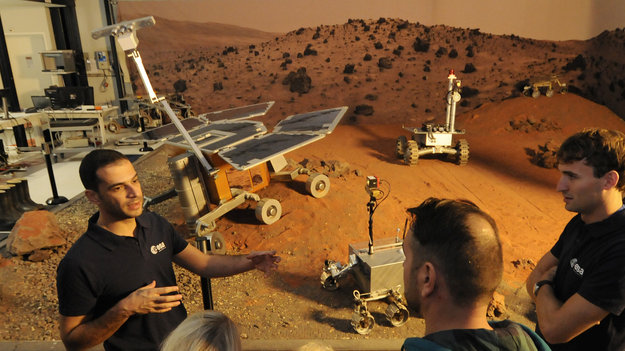
On 4 October ESA’s technical centre ESTEC will open its doors to the public – a must for all space enthusiasts
Veteran spacecraft reaches 60,000th lap around Mars, no pit stops
Odyssey, which discovered widespread water ice just beneath the surface of the Red Planet, is still going strong today, serving as a key communications relay for NASA’s Mars rovers and making continued contributions to planetary science.
Astronomers discover more than 800 dark galaxies in the famous Coma Cluster
The new discovery of these galaxies suggests galaxy clusters as the key environment for the evolution of these mysterious dark galaxies.
Rosetta mission extended
The adventure continues: ESA today confirmed that its Rosetta mission will be extended until the end of September 2016, at which point the spacecraft will most likely be landed on the surface of Comet 67P/Churyumov-Gerasimenko.
Revisit the launch event

From ESA’s European Space Operations Centre in Germany, watch the replay of the event to celebrate the launch of the first satellite for the Sentinel-2 ‘colour vision’ mission
Full launch coverage
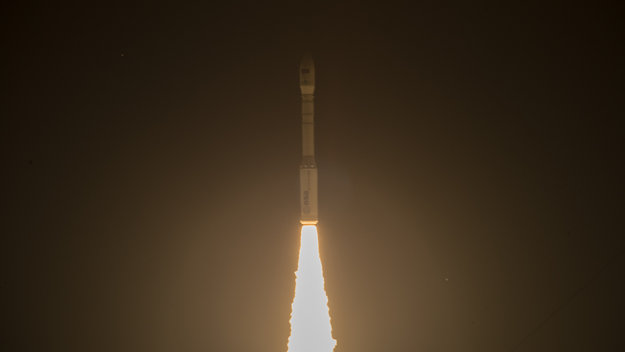
Watch the replay of the full Sentinel-2A launch coverage from Europe’s Spaceport in French Guiana on 23 June
Second Copernicus environmental satellite safely in orbit

The ESA-developed Sentinel satellite – Sentinel-2A – was launched today, adding a high-resolution optical imaging capability to the European Union Copernicus environmental monitoring system.
Second Sentinel in orbit
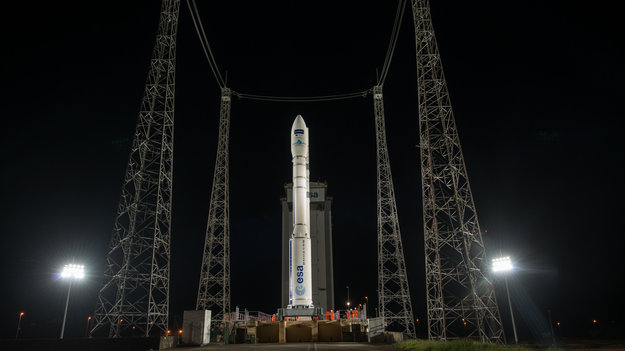
The ESA-developed Sentinel satellite – Sentinel-2A – was launched today, adding a high-resolution optical imaging capability to the European Union Copernicus environmental monitoring system
Ceres Spots Continue to Mystify in Latest Dawn Images
The closer we get to Ceres, the more intriguing the distant dwarf planet becomes.
Liftoff replay

Watch the replay of the Sentinel-2A launch on a Vega rocket from Europe’s Spaceport in French Guiana
Magnetic field discovery gives clues to galaxy-formation processes
This study helps resolve some major questions about how galaxies form and evolve.
Hubble sees the “teenage years” of quasars
The observations are definitely telling us that the peak of quasar activity in the early universe is driven by galaxies colliding and then merging together.
Magnetic complexity begins to untangle

After a year in orbit, the three Swarm satellites have provided a first glimpse inside Earth and started to shed new light on the dynamics of the upper atmosphere – all the way from the ionosphere about 100 km above, through to the outer reaches of our protective magnetic shield.
Free fall in a box

Space Science image of the week: The housing for a free-floating test mass on LISA Pathfinder, ESA’s new fundamental physics mission
Veteran NASA Spacecraft Nears 60,000th Lap Around Mars, No Pit Stops
NASA’s Mars Odyssey spacecraft will reach a major milestone June 23, when it completes its 60,000th orbit since arriving at the Red Planet in 2001.
Rosetta’s MIRO Instrument Maps Comet Water
Data from NASA’s MIRO instrument on board ESA’s Rosetta spacecraft have been used to generate maps of the distribution of water in the coma of 67P/Churyumov-Gerasimenko.
The Mysterious ‘Lakes’ on Saturn’s Moon Titan
A recent study finds that an Earth-like process may be responsible for creating depressions resembling lakes in the surface of Saturn’s moon Titan.
Week In Images
Our week through the lens: 15-19 June 2015