On 23 June, a Vega launcher will loft the first of ESA’s dual Sentinel-2 satellites into orbit from Europe’s Spaceport in Kourou. For the mission control team, liftoff will mark the end of many months of careful preparations and the start …
Watch Sentinel-2A launch

Follow the Sentinel-2A launch live from Europe’s Spaceport in French Guiana on 23 June. Streaming begins at 01:30 GMT (03:30 CEST), with liftoff scheduled at 01:52 GMT (03:52 CEST)
Follow the launch event

Live from ESA’s Space Operations Centre in Germany: follow the event leading up to the launch of Sentinel-2A. Streaming begins at 01:00 GMT (03:00 CEST)
The Very Large Array reveals “bashful” black hole in neighboring galaxy
The instrument finally detected the long-sought radio emission coming from M32’s supermassive black hole.
Hot lava flows discovered on Venus
Scientists analyzing Venus Express observations have detected multiple “hot spots” on the planet with temperatures changing from day to day.
Final days on Earth
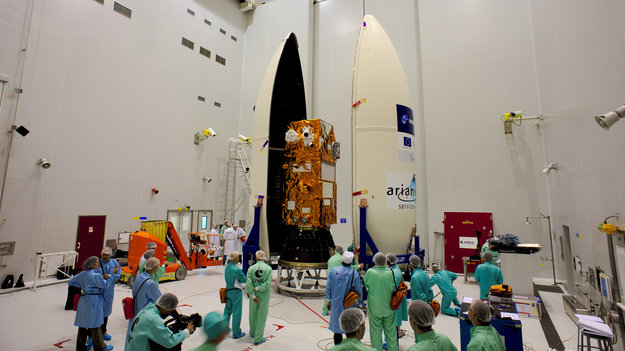
Sealed from view and poised high: watch the timelapse of Sentinel-2A’s encapsulation and integration on the Vega rocket
NASA Joins North Sea Oil Cleanup Training Exercise
A NASA aircraft joined a Norwegian oil spill cleanup exercise, testing a scientific instrument’s ability to recognize more and less damaging types of oil slicks.
Jason-3 Satellite Arrives at California Launch Site
The newest addition to a venerable line of ocean-monitoring satellites has arrived at its launch site in California to prepare for its launch in August.
Cassini Sends Back Views After Zooming Past Dione
The rugged landscape of Saturn’s fracture-faced moon Dione is revealed in images sent back by NASA’s Cassini spacecraft from its latest flyby.
Le Bourget in images

ESA at the Paris Air &Space Show – the week in images
Hot lava flows discovered on Venus
ESA’s Venus Express has found the best evidence yet for active volcanism on Earth’s neighbour planet.
Earth from Space

Join us Friday, 19 June, at 10:00 CEST for the ‘Earth from Space’ video programme. This week we explore the San Francisco Bay Area in the US state of California
From ESA: more than 300 new companies

ESA’s business incubators hit a milestone this month: they have now fostered 300 start-up companies – and more are joining all the time.
Exoplanet smaller than Earth gets its size and mass measured
Kepler-138b is less than a tenth of Earth’s mass and half its size.
ALMA weighs supermassive black hole at center of distant spiral galaxy
Researchers determined that galaxy NGC 1097 harbors a black hole 140 million times more massive than our Sun.
Invisible rain

Technology image of the week: VIP visitors to the ESA pavilion at Le Bourget peer into a ‘cloud chamber’, revealing otherwise invisible cosmic ray tracks
Le Bourget replays

Replays of key media briefings at the Paris Air & Space Show, 15-17 June
International Spacecraft Carrying NASA’s Aquarius Instrument Ends Operations
Aquarius/SAC-D, an international Earth-observing mission that carries NASA’s Aquarius instrument, ended June 8 when an essential component of the spacecraft power and attitude control system stopped operating.
All Systems Go for NASA’s Mission to Jupiter Moon Europa
Europa is considered one of the most promising places in the solar system to search for signs of present-day life, and a new NASA mission to explore this potential is moving forward.
Dissolving Titan
Saturn’s moon Titan is home to seas and lakes filled with liquid hydrocarbons, but what makes the depressions they lie in? A new study suggests that the moon’s surface dissolves in a similar process that creates sinkholes on Earth.
Rosetta replay
Watch the Rosetta mission press briefing held at Le Bourget on 17 June, including a status report on Philae lander
Scientists find methane in Mars meteorites
The discovery hints at the possibility that methane could be used as a food source by rudimentary forms of life beneath the martian surface.
Best observational evidence of first-generation stars in the universe
A bright, distant galaxy shows evidence of harboring these massive, previously purely theoretical stars that were the creators of the elements necessary to forge the cosmos we see today.
Sentinel-2A poised high
With less than a week to liftoff, the next Sentinel satellite for the Copernicus environmental monitoring programme is now in position high up in the launch tower at Europe’s Spaceport in Kourou, French Guiana.
Hot firing of world’s first 3D-printed platinum thruster chamber

The world’s first spacecraft thruster with a platinum combustion chamber and nozzle made by 3D printing has passed its baptism of fire with a series of firings lasting more than an hour and 618 ignitions.
Different faces of Pluto emerging in new images from New Horizons
The photos show an increasingly complex surface with clear evidence of discrete equatorial bright and dark regions.
NASA ‘Eyes’ Study Louisiana’s Changing Wetlands
NASA has completed an intensive study of Louisiana Gulf Coast levees and wetlands, using three advanced instruments on two research aircraft.
Study: Third of Big Groundwater Basins in Distress
UC Irvine studies using NASA GRACE data find a third of Earth’s largest groundwater basins are being rapidly depleted by human use, despite little data about how much water remains.
EDRS roundtable
Replay of discussion at the Paris Air Show on the European Data Relay System and its future services and business opportunities
IXV first results
Replay of media briefing at the Paris Air Show on the first results from the Intermediate eXperimental Vehicle
Rosetta briefing
Watch a briefing from the Rosetta team at ESA’s pavilion at Le Bourget, including the latest results and what lies ahead. Streaming starts 09:30 CEST.
ESA spaceplane on display

The February flight of ESA’s Intermediate eXperimental Vehicle is yielding invaluable insights and results for future reentry craft.
Where Philae phones home
Human spaceflight and operations image of the week: Engineers in the Rosetta control room on watch for Philae signals
Lab mimicry opens a window to the deep interiors of stars and planets
A team of scientists used techniques to mimic stellar and planetary conditions to observe how noble gases behave in order to better understand the atmospheric and internal chemistry of these celestial objects.
ESA at Le Bourget
Watch key events in ESA’s pavilion at the Paris airshow: today, ESA IXV results and EDRS roundtable. Streaming starts at 15:00 CEST
Saturn Spacecraft to Buzz Icy Moon Dione June 16
NASA’s Cassini spacecraft will make a close flyby of Saturn’s moon Dione on June 16, coming within 321 miles (516 kilometers) of the moon’s surface.
Rosetta’s Lander Philae Wakes From Comet Nap
Rosetta’s Philae lander wakes up from hibernation on comet 67P/Churyumov-Gerasimenko.
Asteroid Icarus to Make Distant Pass Tuesday
Asteroid Icarus will safely pass by Earth more than 21 times the distance of Earth to the moon on June 16.
Replay DG briefing
Replay of the media briefing with ESA DG Jean-Jacques Dordain and his successor Johann-Dietrich Woerner at the Paris airshow on 15 June
Philae wake-up triggers intense planning

The receipt of signals from Rosetta’s Philae lander on 13 June after 211 days of hibernation marked the start of intense activity. In coordination with its mission partners, ESA teams are working to juggle Rosetta’s flight plan to help with renewed lander science investigations.
Iridescent Mercury

Space Science Image of the Week: Although NASA’s Messenger mission has ended, ESA’s BepiColombo will continue the quest to understand mysterious Mercury
Helium-shrouded planets may be common in our galaxy
Researchers theorize that some “warm Neptune” exoplanets could have helium-enriched atmospheres after their hydrogen boiled off.
Philae wakes up!
Rosetta’s lander Philae wakes up from hibernation
Rosetta’s lander Philae wakes up from hibernation
Rosetta’s lander Philae has woken up after seven months in hibernation on the surface of Comet 67P/Churyumov-Gerasimenko.
Rosetta’s Philae lander wakes up from hibernation
It appears the lander also was awake once before on Comet 67P/Churyumov-Gerasimenko but couldn’t contact its team on Earth.
NASA Prepares for First Interplanetary CubeSats
When NASA launches its next mission on the journey to Mars – a stationary lander in 2016 – the flight will include the first two CubeSats sent to deep space.
Week In Images
Our week through the lens: 8-12 June 2015
Welcome home
ESA astronaut Samantha Cristoforetti back on Earth after 199 days in space
Le Bourget 2015
ESA at 51st Paris Air and Space Show
The Hubble Telescope detects “sunscreen” layer on distant planet
The presence of a stratosphere can provide clues about the composition of a planet and how it formed.
SPHERE reveals earliest stage of planetary nebula formation
These observations of the red giant star L2 Puppis also clearly show a close stellar companion.
Keeping energy clean and the countryside quiet
Thanks to expertise garnered building space telescopes powerful enough to see exoplanets, large wind turbines are now generating clean power without making a racket.
Landing highlights
ESA’s Samantha Cristoforetti, NASA’s Terry Virts and Russian commander Anton Shkaplerov exit their Soyuz after landing safely in the Kazakh steppe
Helium-Shrouded Planets May Be Common in Our Galaxy
The wacky world of exoplanets continues to surprise astronomers.
Landing replay
ESA’s Samantha Cristoforetti, NASA’s Terry Virts and Russian commander Anton Shkaplerov exit their Soyuz after landing safely in the Kazakh steppe
ESA astronaut Samantha Cristoforetti back on Earth
ESA astronaut Samantha Cristoforetti, NASA astronaut Terry Virts and Russian commander Anton Shkaplerov landed safely today in the Kazakh steppe after a three-hour ride in their Soyuz spacecraft. They left the International Space Station a…
Earth from Space
Join us Friday, 12 June, at 10:00 CEST for the ‘Earth from Space’ video programme. This week, Sentinel-1A takes us over Indonesia’s Central Kalimantan province on the island of Borneo
Bright spots shine in newest Dawn Ceres images
The spots consist of many individual bright points of differing sizes with a central cluster, but scientists still don’t know an explanation for them.
Chandra finds evidence for serial black hole eruptions
The supermassive black hole in NGC 5813 has erupted at least three times, with the latest still occurring.
ESA invites ideas to cut space debris creation

Tomorrow’s satellites must evolve – because the space they operate in is changing. New regulations on cutting space debris are influencing satellite design, and ESA is reaching out to satellite builders.
Bright Spots Shine in Newest Dawn Ceres Images
New images of dwarf planet Ceres, taken by NASA’s Dawn spacecraft, show the cratered surface of this mysterious world in sharper detail than ever before.
Space Station tour teaser
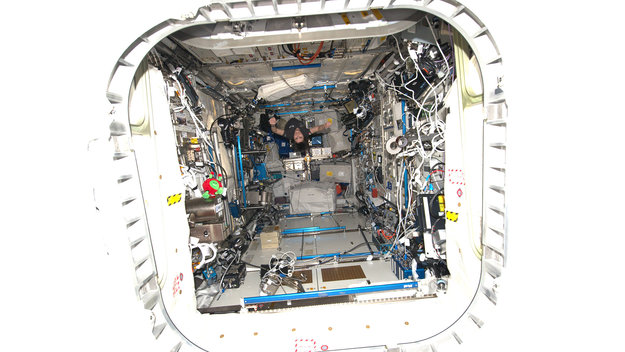
Explore ESA’s Columbus space laboratory in a new interactive panorama of the International Space Station. More modules will follow soon
Sand strike
Technology image of the week: this aluminium plate was ripped inwards by a single sand grain-sized fleck of aluminium oxide
Fly over Ceres in new video
The video is based on observations of Ceres that were taken from Dawn’s first mapping orbit.
Sunset jets on Rosetta’s comet
Researchers from the OSIRIS team believe that the increasing heating-up of Comet 67P is responsible for newly observed night activity.
RoboSimian Drives, Walks and Drills in Robotics Finals
The ape-like RoboSimian robot, developed at JPL, took fifth place in the DARPA Robotics Challenge Finals.
NASA’s LDSD Project Completes Second Experimental Test Flight
Engineers are poring over the data following the second experimental landing technology test of NASA’s Low-Density Supersonic Decelerator (LDSD) project.
Sentinel-2A sealed from view

As preparations for the launch of Sentinel-2A continue on track, the team at Europe’s Spaceport in Kourou, French Guiana has said farewell to the satellite as it was sealed from view in the Vega rocket fairing. Liftoff is set for 23 June at 01:52 GMT (03:52 CEST; 22:52 local time on 22 June).
Watch live

ESA astronaut Samantha Cristoforetti, NASA’s Terry Virts and commander Anton Shkaplerov return to Earth on 11 June, streaming starts at 13:00 GMT / 15:00 CEST
Soyuz spacecraft

Human spaceflight and operations image of the week: Samantha, Terry and Anton’s Soyuz spacecraft will bring them home on Thursday morning after 200 days in space
NASA spacecraft detects impact glass on surface of Mars
Like they do on Earth, these deposits might provide a window into the possibility of past life on the Red Planet.
ALMA’s observation of Einstein ring reveals extraordinary detail
The new observations reveal star-forming clumps in the galaxy equivalent to giant versions of the Orion Nebula.
Nearing launch

In two weeks’ time, Sentinel-2A will be launched from Europe’s Spaceport in French Guiana. Join ESA TV for an introduction to the ‘colour vision’ mission for Copernicus
Fly Over Ceres in New Video
A new animated video of dwarf planet Ceres, based on images taken by NASA’s Dawn spacecraft, provides a unique perspective of this heavily cratered, mysterious world.
NASA Spacecraft Detects Impact Glass on Surface of Mars
NASA’s Mars Reconnaissance Orbiter (MRO) has detected deposits of glass within impact craters on Mars.
NASA to Hold Briefing to Discuss Status of ‘Flying Saucer’ Test
NASA’s Low-Density Supersonic Decelerator project completed its second flight test when the saucer-shaped craft splashed down safely Monday in the ocean off the coast of Kauai.
ESA astronaut Samantha Cristoforetti returning home
ESA astronaut Samantha Cristoforetti will return to Earth on 11 June, along with NASA astronaut Terry Virts and Soyuz commander Anton Shkaplerov, having spent 200 days in space on the International Space Station.
MUSE Museum
‘Food for curious minds’ is the theme of Ecsite 2015, taking place 9-13 June in Trento, Italy
Filamentary Taurus

Space Science image of the week: Herschel’s view of a gigantic stellar crib in the Taurus Molecular Cloud
World Oceans Day

Satellites help us monitor the state of our oceans, supporting ‘healthy oceans, healthy planet’ – the theme for this year’s World Oceans Day
Week In Images
Our week through the lens: 1-5 June 2015
Three candidates for the European Space Agency’s next medium-class science mission
The three proposals each offer the chance to tackle some of the major outstanding scientific questions about our place in the universe.
Charting the Milky Way from the inside out
Using WISE, researchers have discovered more than 400 dust-shrouded nurseries of stars that have helped them trace the shape of our galaxy’s spiral arms.
Tianjin

Earth observation image of the week: a Sentinel-1A radar image of China’s Tianjin city, also featured on the Earth from Space video programme
Earth from Space
Join us Friday, 5 June, at 10:00 CEST for the ‘Earth from Space’ video programme. This week features a Sentinel-1A image of the Chinese city of Tianjin
Crashing comets may explain mysterious lunar swirls
Simulations suggest that comet impacts can account for many of the features in the swirls.
Hubble finds two chaotically tumbling Pluto moons
A comprehensive analysis of all available Hubble Space Telescope data shows that Nix and Hydra are wobbling unpredictably.
Three candidates for ESA’s next medium-class science mission
Exoplanets, plasma physics and the X-ray Universe are the topics chosen by ESA to be considered for the fourth medium-class mission in its Cosmic Vision science programme, for launch in 2025.
CDF Studies three candidates for ESA’s next medium-class science mission
Exoplanets, plasma physics and the X-ray Universe are the topics chosen by ESA to be considered for the fourth medium-class mission in its Cosmic Vision science programme, for launch in 2025 and like all the previously proposed Cosmic Visi…
New launch date set for Sentinel-2A
The second satellite in Europe’s Copernicus programme is set for launch from Europe’s Spaceport in Kourou, French Guiana, on 23 June at 01:52 GMT (03:52 CEST 23 June; 22:52 local time 22 June).
Historic handshake between space and Earth

In the first-ever demonstration of space-to-ground remote control with live video and force feedback, NASA astronaut Terry Virts orbiting Earth on the International Space Station shook hands with ESA telerobotics specialist André Schiele in the Netherlands today.
NASA’s Low-Density Supersonic Decelerator Set to Blast Off
A balloon carrying a test vehicle for NASA’s Low-Density Supersonic Decelerator (LDSD) project is scheduled to lift off no earlier than 10:30 a.m. PDT (1:30 p.m. EDT/ 7:30 a.m. HST) Monday, June 8, from Kauai, Hawaii.
Charting the Milky Way From the Inside Out
Researchers fine-tune maps of our galaxy’s spiral arms using data from NASA’s WISE mission.
Watch: Climate Symposium

Revisit last week’s International Symposium on Climate Change in Rome, which reviewed the links between climate change and world development
A new mix
Human spaceflight and operations image of the week: Vibrating mixtures in microgravity has revealed an unknown effect in liquids
Astronomers discover a young solar system around a nearby star
This work provides a valuable key to understanding the early formation of the Sun and planets.
Cassini sends final close views of odd moon Hyperion
Hyperion is the largest of Saturn’s irregular moons and may be the remnant of a violent collision that shattered a larger object into pieces.
Cassini Sends Final Close Views of Odd Moon Hyperion
NASA’s Cassini spacecraft has returned images from its final close approach to Saturn’s oddball moon Hyperion, upholding the moon’s reputation as one of the most bizarre objects in the solar system.
NASA Instrument on Rosetta Makes Comet Atmosphere Discovery
NASA’s Alice instrument on Rosetta finds that electrons near its target comet cause rapid breakup of water and carbon dioxide molecules released from the comet’s nucleus.
Ultraviolet study reveals surprises in comet coma
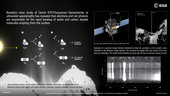
Rosetta’s continued close study of Comet 67P/Churyumov–Gerasimenko has revealed an unexpected process at work, causing the rapid breakup of water and carbon dioxide molecules spewing from the comet’s surface.