
ESA’s goal of removing a derelict satellite from orbit is picking up pace, as a mission design is assembled to be put before European ministers next year for approval.
Elu, loodus, teadus ja tehnoloogia
ESA’s goal of removing a derelict satellite from orbit is picking up pace, as a mission design is assembled to be put before European ministers next year for approval.
Technology image of the week: this deceptively modest joystick is about to make space history
The Rosetta spacecraft has discovered that electrons are responsible for the rapid breakup of water and carbon dioxide molecule’s erupting from the surface of Comet 67P/Churyumov-Gerasimenko.
NASA’s LDSD project will beam back live imagery from a supersonic, edge-of-atmosphere test of braking technology for Mars.

Space Science Image of the Week: Strong winds whip dust and sand from the martian surface into a frenzy, shaping and smoothing the planet’s surface features
The spacecraft is taking its final set of images primarily for navigation purposes and will enter its second mapping orbit around the dwarf planet June 3.
Our week through the lens: 25-29 May 2015
Tests using X-ray and gamma-ray observations rule out two different models of the quantum nature of space-time.
The results lend significant weight to the case for jets being the result of merging black holes, but additional conditions must also be met.
A new view of Ceres, taken by NASA’s Dawn spacecraft on May 23, shows finer detail is becoming visible on the dwarf planet.
NASA’s Cassini spacecraft will make its final close approach to Saturn’s large, irregularly shaped moon Hyperion on Sunday, May 31.
The 32 best images taken by ESA astronaut Alexander Gerst from the International Space Station as voted by his Facebook followers

These three new images of huge filamentary structures of gas and dust from ESA’s Herschel space observatory reveal how matter is distributed across our Galaxy, the Milky Way.
This discovery was made while piecing together a time-lapse movie of a plasma jet blasted from a supermassive black hole inside a galaxy located 260 million light-years from Earth.
The new images reveal more detail about Pluto’s complex and high-contrast surface.
Technology image of the week: cabling for the testing of ESA’s Mercury mission, photographed by artist Edgar Martins
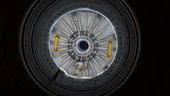
The International Space Station’s Permanent Multipurpose Module was detached and moved by the main robotic arm to another place on the orbiting laboratory yesterday.

An Ariane 5 lifted off last night from Europe’s Spaceport in Kourou, French Guiana and delivered two telecom satellites into their planned orbits.
The launch of flight VA223 occurred on 27 May at 21:16 GMT (23:16 CEST, 18:16 local time).
Testing is underway on NASA’s next mission on the journey to Mars, a stationary lander scheduled to launch in March 2016.
RoboSimian, the ape-like robot developed at NASA’s Jet Propulsion Laboratory, Pasadena, California, will compete in the DARPA Robotics Challenge Finals at the Fairplex in Pomona, California, June 5 and 6.
Building a better parachute – one goal of a team working on NASA’s LDSD, a project to develop breakthrough technologies for landing future robotic and human Mars missions.
JPL has two newly announced science investigations that will help unravel the mystery of whether Jupiter’s moon Europa might have the right conditions for life.
Jupiter’s moon could be the best place in the solar system to look for present-day life beyond our home planet.
A new image from the Very Large Telescope reveals that the star-forming region RCW 34 is home to multiple episodes of star birth.

Follow the International Climate Symposium in Rome, Italy, via live webstream 27–29 May
NASA has selected nine science instruments for a mission to Jupiter’s moon Europa, to investigate whether the mysterious icy moon could harbor conditions suitable for life.
The second flight test of NASA’s Low-Density Supersonic Decelerator (LDSD) now will launch no earlier than 10:30 a.m. PDT (7:30 a.m. HST) Tuesday, June 2, from the U.S. Navy’s Pacific Missile Range Facility (PMRF) on Kauai, Hawaii.
…
Exhibits, displays and presenters from NASA’s Jet Propulsion Laboratory, Pasadena, California, are participating in this year’s World Science Festival in New York, to be held from May 27 through 31.
Human spaceflight and operations image of the week: The first images acquired by Mars Express based on imaging proposals from schools in 12 countries
Space Science Image of the Week: Fifteen years ago, XMM-Newton took a series of mesmerising self-portraits with our planet
The science team wants to examine an outcrop that contains the contact between a pale rock unit the mission analyzed lower on Mount Sharp and a darker bedded rock unit that the mission has not yet examined up close.
The science team wants to examine an outcrop that contains the contact between a pale rock unit the mission analyzed lower on Mount Sharp and a darker bedded rock unit that the mission has not yet examined up close.

Congratulations to the winners of the Sentinel-2 ‘Colour vision’ photo competition!
Tests on Mars have confirmed success of a repair to the autonomous focusing capability of the Chemistry and Camera (ChemCam) instrument on NASA’s Curiosity Mars rover.
NASA’s Curiosity Mars rover climbed a hill Thursday to approach an alternative site for investigating a geological boundary, after a comparable site proved hard to reach.
Researchers at JPL have joined an effort to harness the benefits of searching the “Deep Web,” which could prove useful for both law enforcement and science.
Our week through the lens: 18-22 May 2015
ESA at the Chelsea Flower Show

The 100-day countdown begins today for ESA astronaut Andreas Mogensen’s visit to the International Space Station. Following launch on 1 September, he will test new technologies and deliver a fresh spacecraft for the long-stay crew already aboard the orbital complex.
The galaxy belongs to a new class of objects — extremely luminous infrared galaxies.
First discovered several decades ago, Nasty 1 was identified as a Wolf-Rayet star, a rapidly evolving star that is much more massive than our Sun.

A recent acceleration in ice loss in a previously stable region of Antarctica has been detected by ESA’s ice mission.
NASA’s Mars Exploration Rover Opportunity is studying an elongated crater called “Spirit of St. Louis” and a rock spire called “Lindbergh Mound” within the crater.
A remote galaxy shining with the light of more than 300 trillion suns has been discovered using data from NASA’s Wide-field Infrared Survey Explorer (WISE).
A study not only reveals a spiral galaxy devouring a nearby compact dwarf galaxy but also shows evidence of its past galactic snacks in unprecedented detail.
Advanced LIGO will now undergo commissioning to ensure instrumentation is ready for its first search this autumn.
At first glance, the region covered by this latest Mars Express image release appears to be pockmarked with impact craters. But the largest structure among them may hold a rather explosive secret: it could be remains of an ancient supervol…
NASA’s Dawn mission captured a sequence of navigational images of dwarf planet Ceres from a distance of 4,500 miles (7,200 kilometers) on May 16, 2015.
As the star at the heart of this nebula made its transition into retirement, it shed its outer layers into space, forming this colorful cloud.
The data provide evidence for one model of how type Ia supernovae occur and means both theories actually may be valid.
Bearing balls produced by the European Space Tribology Laboratory, tasked with keeping missions moving in space
NASA’s new Soil Moisture Active Passive (SMAP) mission to map global soil moisture and detect whether soils are frozen or thawed has begun science operations.
These galaxies are nearly as wide as our Milky Way Galaxy — about 60,000 light-years — yet harbor only 1 percent as many stars.

Forty years ago this week, a satellite ground station in Spain became the first to be assigned to what would become ESA. Since then, the network – Estrack – has expanded worldwide and today employs cutting-edge technology to link mission controllers with spacecraft orbiting Earth, voyaging deep in our Solar System or anywhere in between.
The quartet of active galaxies reside in one of the most massive structures ever discovered in the distant universe and is surrounded by a giant nebula of cool dense gas.
Scientists have not determined how the boulder seen in Rosetta images came to perch on the rim of a small depression.
On Saturday 16 May, after a long illness, ESA Director of Launchers Antonio Fabrizi passed away in Rome at the age of 67.
When extreme weather comes our way, realtime information from space can help us to decide if closing a bridge is the right thing to do.
The study of white dwarf migration in globular cluster 47 Tucanae challenges some of the ideas about how and when a star loses mass near the end of its life.
A new study reveals that the amount of X-rays from magnetar SGR 1745-2900 is dropping more slowly than other previously observed magnetars, and its surface is hotter than expected.
NASA has found that the last section of Antarctica’s Larsen B Ice Shelf, which partially collapsed in 2002, is likely to disintegrate before the end of the decade.
Ever wonder why stars seem to twinkle? This effect is caused by variations in the density of our atmosphere that cause blurring in light coming from space.
Researchers have found that levels of metals contained in dead galaxies provide key “fingerprints,” making it possible to determine the cause of death.
New data from the Fermi telescope suggests the precise mechanism that led to the absence of antimatter.
An asteroid, designated 1999 FN53, will safely pass more than 26 times the distance of Earth to the moon on May 14.
Be inspired by our Cheops drawing competition
It started with a simple question that ended with a surprising answer and new technology that is being used in cutting-edge heart surgery and could save millions of euros in hospital bills.
This new class may harbor either unexpected amounts of dark matter or massive black holes.
Now the spacecraft will begin its first search for new moons or rings that might threaten its passage through the Pluto system.
The laboratory find suggests the moon’s ocean is interacting with its rocky seafloor.
NASA’s Kepler spacecraft began hunting for planets outside our solar system on May 12, 2009.
NASA laboratory experiments suggest the dark material coating some geological features of Jupiter’s moon Europa is likely sea salt from a subsurface ocean, discolored by exposure to radiation.

ESA astronaut Samantha Cristoforetti’s mission on the International Space Station has been extended until the beginning of June. It was planned to end this week with a return to Earth together with NASA astronaut Terry Virts and cosmonaut Anton Shkaplerov.
Astronomers have found the best proof yet that the mechanism that triggers core-collapse supernovae is inherently lopsided.
Dawn scientists can now conclude that the intense brightness of these spots is due to the reflection of sunlight by highly reflective material on the surface, possibly ice.
The mysterious bright spots on the dwarf planet Ceres are better resolved in a new sequence of images taken by NASA’s Dawn spacecraft on May 3 and 4, 2015.
NASA has selected 15 proposals, including one from JPL, for study under Phase I of the NASA Innovative Advanced Concepts program, which aims to turn science fiction into science fact through the development of pioneering technologies.
…
New video shows early results from a new array of radio antennas. The project is designed to catch things that flash, flare and explode.
A balloon will launch the Low-Density Supersonic Decelerator (LDSD) mission this June.
ESA’s Rosetta mission and Alexander Gerst were star attractions at re:publica 2015 in Berlin
ESA astronaut Samantha Cristoforetti is sharing her world in space with video tours of her experiments, the space toilet and bathroom as well as giving lessons about gravity
Though plentiful in and around many galaxies, newborn examples of globular cluster are vanishingly rare and the conditions necessary to create new ones have never been detected until now.
The discovery wouldn’t have been possible without the spacecraft flying incredibly close to the planet in the months before impact.

Space Science Image of the Week: Jupiter’s moon Europa is brimming with water – hidden lakes, layers of icy slush, an underground ocean and a fractured crust of ice
After a brief side trip to inspect a Martian valley that filled with sand long ago, NASA’s Curiosity Mars rover is back on a route toward the next-higher layer of Mount Sharp.
The sun dips to a Martian horizon in a blue-tinged sky in images sent home to Earth this week from NASA’s Curiosity Mars rover.
The Department of Homeland Security Science and Technology Directorate, in partnership with NASA’s Jet Propulsion Laboratory, announced the transition of the final prototype of the Finding Individuals for Disaster and Emergency Response …
After a brief side trip to inspect a Martian valley that filled with sand long ago, NASA’s Curiosity Mars rover is back on a route toward the next-higher layer of Mount Sharp.
Our week through the lens: 4-8 May 2015

ESA, France’s space agency CNES and the German aerospace centre DLR inaugurated the Airbus A310 ZERO-G refitted for altered gravity by running 12 scientific experiments this week.
The exhibition where art meets science is coming soon to the UN Headquarters in New York City
This gaseous atmosphere of our neighboring galaxy is about 1,000 times more massive than previously estimated and stretches halfway to the Milky Way.
Earth observation image of the week: the glaciers of South Georgia Island in the Atlantic Ocean, also featured on the Earth from Space video programme
NASA’s NuSTAR, has found evidence that a massive star exploded in a lopsided fashion, sending ejected material flying in one direction and the core of the star in the other.
In the wreckage of a collapsed textile factory and another building in the Nepalese village of Chautara, four men were rescued, thanks to a NASA technology that was able to find their heartbeats.
Join us Friday, 8 May, at 10:00 CEST for the ‘Earth from Space’ video programme. This week features an image of South Georgia Island
Scientists think most of the observed activity on Enceladus represents curtain eruptions from the “tiger stripe” fractures, rather than intermittent geysers along them.
New research finds that water-rich asteroids similar to those found in our solar system are plentiful in the galaxy.

As ESA’s Proba-V works quietly on its main task of monitoring vegetation growth across Earth, the minisatellite is also picking up something from a little higher: signals from thousands of aircraft.
New research using data from NASA’s Cassini mission suggests most of the eruptions from Saturn’s moon Enceladus might be diffuse curtains rather than discrete jets.