NASA’s SMAP and University of Texas scientists are rounding up critical soil information for managing the Lone Star State’s limited water.
Send your drawing into space with Cheops
Do you want to send your art into space on the new Cheops satellite? ESA and its mission partners are inviting children to submit drawings that will be miniaturised and engraved on two plaques that will be put on the satellite.
NASA’s SDO observes “Cinco de Mayo” solar flare
This burst of radiation was the most powerful so far this year and already has resulted in a radio blackout.
Zero-G hangout
Live today at 15:00 CEST from Bordeaux, France, connect with us for an ESA hangout on science in altered gravity
Dragon mountains
Technology image of the week: ESA’s Proba-V minisatellite views the sharp peaks of South Africa’s Drakensberg range
Public Event Will Celebrate NASA Mission to Dwarf Planet Ceres
NASA’s Dawn mission will host the flagship event for its “I C Ceres” space festival at the California Institute of Technology in Pasadena on Saturday, May 9, from 10 a.m. to 4:30 p.m.
DHS and NASA Technology Helps Save Four in Nepal Earthquake Disaster
Four men trapped under up to 10 feet of bricks, mud and other debris have been rescued in Nepal thanks to new search-and-rescue technology developed in partnership by the Department of Homeland Security’s Science and Technology Directora…
Contingency training
Human spaceflight and operations image of the week: Sentinel-2 mission control team trains for launch
Astronomers find first evidence of changing conditions on a super-Earth
The ability to peek into the atmospheres of rocky “super-Earths” and observe conditions on their surfaces marks an important milestone toward identifying habitable planets outside the solar system.
Astronomers set a new galaxy distance record
A team discovered an exceptionally luminous galaxy more than 13 billion years in the past; it existed so long ago that it appears to be only 100 million years old.
Traffic Around Mars Gets Busy
NASA’s Mars Exploration Program has begun using systematic precautions to prevent Mars orbiters from flying too close to each other.
Pulsar with widest orbit ever detected, discovered by high school research team
Further observations by astronomers using the Green Bank Telescope revealed that this pulsar is part of only a handful of double neutron star systems.
Strong evidence for coronal heating theory by nanoflares
Clear evidence now suggests that the heating mechanism depends on regular but intermittent explosive bursts of heat, rather than on continuous gradual heating.
In the belly of the Swan
Space Science Image of the Week: This cool view of the Cygnus region in the Milky Way reveals young stars waiting to be born
Join the virtual classroom
Registration is open for a free online course that provides an introduction to monitoring climate change using satellite Earth observation.
NASA Aids Response to Nepal Quake
NASA and its partners are gathering the best available science and information on the April 25 magnitude 7.8 earthquake in Nepal to assist in relief and humanitarian operations.
Chandra suggests black holes gorging at excessive rates
This finding may help astronomers understand how the largest black holes were able to grow so rapidly in the early universe.
New exoplanet too big for its star
Scientists have discovered an exoplanet with Saturn’s mass and Jupiter’s radius orbiting a small, cool star.
Week In Images
Our week through the lens: 27 April – 1 May 2015
NASA completes MESSENGER mission with impact on Mercury’s surface
With four years and 4,105 orbits around the planet, the spacecraft determined Mercury’s surface composition, revealed its geological history, discovered its internal magnetic field is offset from the planet’s center, and verified its polar deposi…
Rock Spire in ‘Spirit of St. Louis Crater’ on Mars
An elongated crater called “Spirit of St. Louis,” with a rock spire in it, dominates a recent scene from the panoramic camera (Pancam) on NASA’s Mars Exploration Rover Opportunity.
Business with ESA
The new Industry Portal provides concrete information on ESA’s Business Opportunities, informative material on how to do business with ESA and access to useful educational tools
Land shifts in Nepal
The Sentinel-1A satellite has given us a clearer picture of the ground deformation caused by the 25 April earthquake in Nepal
MESSENGER mission to impact Mercury today
After a mission of nearly 11 years, the spacecraft has run out of fuel and will smash into the planet’s surface at about 3:26 p.m. EDT.
NuSTAR captures possible “screams” from zombie stars
The space telescope has observed a baffling X-ray glow at the heart of the Milky Way that could involve different classes of stellar corpses.
The Pillars of Creation revealed in 3-D
New observations demonstrate how the different dusty pillars of this iconic object are distributed in space and reveal many new details, including a previously unseen jet from a young star.
NASA’s NuSTAR Captures Possible ‘Screams’ from Zombie Stars
NASA’s NuSTAR has spotted a mysterious glow of high-energy X-rays in the heart of the Milky way that could be the “howls” of dead stars as they feed on stellar companions.
Nepal earthquake on the radar
On 25 April, a 7.8-magnitude earthquake struck Nepal, claiming over 5000 lives and affecting millions of people. Satellite images are being used to support emergency aid organisations, while geo-scientists are using satellite measurements …
Mercury orbiter unboxed
Technology image of the week: Unboxing BepiColombo’s Mercury Magnetospheric Orbiter at ESA’s Test Centre
Tracking Japan’s asteroid impact mission

ESA is set to support Japan’s ‘touch-and-go’ Hayabusa-2 spacecraft, now en route to a little-known asteroid, helping to boost the scientific return from this audacious mission.
Astronomers discover three super-Earths orbiting nearby star
The team discovered the planets by detecting a wobble of the star HD 7924 as a result of the gravitational pull of the planets orbiting around it.
Water could have been abundant in the first billion years
Despite young molecular clouds containing far less oxygen than the Sun, theorists still found as much water vapor in the early universe as we see in the Milky Way today.
NASA’s New Horizons detects Pluto surface features, including possible polar cap
Scientists interpreted the latest image data to reveal that the dwarf planet has broad surface markings – some bright, some dark – including a bright area at one pole that may be a polar cap.
Space aids Ebola patients

New antiviral drugs to treat Ebola patients in West Africa have been tested with the help of a transportable diagnostics laboratory developed with ESA’s support.
Hawaii Says ‘Aloha’ to NASA’s Low-Density Supersonic Decelerator
NASA’s Low-Density Supersonic Decelerator test vehicle has arrived at the U.S. Navy’s Pacific Missile Range Facility in Kauai, Hawaii.
Ready to fly
Human spaceflight and operations image of the week: Newly refitted Airbus A310 aircraft on the runway and ready for its first flight for weightless research
Strange supernova is “missing link” in gamma-ray burst connection
Studies show that supernovae with strong engines and lighter particles produce gamma-ray bursts.
First exoplanet visible light spectrum
Observations revealed new properties of the first exoplant ever discovered around a normal star — 51 Pegasi b.
Saturn’s sponge-like moon

Space Science Image of the Week: Saturn’s moon Hyperion may be a potato-shaped lump of porous rock but, as discovered by Cassini, it is more intriguing than it seems
NASA Wins 2015 Webby Awards
The websites and a mobile app selected for best-of-the-Web honors represent the diversity of NASA’s online offerings.
Deep Space Atomic Clock
The Deep Space Atomic Clock mission will explore how to better navigate spacecraft and collect data with more precision.
A sharp view into black holes
The Event Horizon Telescope has made a step toward taking the first detailed pictures of black holes by adding the South Pole Telescope to its instrumentation lineup.
Ariane 5’s first launch of 2015

An Ariane 5 has lifted off from Europe’s Spaceport in Kourou, French Guiana and delivered two telecom satellites into their planned orbits.
Dawn Enters Science Orbit
NASA’s Dawn spacecraft entered into its first science orbit on Thursday, April 23, as scheduled.
Week In Images
Our week through the lens: 20-24 April 2015
Astronomers find runaway galaxies
These compact elliptical galaxies likely have been flying out of their home clusters by interactions with larger galaxies.
Looking back: Hubble at 25, an interactive timeline
Hubble data has yielded tens of thousands of scientific papers, and its powerful camera continues to beam back breathtaking images of the universe.
Giant cosmic tsunami wakes up comatose galaxies
If clusters of galaxies merge, a huge shock wave can drive the birth of a new generation of stars.
Florida
Earth observation image of the week: a Sentinel-1 image over the US state of Florida, also featured on the Earth from Space video programme
JPL Celebrates Hubble’s 25th Anniversary
This week marks the 25th anniversary of the launch of NASA’s Hubble Space Telescope, and JPL is celebrating its significant role in the historic mission.
Meet Sentinel-2

The second satellite for Europe’s Copernicus programme is set for launch on 12 June. Discover the ‘colour vision’ mission
Preparing to launch ‘colour vision’ satellite
The latest satellite for the European Commission’s environmental Copernicus programme has arrived safe and sound in French Guiana for launch on 12 June. Carrying a multispectral imager, Sentinel-2A is set to give us a new perspective of our land and vegetation.
Hubble 25
Celebrating 25 years of the Hubble Space Telescope, this montage presents the incredible range of images that have helped to shape our view of the Universe
Celestial fireworks celebrate Hubble’s 25th anniversary
This glittering tapestry of young stars exploding into life in a dramatic fireworks display has been released today to celebrate 25 incredible years of the Hubble Space Telescope.
Earth from Space

Join us Friday, 24 April, at 10:00 CEST for the ‘Earth from Space’ video programme. This week features a Sentinel-1 image over the US state of Florida
NASA unveils celestial fireworks as official image for Hubble 25th anniversary
The sparkling centerpiece of Hubble’s silver anniversary fireworks is a giant cluster of about 3,000 stars called Westerlund 2.
NASA’s NExSS to lead search for life on distant worlds
The coalition hopes to better understand the various components of exoplanets, as well as how the stars and neighbor planets interact to support life.
Space artist nominated for prestigious prize

Katie Paterson’s ESA-supported work Campo del Cielo, Field of the Sky – which included a symbolic return to space for a chunk of meteorite – has been shortlisted for the International Prize for Contemporary Art, granted by the Foundation Prince Pierre de Monaco.
Mars Orbiter Views Curiosity Rover in ‘Artist’s Drive’
A view from NASA’s Mars Reconnaissance Orbiter on April 8, 2015, catches sight of NASA’s Curiosity Mars rover passing through a valley called “Artist’s Drive” on the lower slope of Mount Sharp.
Happy Earth Day
A snapshot of our home planet captured on the morning of Earth Day by the MSG-3 satellite
Pulsing light may indicate supermassive black hole merger
In a new study, astronomers present direct evidence of a pulsing quasar, which may substantiate the existence of black hole binaries.
Clusters of monster stars lit up the early universe
Scientists find that the first stars could have clustered together in phenomenally bright groups, with periods when they were as luminous as 100 million Suns.
Perseverance paves way for wind laser

Developing new satellite instruments is always challenging, but at times more head-scratching is needed to create something truly cutting-edge. ESA’s Aeolus mission may have caused a few headaches along the way, but its wind lasers are now ready and the task of putting the rest of the instrument together can begin so that it can be ready for launch in 2016.
Second Dragon, fruit flies and fresh coffee for Samantha
ESA astronaut Samantha Cristoforetti is nearing the end of her six-month Futura mission but her action-packed stay on the International Space Station is showing no signs of slowing down.
Light out of darkness
Technology image of the week: The darkened laser test bench of ESA’s Opto-Electronics Lab
Jason-3 Will Add to Record of the Sea’s Rise and Fall

Jason-3 will add to a 23-year data set used to study climate change and ocean cycles like El Niño, as well as for hurricane forecasts, navigation and other ocean needs.
NASA’s NExSS Coalition to Lead Search for Life on Distant Worlds
A new initiative is dedicated to the search for life on planets outside our solar system.
NASA RapidScat Proving Valuable for Tropical Cyclones
Forecasters are already finding NASA’s new ISS-RapidScat mission helpful as they keep watch on major storms around the globe.
NASA Soil Moisture Mission Produces First Global Maps
NASA’s new satellite mission to map the water in the soil under our feet has passed another key milestone by generating its first full global maps.
Astronomers probe young star and its planets
The planetary system HR8799, a young star only 30 million years old, was the first to be directly imaged with three planets found in 2008 and a fourth one in 2010.
Alma reveals intense magnetic field close to supermassive black hole
This new observation helps astronomers understand the structure and formation of these massive inhabitants of the centers of galaxies and the twin high-speed jets of plasma they frequently eject from their poles.
Spin service
Human spaceflight and operations image of the week: ESA astronaut Claude Nicollier working on the Hubble space telescope 600 km from Earth
Ceres’ Bright Spots Come Back Into View
The two brightest spots on dwarf planet Ceres, which have fascinated scientists for months, are back in view in the newest images from NASA’s Dawn spacecraft.
Ceres’ Bright Spots Come Back Into View
The two brightest spots on dwarf planet Ceres, which have fascinated scientists for months, are back in view in the newest images from NASA’s Dawn spacecraft.
Icy tendrils reaching into Saturn ring traced to their source
Scientists have been able to show that each unique tendril structure can be reproduced by particular sets of geysers on Enceladus’ surface.
A cold cosmic mystery solved
A team of astronomers may have found an explanation for the existence of the Cold Spot, a larger-than-expected cold area of the sky.
Thor’s neon-hued helmet
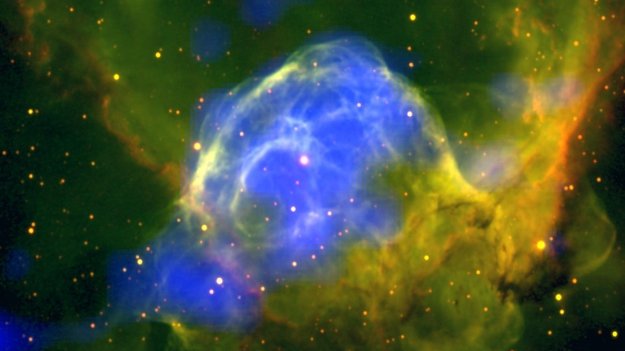
Space Science Image of the Week: Intense X-rays have sculpted bubbles, filaments and rippling outbursts within the Thor’s Helmet nebula, as seen by ESA’s XMM-Newton
Week In Images
Our week through the lens: 13-17 April 2015
Fast access to CryoSat’s Arctic ice measurements now available

ESA’s ice mission has become the first satellite to provide information on Arctic sea-ice thickness in near-real time to aid maritime activities in the polar region.
Dawn glimpses Ceres’ north pole
These images represent the highest-resolution views of Ceres to date.
NASA’s New Horizons nears historic encounter with Pluto
In an unprecedented flyby this July, our knowledge of what the Pluto system is really like will expand exponentially.
Central/southern Italy

Earth observation image of the week: part of Italy’s Molise, Apulia and Campania regions are pictured in this radar composite image from Sentinel-1A
Dawn Glimpses Ceres’ North Pole
After spending more than a month in orbit on the dark side of dwarf planet Ceres, NASA’s Dawn spacecraft has captured several views of the sunlit north pole of this intriguing world.
NASA’s Curiosity Rover Making Tracks and Observations
NASA’s Curiosity Mars rover is approaching a new geological unit and has surpassed 10 kilometers in total distance driven on Mars.
NASA Nominated for 2015 Best-of-the-Web Honors
Fans of NASA can vote for the agency’s nominees in the 2015 Webby awards competition.
Spitzer, Ogle spot planet deep within our galaxy
The discovery demonstrates that Spitzer can be used to help solve the puzzle of how planets are distributed throughout our flat, spiral-shaped Milky Way Galaxy.
Giant galaxies die from the inside out
Observations show that star formation shuts down in the centers of elliptical galaxies first.
GOCE helps tap into sustainable energy resources
Going far above and beyond its original mission objectives, results from the GOCE gravity satellite are now being used to produce maps for geothermal energy development.
Glitter Cloud May Serve As Space Mirror
Space telescopes may one day make use of glitter-like materials to help take images of new worlds, according to JPL researchers.
Asteroid Named for Nobel Prize Winner Joins Historic Lineup
An asteroid discovered by NASA’s NEOWISE spacecraft has a new designation: 316201 Malala, to honor Malala Yousafzai of Pakistan, who received the 2014 Nobel Peace Prize.
Asteroid touchdown
Technology image of the week: ESA’s Asteroid Impact Mission currently under study is set to include a surface lander
Rosetta and Philae find comet not magnetized
The only magnetic field the instruments measured at Comet 67P/Churyumov-Gerasimenko was an external one.
Dark matter may not be completely dark after all
Researchers observed four colliding galaxies and found that one dark matter clump appeared to be lagging behind the galaxy it surrounds.
Icy Tendrils Reaching into Saturn Ring Traced to Their Source
Long, sinuous, tendril-like structures seen near Enceladus originate directly from its geysers, according to scientists studying images from NASA’s Cassini spacecraft.
NASA’s Spitzer Spots Planet Deep Within Our Galaxy
NASA’s Spitzer Space Telescope has teamed up with a telescope on the ground to find a remote gas planet about 13,000 light-years away, making it one of the most distant planets known.
NASA Celebrates Earth Day with Public Events, Online Activities
NASA will celebrate the 45th annual Earth Day April 17-22 with a variety of live and online activities to engage the public in the agency’s mission to better understand and protect our home planet.
Root cause

Human spaceflight and operations image of the week: looking at the ‘root cause’ for plant growth in altered gravity
Rosetta and Philae find comet not magnetised

Measurements made by Rosetta and Philae during the probe’s multiple landings on Comet 67P/Churyumov-Gerasimenko show that the comet’s nucleus is not magnetised.
NASA-funded study explains Saturn’s epic tantrums
The tempests on Saturn, which can grow into bright bands that encircle the entire planet, are on a natural timer that is reset by each subsequent storm.
Mars’ rover’s weather data bolster case for brine
Perchlorate, identified in martian soil by the Curiosity mission, has properties of absorbing water vapor from the atmosphere and lowering the freezing temperature of water.