A new study of Earth’s ionosphere, a part of the upper atmosphere, could have applications for better GPS communications.
New NASA Earth Missions Expand View of Home Planet
Four new NASA Earth-observing missions are collecting data from space – with a fifth newly in orbit – after the busiest year of NASA Earth science launches in more than a decade.
New NASA Space Cowboy Successfully Deploys Its ‘Lasso’
Like a cowboy at a rodeo, NASA’s newest Earth-observing satellite, the Soil Moisture Active Passive (SMAP), has triumphantly raised its “arm” and unfurled a huge golden “lasso” (antenna).
Earth from Space

Join us Friday, 27 February, at 10:00 CET for the ‘Earth from Space’ video programme. This week features a false-colour image of Brussels
“Bright spot” on Ceres has dimmer companion
This may be pointing to a volcano-like origin of the spots, but Dawn scientists will wait for better resolution to make geologic interpretations.
Pockets of calm protect molecules around supermassive black hole
This is most likely due to dense areas of dust and gas that shield molecules from otherwise lethal radiation.
CubeSats offered deep-space ride on ESA asteroid probe
Think of it as the ultimate hitchhiking opportunity: ESA is offering CubeSats a ride to a pair of asteroids in deep space.
NASA’s Curiosity Mars Rover Drills at ‘Telegraph Peak’
Sample-collection drilling that NASA’s Curiosity Mars rover completed Tuesday will likely be the last before the rover departs “Pahrump Hills.”
‘Bright Spot’ on Ceres Has Dimmer Companion
Dwarf planet Ceres continues to puzzle scientists as NASA’s Dawn spacecraft gets closer to being captured into orbit around the object.
Physicists offer a solution to the puzzle of the origin of matter in the universe
Scientists propose that the matter-antimatter asymmetry could be related to the Higgs boson particle.
Ancient super-bright quasar with massive black hole found
At a distance of 12.8 billion light-years from Earth, this quasar was formed only 900 million years after the Big Bang.
Improved vision for James Webb Space Telescope
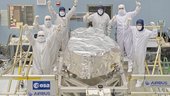
Key science elements of the James Webb Space Telescope have been upgraded ahead of the observatory’s launch in 2018.
Software satellite
Technology image of the week: Through daily software uploads, this miniature satellite will be a testbed for innovative control methods
New NASA Soil Moisture Mapper Completes Key Milestone
Mission controllers at JPL today sent commands to unfurl the reflector antenna on NASA’s new Soil Moisture Active Passive (SMAP) observatory, launched Jan. 31.
Latest Selfie from NASA Mars Rover Shows Wide Context
NASA’s Curiosity Mars rover used the camera on its robotic arm to record the pieces of a portrait that shows the rover within a panorama of the area it is studying.
NASA Briefing to Discuss First Spacecraft Arrival at a Dwarf Planet
JPL will host a briefing Monday, March 2, about the March 6 arrival of NASA’s Dawn spacecraft at the dwarf planet Ceres. The event will be carried live on NASA TV and online.
Out of this world
Watch a replay of our ‘Out of this world’ Google hangout between ESA astronaut Tim Peake and pupils from Rode Heath Primary from Cheshire, UK
Actin’ strange
Human spaceflight and operations image of the week: Human endothelial cells and nuclei stained and exposed under a microscope in preparation for space
ESA’s spaceplane is coming home

ESA’s IXV spaceplane, launched on a Vega rocket on 11 February, is now on its way to Europe for detailed study in Italy.
Last look at Sentinel-2A

Before Sentinel-2A is packed up and shipped to French Guiana for its launch targeted on 12 June, media representatives and specialists got one last look at the second satellite for Europe’s Copernicus programme.
Calling on satellites in alpine rescues
Emergency services rescued 1780 people in the Austrian Alps last year. They can now count on satellites to access maps, send messages, give warnings and stay in contact.
Why comets are like deep-fried ice cream
Research shows that under a crystalline crust should still be very cold and contain more porous amorphous ice.
NASA to Highlight Results from New Earth Missions
Over the past 12 months NASA has added five missions to its orbiting Earth-observing fleet. NASA scientists will share early observations during a media telecon Feb. 26.
Scientific spring in isolated Antarctica

In Antarctica, the crew of the French–Italian Concordia research station are preparing for the winter. They have to survive six months of complete isolation – four in darkness because the Sun never rises above the horizon – while they perform science in one of the most barren places on Earth.
Does dark matter cause mass extinctions and geologic upheavals?
A university professor concludes that movement through dark matter may perturb the orbits of comets and lead to additional heating in Earth’s core, both of which could be connected with mass extinction events.
Colours in the cloud
Space Science Image of the Week: Herschel and Spitzer team up to explore the Small Magellanic Cloud, one of our nearest extragalactic neighbours
Week In Images
Our week through the lens: 16-20 February 2015
Telescopes give shape to furious black hole winds
This discovery that the winds blow in all directions has given astronomers their first opportunity to measure the strength of these ultra-fast winds and prove they are powerful enough to inhibit the host galaxy’s ability to make new stars.
<i>Astronomy</i> selects 2015 Youth Essay Contest winner
Thirteen-year-old Julia Derzay of Pewaukee, Wisconsin, wins a trip to the Northeast Astronomy Forum & Telescope Show with her entry for Astronomy’s 2015 Youth Essay Contest.
Hubble gets best view of a circumstellar debris disk distorted by a planet
The new images reveal the inner disk around Beta Pictoris and confirm structures predicted by computer simulations.
NASA, ESA Telescopes Give Shape to Furious Black Hole Winds
NASA’s Nuclear Spectroscopic Telescope Array (NuSTAR) and ESA’s (European Space Agency) XMM-Newton telescope are showing that fierce winds from a supermassive black hole blow outward in all directions — a phenomenon that had been suspec…
ESA’s Biomass satellite goes ahead

Following the initial selection in 2013 for Biomass to become ESA’s seventh Earth Explorer mission and the completion of preparatory activities, ESA Member States yesterday gave the green light for its full implementation for launch in 2020.
Earth from Space
Join us Friday, 20 February, at 10:00 CET for the ‘Earth from Space’ video programme. This week features a Sentinel-1A mosaic of Estonia
Dark matter guides growth of supermassive black holes
There seems to be a mysterious link between the amount of dark matter a galaxy holds and the size of its central black hole.
A close call of 0.8 light-years
Astronomers have identified the closest known flyby of a star to our solar system.
A close call of 0.8 light-years
Astronomers have identified the closest known flyby of a star to our solar system.
Mars hills hide icy past
A complex network of isolated hills, ridges and small basins spanning 1400 km on Mars is thought to hide large quantities of water-ice.
Happy Chinese New Year

Wishing the world’s Chinese population safe travels for their celebrations of the year of the sheep
Dawn captures sharper images of Ceres
As the spacecraft delivers better images and other data, the science team will be investigating the nature and composition of the dwarf planet.
New SPHERE instrument shows its power
The instrument has been used to search for a brown dwarf expected to be orbiting the unusual double star V471 Tauri — and found nothing.
Try before you fly
Technology image of the week: an ESA-led team rode this Polish centrifuge to prepare for a technology-testing parabolic flight
Dawn Captures Sharper Images of Ceres
Craters and mysterious bright spots are beginning to pop out in the latest images of Ceres from NASA’s Dawn spacecraft.
Cool ride!
Thanks to space, some Parisian Metro riders now enjoy a very high-tech commute. A satellite spin-off is paving the way for more comfortable journeys.;
Final goodbye
Human Spaceflight and Operations image of the week: the International Space Station and the last Automated Transfer Vehicle streaking through the sky over Europe
Rosetta in 2015
From close encounters to distant flybys, discover what’s in store for the Rosetta mission as the comet increases in activity
Mystery Mars plume baffles scientists
The plumes were seen rising to altitudes of over 155 miles (250 kilometers) above the same region of Mars on both occasions.
A new way to view Titan: “Despeckle” it
The technique produces radar images of Titan’s surface that are much clearer and easier to look at than the views to which scientists and the public have grown accustomed.
SMOS on acid

With fundamental changes happening to the chemistry of the world’s oceans, salinity information from ESA’s SMOS mission is being used with other Earth observation data to obtain information on ‘the other carbon dioxide problem’ – ocean acidification.
Close encounter
Space science image of the week: Rosetta swoops in for the closest comet flyby yet
Mystery Mars plume baffles scientists
Plumes seen reaching high above the surface of Mars are causing a stir among scientists studying the atmosphere on the Red Planet.
ALMA sees super stellar nurseries at heart of Sculptor Galaxy
The research suggests that it’s not just the number of stellar nurseries that sets the throttle for a galaxy to create new stars, but also what kind of stellar nurseries are present.
<i>Interstellar</i> technology throws light on spinning black holes
The computed code used to generate the movie’s iconic images revealed that when a camera is close up to a rapidly spinning black hole, peculiar surfaces in space create more than a dozen images of individual stars and of the thin, bright plane of the g…
ATV undocking

Time-lapse showing the departure of ATV Georges Lemaître from the International Space Station on 14 February
Last ATV reentry leaves legacy for future space exploration

ESA’s fifth automated cargo ferry completed its mission to the International Space Station today when it reentered the atmosphere and burned up safely over an uninhabited area of the southern Pacific Ocean.
‘Pale Blue Dot’ Images Turn 25
NASA’s Voyager 1 spacecraft showed its love for the solar system, including Earth, with these images on Feb. 14, 1990.
Week In Images
Our week through the lens: 9-13 February 2015
Happy Valentine’s
Choose your favourite image and send an e-card
Mismatched twin stars spotted in the delivery room
The discovery of these stellar twins could provide invaluable insight into the formation and evolution of massive stars, close binaries, and star nurseries.
Exploded star blooms like a cosmic flower
Astronomers are discovering that some type Ia supernova explosions may not be as symmetric as previously thought.
ATV-5 mission ends
Follow the last moments of ESA’s fifth and final Automated Transfer Vehicle as it leaves a legacy for future space exploration
Follow ESA spacecraft
See the ground tracks of ESA spacecraft and satellites on our interactive map, including the final voyage of Europe’s Automated Transfer Vehicle
Earth from Space
Join us Friday, 13 February, at 10:00 CET for the ‘Earth from Space’ video programme. This week features Las Vegas and Lake Mead in the United States
The Very Large Array finds unexpected “storm” at galaxy’s core
The discovery provides important insight on how supermassive black holes can have a catastrophic effect on the galaxies in which they reside.
Astronomers catch multiple-star system in first stages of formation
Direct observations of this process give strong support to one of several suggested pathways to producing such systems.
IXV safely recovered
IXV is hoisted onboard the Nos Aries recovery ship. Looking in great shape, it will now travel back to Europe for further analysis
A New Way to View Titan: ‘Despeckle’ It
Views of Saturn’s hazy moon Titan now appear much sharper, thanks to a technique that greatly improves radar images taken by NASA’s Cassini spacecraft.
Liftoff to splashdown
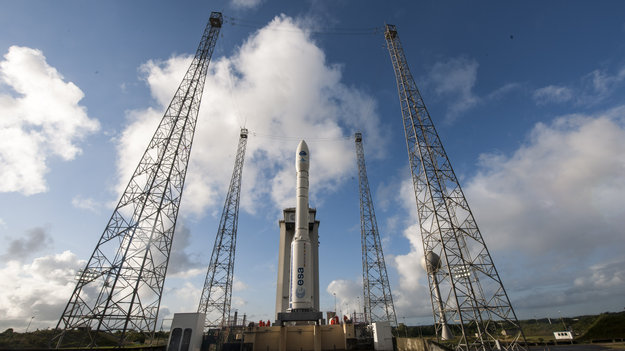
Relive IXV’s 100 minute reentry success from liftoff at Europe’s Spaceport to splashdown in the Pacific Ocean on 11 February
IXV awaits ship
Job done, IXV floats in the Pacific Ocean awaiting the Nos Aries recovery ship that will hoist it on board for its journey back to Europe for further analysis
ESA experimental spaceplane completes research flight

An experimental vehicle to develop an autonomous European reentry capability for future reusable space transportation has completed its mission. ESA’s Intermediate eXperimental Vehicle flew a flawless reentry and splashed down in the Pacific Ocean just west of the Galapagos islands.
Vega VV04 liftoff

Watch the liftoff of Vega VV04 with ESA’s experimental spaceplane at 13:40 GMT (14:40 CET) on 11 February
IXV in pictures
View the latest pictures of ESA’s reentry mission lasting 100 minutes. IXV will test in flight the lastest technologies and critical systems for future space exploration
Experimental spaceplane completes research flight
The European Space Agency’s Intermediate eXperimental Vehicle flew a flawless reentry and splashed down in the Pacific today.
Why Comets Are Like Deep Fried Ice Cream
Origins of crunchy crusts on comets explained in new laboratory research.
National Academy of Engineering Adds Two JPL Members
Two JPL researchers have been elected to the National Academy of Engineering, the highest professional distinction for engineers.
Smile, and the Universe Smiles With You
An upbeat-looking galaxy cluster appears to smile at us in a newly released image from the NASA/ESA Hubble Space Telescope.
Mars Rover Nearing Marathon Achievement
Since landing on Mars in January 2004, NASA’s Mars Exploration Rover Opportunity has driven nearly as far as a marathon footrace.
ATV to bid farewell to Space Station for last time

ESA’s last Automated Transfer Vehicle will leave the International Space Station on Saturday for its final solo voyage, setting course for a fiery demise that will mark the end of its mission and the programme.
In the hot seat

Human spaceflight and operations image of the week: The Control Centre that will command Europe’s largest spacecraft, the Automated Transfer Vehicle, when it undocks from the International Space Station on Saturday
ESA astronaut Thomas Pesquet’s space colleagues announced
The next crews to visit the International Space Station, including ESA astronaut Thomas Pesquet, have been announced.
IXV gets ready
ESA’s spaceplane is set for its 100 minute mission tomorrow, 11 February. See how it was done in the timelapse video
Google helps Lick Observatory stay open with $1 million gift
A resurgence of support from the University of California and several large donations signal a turning of the tide for the world’s first permanent mountaintop observatory.
Google helps Lick Observatory stay open with $1 million gift
A resurgence of support from the University of California and several large donations signal a turning of the tide for the world’s first permanent mountaintop observatory.
Europe set to test new spaceplane
In a world first, the European Space Agency will launch and land an unmanned spaceplane February 11 that has no wings but instead features an aerodynamic shape that produces the lift to fly through the atmosphere.
NASA spacecraft completes 40,000 Mars orbits
The orbiter is investigating seasonal and longer-term changes, including some warm-season flows that are the strongest evidence so far for liquid water on Mars today.
NASA Spacecraft Completes 40,000 Mars Orbits
NASA’s Mars Reconnaissance Orbiter has exceeded 40,000 trips around Mars and continues to study patterns of change on the Red Planet.
A sweet martian treat
Space Science Image of the Week: This surprising view of the Red Planet, courtesy of Mars Express, shows chocolate, caramel and cream-coloured swirls encircling the south pole
Watch IXV launch
Join us for the launch of Europe’s experimental spaceplane, scheduled for 13:00 GMT (14:00 CET) on 11 February. Streaming starts at 12:45 GMT (13.45 CET)
First pair of merging stars destined to become supernova found
A team of astronomers has discovered a close pair of white dwarf stars in a planetary nebula that have a total mass of about 1.8 times that of the Sun.
IXV mission timeline
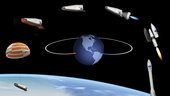
An annotated timeline of the most critical events during the IXV mission. ESA’s wingless spaceplane is set for liftoff on a Vega rocket from Kourou, French Guiana, 11 February 2015.
Week In Images
Our week through the lens: 2-6 February 2015
Camera to record doomed ATV’s disintegration – from inside

Next Monday, ESA astronaut Samantha Christoforetti will float into Europe’s space ferry to install a special infrared camera, set to capture unique interior views of the spacecraft’s break-up on reentry.
Curiosity analyzing sample of martian mountain
Preliminary results suggest the area had acidic ancient conditions
Planck mission explores the history of our universe
The latest data release is providing insights on the first stars, dark energy, and cosmic structure.
Lisbon
Earth observation image of the week: a Sentinel-1 radar image of Portugal’s capital, also featured on the Earth from Space video programme
Latest Galileo satellites reach launch site

Another two Galileo satellites have touched down in French Guiana ready to take their place in Europe’s satellite navigation constellation.
What’s new about Europe’s reentry mission?

ESA’s experimental spaceplane, poised for liftoff on Vega, is set to showcase the latest technologies and critical systems to extend Europe’s capability for space exploration.
NASA’s Curiosity Analyzing Sample of Martian Mountain
NASA’s Curiosity Mars rover is analyzing a rock-powder sample collected by using the rover’s drill in a gentler manner than at previous drill targets.
Planck Mission Explores the History of Our Universe
New data from Planck are helping scientists better understand the history and fabric of our universe, as well as our own Milky Way galaxy.
Dawn Gets Closer Views of Ceres
NASA’s Dawn spacecraft, on approach to dwarf planet Ceres, has acquired its latest and closest-yet snapshot of this mysterious world.
Earth from Space
Join us Friday, 6 February, at 10:00 CET for the ‘Earth from Space’ video programme. This week features a Sentinel-1 radar image over the metropolitan area of Portugal’s capital, Lisbon