
New Planck maps uncover the ‘polarised’ light from the early Universe, revealing that the first stars formed much later than previously thought
Hubble captures rare triple-moon conjunction
These so-called Galilean satellites complete orbits around Jupiter with durations ranging from two to 17 days.
The Lunar Reconnaissance Orbiter discovers lunar hydrogen more abundant on Moon’s pole-facing slopes
Explorers are excited because these deposits could be mined if they are sufficiently abundant.
New Horizons returns new images of Pluto
These are the first photos of the Pluto system for the spacecraft’s optical navigation phase of the mission.
NASA Aircraft, Spacecraft Aid Atmospheric River Study
NASA is part of a major field campaign studying intense atmospheric river storms from the ocean, land, air and space.
Estonia joins ESA family

PR N° 5-2015: Estonia took a step further in its relations with ESA by signing the Accession Agreement to the ESA Convention on 4 February 2015, to become the 21st ESA Member State
Rosetta swoops in for a close encounter
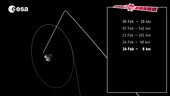
ESA’s Rosetta probe is preparing to make a close encounter with its comet on 14 February, passing just 6 km from the surface.
Rosetta swoops in for a close encounter
The February 14 flyby will allow the spacecraft to sample the innermost parts of Comet 67P/Churyumov-Gerasimenko’s atmosphere.
New infrared view of the Trifid Nebula reveals new variable stars far beyond
They are the first such stars found that lie in the central plane of the Milky Way beyond its central bulge.
Meade appoints new president
Victor Aniceto, former vice president of sales and marketing, will succeed Joe Lupica.
Mars Orbiter Spies Curiosity Rover at Work
NASA’s Mars Reconnaissance Orbiter recently caught a view of NASA’s Curiosity Mars rover studying an outcrop at the base of a Martian mountain.
Spaceship to ship

Human spaceflight and operations image of the week: A tracking station aboard Nos Aries will be the first to pick up IXV’s call home after reentry
IXV: 100 minutes of critical teamwork

During its brief but crucial mission, experts on three continents and the high seas will work in close cooperation for ESA’s IXV spaceplane mission, monitoring its free flight in space, spectacular reentry and safe splashdown in the Pacific.
Plant power from above
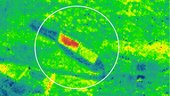
Field experiments have shown how ESA’s potential FLEX mission could identify vegetation that is suffering degrees of stress invisible to the naked eye.
“Live fast, die young” galaxies lose the gas that keeps them alive
A pilot study looking at galaxies that die young has found some might shoot out this gas early on, causing them to redden and kick the bucket prematurely.
Meteorite may represent “bulk background” of Mars’ battered crust
NWA 7034 has been shown to be a 4.4-billion-year-old chunk of the martian crust, the first such sample to make it to Earth.
IXV testing technologies
Find out how ESA’s cutting-edge spaceplane advances Europe’s ambition for autonomous landings from space
Arcadia High School Takes First Place at Science Bowl
Arcadia High School triumphed over 23 other teams at the National Science Bowl regional competition held at JPL on Jan. 31.
IXV and Vega united
ESA’s Vega rocket, with IXV on top, now awaits its fourth flight with liftoff on 11 February at 13:00 GMT (14:00 CET)
The telltale signs of a galactic merger
This galaxy has drifted too close to another nearby galaxy and the dramatic interaction has twisted its spiral arms out of shape.
Cat scan of nearby supernova remnant reveals frothy interior
Astronomers have generated a new 3-D map of Cassiopeia A’s interior, using the astronomical equivalent of a CAT scan.
Haunted stellar relic
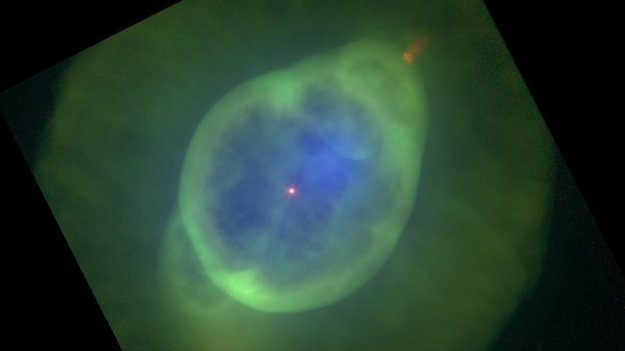
Space Science Image of the Week: A composite XMM-Newton and Hubble view of Jupiter’s Ghost planetary nebula
NASA Launches Groundbreaking Soil Moisture Mapper
NASA successfully launched its first Earth satellite designed to collect global observations of the vital soil moisture hidden just beneath our feet.
Gravitational Waves from Early Universe Remain Elusive
A joint analysis of data from Planck and the ground-based experiment BICEP2 has found no conclusive evidence of gravitational waves from the birth of our universe.
The search continues
Planck and Bicep2 join forces but gravitational waves remain elusive
Week In Images
Our week through the lens: 26-30 January 2015
Cassini catches Titan naked in the solar wind
Observations suggest that unmagnetized bodies like Saturn’s moon might interact with the solar wind in the same basic ways regardless of their nature or distance from the Sun.
Black hole chokes on a swallowed star
Extensive data analysis has led astronomers to believe they witnessed a giant black hole tear apart a star back in 2009.
Gravitational waves remain elusive, according to Planck
The satellite’s work with ground-based telescopes has shown that interstellar dust was actually the cause of more than half of the signal detection announced almost a year ago.
Black hole chokes on a swallowed star
Extensive data analysis has led astronomers to believe they witnessed a giant black hole tear apart a star back in 2009.
SMAP Earth Mission Launch No Earlier Than Saturday
The launch of NASA’s Soil Moisture Active Passive (SMAP) observatory has been delayed to a targeted launch date of Jan. 31.
NASA TV Coverage Reset for Launch of Newest Earth-Observing Mission
NASA’s SMAP mission is now scheduled for launch at 6:20 a.m. PST Friday, Jan. 30.
Magnificent merger
Tell-tale signs of a dramatic encounter between galaxies are evident in this striking view captured by the Hubble Space Telescope
IXV packed and ready
ESA’s IXV spaceplane is a snug fit inside Vega’s protective fairing and will soon be attached to the rocket in preparation for launch on 11 February
Earth from Space

Join us Friday, 30 January, at 10:00 CET for the ‘Earth from Space’ video programme. Ahead of World Wetlands Day, this week’s programme features the Ramsar sites on the island of Corsica
Dawn spacecraft captures best-ever view of dwarf planet
The images were taken 147,000 miles (237,000 kilometers) from Ceres and represent a new milestone for a spacecraft that soon will become the first human-made probe to visit a dwarf planet.
Some potentially habitable planets began as gaseous, Neptune-like worlds
Computer models show that tidal forces and atmospheric escape can transform certain exoplanets.
Astronomers Discover Ancient System with Five Small Planets
The star system Kepler-444 is the oldest known to host terrestrial-sized planets.
Cassini Catches Titan Naked in the Solar Wind
Researchers studying data from NASA’s Cassini mission have observed that Saturn’s largest moon, Titan, behaves much like Venus, Mars or a comet when exposed to the raw power of the solar wind.
NASA’s SMAP Earth Mission Launches
NASA’s Soil Moisture Active Passive (SMAP) mission has launched from California into the early morning skies above the Pacific Ocean.
Cubes with a view
Technology image of the week: Next year this ESA three-unit CubeSat will be probing largely unexplored layers of Earth’s atmosphere
Gigantic ring system around J1407b
The exoplanet’s ring system consists of over 30 rings, each of them tens of millions of miles in diameter.
Citizen scientists lead astronomers to mystery objects in space
Scientists analyzed the “yellow balls” that appeared in Spitzer data and figured out that they are a new way to detect the early stages of massive star formation.
Building a Better Weather Forecast? SMAP May Help
Soil moisture data from NASA’s SMAP mission will open a path to improved weather forecasts.
SMAP Readiness Review Gives ‘Go’ for Launch
Managers from NASA and United Launch Alliance (ULA) met Tues., Jan. 27, at Vandenberg Air Force Base to assess the status of NASA’s Soil Moisture Active Passive spacecraft and the ULA Delta II rocket that will boost SMAP into space.
…
NASA’s Dawn Spacecraft Captures Best-Ever View of Dwarf Planet
NASA’s Dawn spacecraft has returned the sharpest images ever seen of the dwarf planet Ceres.
Citizen Scientists Lead Astronomers to Mystery Objects in Space
“Hmm, what’s that?” Simply by asking the question, volunteers have led researchers to illuminate a little-known stage of massive star formation.
Arms that never tire
ESA astronaut Tim Peake and Rosetta Project Scientist Dr Matt Taylor talk robotics in space missions in a Google hangout. Watch the replay
IXV into position

ESA’s experimental spaceplane, in the final stages of preparation for launch, is mounted on the adapter that secures it to the Vega rocket
Asteroid that flew past Earth has moon
Scientists have released the first radar images of asteroid 2004 BL86, which made its closest approach January 26.
Kepler astronomers discover ancient star with five Earth-sized planets
This system tells us that planets were forming around stars nearly 7 billion years before our solar system.
Striking lightning
Human spaceflight and operations image of the week: lightning strike seen from the International Space Station
SMAP Will Track a Tiny Cog That Keeps Cycles Spinning
Soil moisture, which keeps Earth’s interlocking cycles of water, carbon and energy turning in harmony, is the focus of NASA’s SMAP mission, launching Jan. 29.
Asteroid That Flew Past Earth Has Moon
Radar Images from Goldstone indicate that asteroid 2004 BL86, which safely flew past Earth, has a moon.
Rosetta watches comet shed its dusty coat
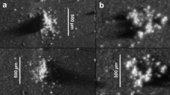
ESA’s Rosetta mission is providing unique insight into the life cycle of a comet’s dusty surface, watching 67P/Churyumov–Gerasimenko as it sheds the dusty coat it has accumulated over the past four years.
Satellites for peat’s sake

Satellites can help us to safeguard nature’s richest carbon storehouses – peatlands.
Hilltop panorama marks Mars rover’s 11th anniversary
Opportunity has driven 25.9 miles (41.7 kilometers) since it arrived at the Red Planet in 2004.
Rosetta watches comet shed its dusty coat
The mission is providing unique insight into the life cycle of Comet 67P/Churyumov-Gerasimenko’s dusty surface.
Ancient and cratered
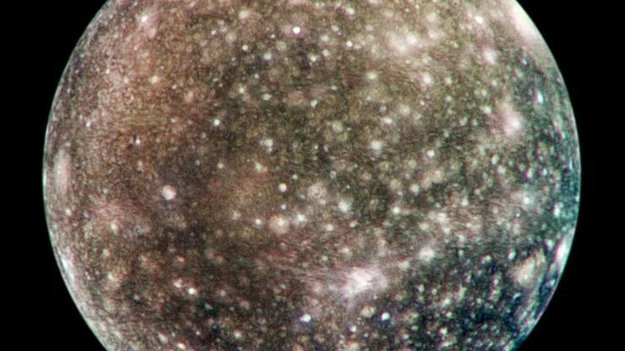
Space Science Image of the Week: NASA’s Galileo spacecraft shares a view of Jupiter’s moon Callisto, one of the worlds that will be explored by ESA’s Juice mission
Week In Images
Our week through the lens: 19-23 January 2015
Integral manoeuvres for the future

Since 2002, ESA’s Integral spacecraft has been observing some of the most violent events in the Universe, including gamma-ray bursts and black holes. While it still has years of life ahead, its fuel will certainly run out one day.
Satellites catch Austfonna shedding ice
Rapid ice loss in a remote Arctic ice cap has been detected by the Sentinel-1A and CryoSat satellites.
Getting to know Rosetta’s comet
The spacecraft is revealing Comet 67P/Churyumov-Gerasimenko as having a remarkable array of surface features and with many processes contributing to its activity, painting a complex picture of its evolution.
Rosetta Comet ‘Pouring’ More Water into Space
There has been a significant increase in the amount of water “pouring” out of the Rosetta mission’s comet.
Five Things About NASA’s SMAP
The Soil Moisture Active Passive (SMAP) mission, scheduled for launch on Jan. 29, will measure the moisture in Earth’s soil with greater accuracy and higher resolution than any preceding mission, producing a global map of soil moisture e…
Hilltop Panorama Marks Mars Rover’s 11th Anniversary
A panorama from one of the highest elevations that NASA’s Mars Exploration Rover Opportunity has reached in its 11 years on Mars includes the U.S. flag at the summit.
Helicopter Could Be ‘Scout’ for Mars Rovers
A proposed helicopter could triple the distances that Mars rovers can drive in a Martian day and help pinpoint interesting targets for study.
Getting to know Rosetta’s comet
Rosetta is revealing its host comet as having a remarkable array of surface features and with many processes contributing to its activity, painting a complex picture of its evolution.
Earth from Space
Join us Friday, 23 January, at 10:00 CET for the ‘Earth from Space’ video programme. Discover the largest glacier in the Alps in this week’s programme
Chandra celebrates the International Year of Light
Organizations, institutions, and individuals involved in the science and applications of light will be joining together for this yearlong celebration.
Black hole on a diet creates a “changing look” quasar
Until now, scientists have been unable to study both the bright and dim phases of a quasar in a single source.
Comet close-ups

High-resolution images from ESA’s Rosetta spacecraft reveal an incredible array of surface features on the comet
Mysteries in Nili Fossae
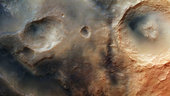
These new images from the high-resolution stereo camera on ESA’s Mars Express show Nili Fossae, one of the most enticing regions on Mars. This ‘graben system’ lies northeast of the volcanic region of Syrtis Major on the northwestern edge of the large Isidis impact basin – and intriguing hints of methane have been seen here.
NASA, Microsoft Collaboration Will Allow Scientists to ‘Work on Mars’
NASA and Microsoft have teamed up to develop software called OnSight, a new technology that will enable scientists to work virtually on Mars using wearable technology called Microsoft HoloLens.
Gullies on Vesta Suggest Past Water-Mobilized Flows
Protoplanet Vesta, visited by NASA’s Dawn spacecraft from 2011 to 2013, was once thought to be completely dry, incapable of retaining water because of the low temperatures and pressures at its surface.
SPIDER Experiment Touches Down in Antarctica
An instrument called SPIDER just landed after 16 days drifting in the wind above Antarctica, searching for signs of inflation in the earliest moments of the universe.
Let there be light
Technology image of the week: a laser from ESA’s Optical Ground Station, illuminating the future of optical communications
Telescope on NASA’s SDO collects its 100 millionth image
The Atmospheric Imaging Assembly, which uses four telescopes working parallel to gather eight images of the Sun, cycles through 10 different wavelengths every 12 seconds.
Telescope To Seek Dust Where Other Earths May Lie
The journey to find worlds ripe for life begins in part by following a trail of dust.
Winter tracking

Human spaceflight and operations image of the week: ESA’s Kiruna station in the snow
Thomas and Luca
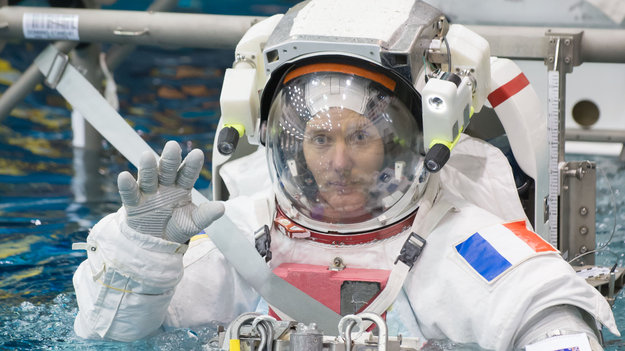
Image gallery of ESA astronaut Thomas Pesquet spacewalk training at NASA’s Johnson Space Center with veteran ESA spacewalker Luca Parmitano
Dawn delivers new image of Ceres
This is the first in a series of images that will be taken for navigation purposes during the approach to Ceres.
Dawn delivers new image of Ceres
This is the first in a series of images that will be taken for navigation purposes during the approach to Ceres.
Destination: Moon

An eight-minute film of the past, present and future of Moon exploration, from the lunar cataclysm to ESA’s vision of what lunar exploration could be
Dawn Delivers New Image of Ceres
As NASA’s Dawn spacecraft closes in on Ceres, new images show the dwarf planet at 27 pixels across, about three times better than the calibration images taken in early December.
An ecosystem in a box

An unusual package was delivered to a hotel in Beijing, China, in 1987 containing a batch of blue–green algae that would spend five days in space in a capsule. The ESA-led MELiSSA project was on its way.
A stormy shape-shifter

Space Science Image of the Week: ESA’s Venus Express spacecraft snapped this image in 2007 of a rapidly shape-shifting vortex at Venus’ south pole
Snapshot of cosmic burst of radio waves
The theories are now that the radio wave burst might be linked to a compact type of object — such as neutron stars or black holes — and the bursts could be connected to collisions or “star quakes.”
NEOWISE: A yearlong look at the sky
The spacecraft discovered and characterized 40 near-Earth objects in the first year after the mission was restarted.
‘Lost’ 2003 Mars Lander Found by Mars Reconnaissance Orbiter
The Beagle 2 Mars Lander, built by the United Kingdom, has been thought lost on Mars since 2003, but has now been found in images from NASA’s Mars Reconnaissance Orbiter.
NASA SMAP Observatory Ready for Launch
The launch of NASA’s Soil Moisture Active Passive (SMAP) mission at Vandenberg Air Force Base (VAFB) in California is scheduled for Thursday, Jan. 29.
NuSTAR Principal Investigator Receives Astrophysics Prize
The 2015 Rossi Prize has been awarded to Fiona Harrison, the principal investigator of NASA’s Nuclear Spectroscopic Telescope Array, or NuSTAR.
DG Briefing replay
Watch the replay of ESA DG’s traditional start-of-year media briefing on the activities for 2015, Friday 16 January.
Week In Images
Our week through the lens: 12-16 January 2015
New Horizons begins first stages of Pluto encounter
The “optical navigation” campaign that starts January 25 will mark the first time pictures from the spacecraft will be used to help pinpoint Pluto’s location.
Three nearly Earth-sized planets found orbiting nearby star
The outermost planet orbits in the “Goldilocks” zone, a region where surface temperatures could be moderate enough for liquid water and perhaps life to exist.
Beagle-2 lander found on Mars
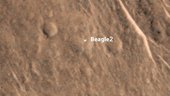
The UK-led Beagle-2 Mars lander, which hitched a ride on ESA’s Mars Express mission and was lost on Mars since 2003, has been found in images taken by a NASA orbiter at the Red Planet.
Rejigging the Cluster quartet

Aiming to study Earth’s ‘bow shock’ in the solar wind, the constellation of Cluster satellites is being rejigged to bring two of the four to within almost touching distance.
NEOWISE: A Yearlong Look at the Sky
A NASA spacecraft using infrared imaging discovered 40 near-Earth objects in one year and observed many others, including a comet that has become this month’s brightest.
NASA’s New Horizons Begins First Stages of Pluto Encounter
NASA’s New Horizons spacecraft is entering the first of several approach phases, culminating July 14 with the first close-up flyby of the dwarf planet Pluto.