It is shown that the Bell inequalities are closely related to the triangle inequalities involving
distance functions amongst pairs of random variables with values ##IMG##
[http://ej.iop.org/images/0143-0807/37/5/055402/ejpaa29fdieqn1.gif] {${0,1}$}…
Relativistic version of the Feynman–Dyson–Hughes derivation of the Lorentz force law and Maxwell’s homogeneous equations
The canonical Poisson bracket algebra of four-dimensional relativistic mechanics is used to derive
the equation of motion for a charged particle, with the Lorentz force, and the homogeneous Maxwell
equations.
On the vector model of angular momentum
Instead of (or in addition to) the common vector diagram with cones, we propose to visualize the
peculiarities of quantum mechanical angular momentum by a completely quantized 3D model. It
spotlights the discrete eigenvalues and noncommutativity of c…
Underground and wet

Human spaceflight and robotic exploration image of the week: Astronauts from five nations get wet during ESA’s underground training course
Hubble nets a cosmic tadpole
Tadpole galaxies are rare and difficult to find in the local universe.
These chemicals could be the calling card for extraterrestrial life
To find alien life, we may want to scour for the right chemistry.
Find out how the first galaxies came together in three minutes
Minute Physics pieces together what we know about the great-great-grandfathers of galaxies that we see today.
When it comes to brown dwarfs, “how far?” is a key question
They are of particular interest to scientists because they can offer clues to star-formation processes.
NASA Maps California Drought Effects on Sierra Trees
A new map created with measurements from an airborne instrument developed by NASA’s Jet Propulsion Laboratory, Pasadena, California, reveals the devastating effect of California’s ongoing drought on Sierra Nevada conifer forests.
Growing Arctic Carbon Emissions Could Go Unobserved
Winter changes in Arctic carbon dioxide may accelerate global warming. Scientists could detect these changes by aircraft with ongoing monitoring programs.
NASA Rover Findings Point to a More Earth-like Martian Past
Chemicals found in Martian rocks by NASA’s Curiosity Mars rover suggest the Red Planet once had more oxygen in its atmosphere than it does now.
In full flight
Space Science Image of the Week: Testing the parachute that will slow Schiaparelli for a Mars landing
Explicit Derivation of Duality between a Free Dirac Cone and Quantum Electrodynamics in (2+1) Dimensions
Author(s): David F. Mross, Jason Alicea, and Olexei I. MotrunichTheoretical work reveals a surprising relationship between the physics of fermionic vortices and quantum electrodynamics.[Phys. Rev. Lett. 117, 016802] Published Mon Jun 27, 2016
NASA rover findings point to a more Earth-like martian past
Researchers found high levels of manganese oxides by using a laser-firing instrument on the rover.
How researchers used a simulated universe to learn more about real black holes
To dig to the bottom of the LIGO merger, researchers at Durham University created a universe.
NASA Weighs Use of Rover to Image Potential Mars Water Sites
NASA is weighing using the Curiosity Mars rover to capture images of dark streaks present on some higher slopes of Mount Sharp that may be potential water sites.
NASA’s Juno Spacecraft Closing in on Jupiter
Today (6/24), at exactly 9:57 and 48 seconds a.m. PDT, NASA’s Juno spacecraft was 5.5 million miles (8.9 million kilometers) from its July 4th appointment with Jupiter.
NASA Technology Applied in Breast Cancer Study
Getting spacecraft ready for launch may have more to do with medical research than you think.
Prediction and Control of Slip-Free Rotation States in Sphere Assemblies
Author(s): D. V. Stäger, N. A. M. Araújo, and H. J. Herrmann
Spinning a few spheres among a large collection of them can lead to a predictable state where each sphere rotates in synch with the others.
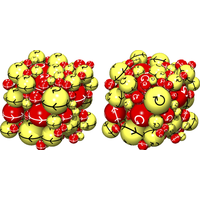
[Phys. Rev. Lett. 116, 254301] Published Fri Jun 24, 2016
Effects of Nonlinear Inhomogeneity on the Cosmic Expansion with Numerical Relativity
Author(s): Eloisa Bentivegna and Marco BruniCosmologists have begun using fully relativistic models to understand the effects of inhomogeneous matter distribution on the evolution of the Universe.[Phys. Rev. Lett. 116, 251302] Published Fri Jun 24, 2016
Week In Images
Our week through the lens: 20-24 June 2016
NASA extends Hubble Space Telescope science operations contract
The agency awarded a sole source contract extension to the Association of Universities for Research in Astronomy for continued Hubble science operations support at the Space Telescope Science Institute in Baltimore.
Reply to Comment on ?Modelling the magnetic dipole?
The claim that the model of a pair of fictitious magnetic charges, described in our recent paper, is
that of an infinitely thin solenoid is a mistake, mainly based on misinterpretation of certain
figures therein.
Comment on ?Modeling the magnetic dipole?
The model which Seleznyova et al (2016 Eur. J. Phys. 37 025203
[http://dx.doi.org/10.1088/0143-0807/37/2/025203] ) claim to consist of two oppositely charged
magnetic monopoles is in fact a model of an infinitely thin solenoid.
Reply to Comment on ‘Modelling the magnetic dipole’
The claim that the model of a pair of fictitious magnetic charges, described in our recent paper, is
that of an infinitely thin solenoid is a mistake, mainly based on misinterpretation of certain
figures therein.
Comment on ‘Modeling the magnetic dipole’
The model which Seleznyova et al (2016 Eur. J. Phys. 37 025203
[http://dx.doi.org/10.1088/0143-0807/37/2/025203] ) claim to consist of two oppositely charged
magnetic monopoles is in fact a model of an infinitely thin solenoid.
Underground astronauts preparing for space

We usually send them 400 km up, but next week ESA will be sending six astronauts 800 m underground into the rocky caves of Sardinia, Italy. The caving course recreates aspects of a space expedition with an international crew and has become an essential part of ESA’s astronaut training.
This year’s participants are ESA astronaut Pedro Duque, NASA astronauts Jessica Meir and Richard Arnold, Japanese astronaut Aki Hoshide, Chinese astronaut Ye Guangfu and cosmonaut Sergei Korsakov.
Earth from Space

Join us Friday, 24 June, at 10:00 CEST for the ‘Earth from Space’ video programme. This week features a Sentinel-3A image of the Mediterranean
Here’s why Juno is taking a deep, dangerous dive into Jupiter’s magnetic fields
To accomplish its mission, NASA’s new Jupiter probe needs to put itself on the line dozens of times.
New dark spots appear on Neptune’s cloud layers
Hubble spied a new feature on the dark blue ice giant.
Qatar exoplanet project announces the discovery of three new exoplanets
The three new hot Jupiters are the first discovered by Qatar since 2011.
NASA Scientists Discover Unexpected Mineral on Mars
Scientists have discovered an unexpected mineral in a rock sample at Gale Crater on Mars, a finding that may alter our understanding of how the planet evolved.
Floating Piers

The Sentinel-2A satellite captured creation of the ‘Floating Piers’ installation on Lake Iseo by the Bulgarian–American artist, Christo
Sentinel space testing
Technology image of the week: Sentinel-2B being lowered into Europe’s largest vacuum chamber for testing
We now know a little about the stars that made gravitational wave black holes
What formed the black holes that formed detected gravitational waves?
An ocean for Pluto and a thinner ice shell on Enceladus
Plenty of good news for our ocean worlds!
Astronomers watched a black hole gobble a star in unprecedented detail
Black holes are a giant X-ray beacon … and an X-ray telescope caught one in the act.
Sentinel-1 satellites combine radar vision
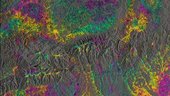
The twin Sentinel-1 satellites have – for the first time – combined to show their capability for revealing even small deformations in Earth’s surface.
Sensing Orion

European Service Module testing at NASA’s Plum Brook Station
Persistent Superfluid Flow Arising from the He-McKellar-Wilkens Effect in Molecular Dipolar Condensates
Author(s): A. A. Wood, B. H. J. McKellar, and A. M. Martin
A new technique is proposed that would allow persistent flows to be generated in dipolar Bose-Einstein condensates confined in a toroidal trap.
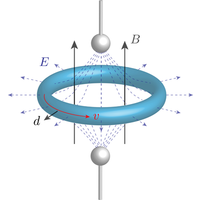
[Phys. Rev. Lett. 116, 250403] Published Tue Jun 21, 2016
A never-before-seen magnetar nebula was just discovered
The most powerful magnets in the universe are caught red-handed with a cloud of debris from the supernova that birthed them.
Electric winds turn Venus into even more of a hellscape
While the lower levels are already bone dry, electric winds make sure the upper atmosphere stays cooked too.
Salts on Mars could pose unseen hazards to explorers
It may leave some water on Mars, but could be toxic to humans living there.
Measuring nonlinear oscillations using a very accurate and low-cost linear optical position transducer
An accurate linear optical displacement transducer of about 0.2 mm resolution over a range of ∼40 mm
is presented. This device consists of a stack of thin cellulose acetate strips, each strip
longitudinally slid ∼0.5 mm over the precedent one so …
The Hubble party balloon and the expanding universe
We show that the metaphor of the inflated balloon used to describe expanding space-time according to
the Hubble law can be transformed into a simple laboratory experiment. We obtain, in terms of
measured recession speeds and distances of ink dots dra…
Yet another encounter with the golden ratio: balancing laminar bodies on the edge
If one removes a regular even sided polygon from a larger self-similar polygon then the excised
polygon can be balanced on the edge provided the ratio of the sides of the larger to the smaller
polygon is the golden ratio. Such an excision can be carr…
A simple model of a swing
The paper presents a simple model of a swing meant for undergraduates’ educational experiments. The
purpose of these experiments is the experimental study of physical principles of self-oscillations,
free, forced and parametric oscillations. The mo…
Ice cubes on drinks cans—the question
In this question we are investigating thermal conduction and latent heat. What happens when ice
cubes are placed on top of drinks cans in saucers of warm water?
Backwards clock in a plane mirror—the answer
In my article (Featonby 2016 Phys. Educ . 51 037002) I asked what happens when you view a backward
clock in a plane mirror? Will the motion be clockwise or anticlockwise?
Reviews
Description unavailable
NASA’s K2 Finds Newborn Exoplanet Around Young Star
Astronomers have discovered the youngest fully formed exoplanet ever detected.
Tim Peake meets the media
Replay: ESA astronaut Tim Peake meets the media at the European Astronaut Centre for the first time since landing back on Earth
Role of the Membrane for Mechanosensing by Tethered Channels
Author(s): Benedikt Sabass and Howard A. StoneA tiny conical deformation in a channel embedded in a lipid membrane can give rise to a significant energy release when the channel opens.[Phys. Rev. Lett. 116, 258101] Published Mon Jun 20, 2016
The spider in the loop

Space Science Image of the Week: This Planck view of the North Celestial Loop shows its wispy filaments in detail, including a feature nicknamed ‘the Spider’
A young super-Neptune offers clues to the origin of close-in exoplanets
A team of astronomers has confirmed the existence of a young planet approximately 5 times the size of Earth.
Astrophysicists release new study of one of the first stars
In all likelihood, the first stars that formed in the Milky Way will never be directly observed.
Ariane 5 delivers its heaviest commercial payload

On its third mission this year, Ariane 5 lofted more than 10.7 tonnes – its heaviest commercial cargo so far.
Soyuz TMA-19M landing
Watch replay of ESA astronaut Tim Peake, NASA astronaut Tim Kopra and commander Yuri Malenchenko fall back to Earth
Back on Earth
Image gallery: ESA astronaut Tim Peake, NASA astronaut Tim Kopra and Russian Soyuz commander Yuri Malenchenko landed safely today
Tim Peake returns to Earth
ESA astronaut Tim Peake, NASA astronaut Tim Kopra and Russian Soyuz commander Yuri Malenchenko landed safely today in the Kazakh steppe after a three-hour ride in their Soyuz spacecraft. They left the International Space Station at 05:52&n…
Tim’s Top 20

Tim Peake’s best photos from space chosen and commented on by professional photographer Max Alexander
Time Dependence of the Electron and Positron Components of the Cosmic Radiation Measured by the PAMELA Experiment between July 2006 and December 2015
Author(s): O. Adriani et al.
Discrepancies in the positron content of cosmic rays measured at different times are explained by the periodic reversal of the solar magnetic field’s direction.
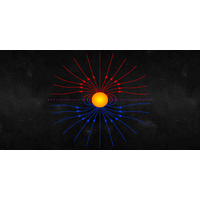
[Phys. Rev. Lett. 116, 241105] Published Fri Jun 17, 2016
Week In Images
Our week through the lens: 13-17 June 2016
A bevy of unexpected gas giants hide in a nearby star cluster
The denser environment in a cluster will cause more frequent interactions between planets and nearby stars, which may explain the excess of hot Jupiters.
NASA’s Juno Spacecraft to Risk Jupiter’s Fireworks for Science
On July 4, NASA will fly a solar-powered spacecraft the size of a basketball court within 2,900 miles (4,667 kilometers) of the cloud tops of our solar system’s largest planet.
Live: Tim returns to Earth
Watch the return of ESA astronaut Tim Peake, NASA astronaut Tim Kopra and Soyuz spacecraft commander Yuri Malenchenko on Saturday.
Over the rainbow

Operations image of the week: ESA’s deep-space tracking station in Argentina framed by a rainbow and highlighted by the Sun
Made for Mercury
Technology image of the week: the shiny face of Japan’s contribution to the BepiColombo mission to Mercury, currently being tested at ESA
Earth from Space
Join us Friday, 17 June, at 10:00 CEST for the ‘Earth from Space’ video programme. This week features a Sentinel-2A image of the southern Tibetan Plateau
A planet burning hotter than a star is on a death spiral
A young giant sun cooks its planet hotter than some stars.
Small asteroid is Earth’s constant companion
Researchers’ calculations indicate 2016 HO3 has been a stable quasi-satellite of Earth for almost a century.
ExoMars sets sights on the Red Planet
ExoMars captured its first images of Mars this week as part of its preparations for arriving at the Red Planet in October.
It may take 1500 years to meet E.T.
It is highly probable that the human race will hear from aliens, but it may not be for a while.
The one dimensional Schr?dinger equation: symmetries, solutions and Feynman propagators
A simple method to find the symmetries of the Schr?dinger equation in one dimension with arbitrary
potentials is presented. The method hereby used can be of interest to students in quantum mechanics
at the undergraduate level. Several physical questi…
The ?twin paradox? in relativistic rigid motion
Relativistic rigid motion suggests a new version for the so-called ?twin paradox?, comparing the
ages of two astronauts on a very long spaceship. Although there is always an instantaneous inertial
frame in which the whole spaceship, being rigid, is s…
The ‘twin paradox’ in relativistic rigid motion
Relativistic rigid motion suggests a new version for the so-called ‘twin paradox’, comparing the
ages of two astronauts on a very long spaceship. Although there is always an instantaneous inertial
frame in which the whole spaceship, being rigid, …
The one dimensional Schrödinger equation: symmetries, solutions and Feynman propagators
A simple method to find the symmetries of the Schrödinger equation in one dimension with arbitrary
potentials is presented. The method hereby used can be of interest to students in quantum mechanics
at the undergraduate level. Several physical quest…
What do the stars look like from Mars?
The Mars-like deserts of the American Southwest are some of Earth’s most iconic stargazing grounds. Far from pestering city lights and free from regular cloud cover, they provide a starry-skied sanctuary for lovers of the night.
So, it would stan…
Small Asteroid Is Earth’s Constant Companion
A small asteroid has been discovered in an orbit around the sun that keeps it as a constant companion of Earth, and it will remain so for centuries to come.
Could dark matter really be first generation black holes?
One physicist believes LIGO-like black holes could be the “missing mass” long sought by particle physicists. Not everyone is so sure.
GW151226: Observation of Gravitational Waves from a 22-Solar-Mass Binary Black Hole Coalescence
Author(s): B. P. Abbott et al. (LIGO Scientific Collaboration and Virgo Collaboration)
LIGO has detected a second burst of gravitational waves from merging black holes, suggesting that such detections will soon become routine and part of a new kind of astronomy.
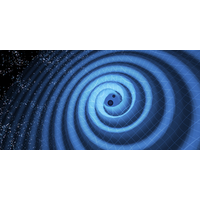
[Phys. Rev. Lett. 116, 241103] Published Wed Jun 15, 2016
Planet-devouring star reveals possible limestone crumbs
Researchers found that the rocky material being accreted by the star could be comprised of minerals that are typically associated with marine life processes here on Earth.
LIGO Detects a Second Set of Gravitational Waves
The detection bolsters the search for more black hole mergers and ripples in space-time.
A little help from friends

ESA’s first Mars orbiter will provide an important helping hand when the second arrives at the Red Planet in October.
Substellar brown dwarfs can still pack a star-like punch
A brown dwarf was found with “solar” flares that outshine our own sun, despite not making the grade as a star.
Smaller stars may not be the best parents for would-be planets
Chandra finds powerful X-rays that may disrupt the formation of exoplanets around smaller stars.
Comment on ?Limitations on the superposition principle: superselection rules in non-relativistic quantum mechanics?
Description unavailable
Comment on ‘Limitations on the superposition principle: superselection rules in non-relativistic quantum mechanics’
Description unavailable
Rover Opportunity Wrapping up Study of Martian Valley
“Marathon Valley,” slicing through a large crater’s rim on Mars, has provided fruitful research targets for NASA’s Opportunity rover since July 2015, but the rover may soon move on.
A First: NASA Spots Single Methane Leak from Space
For the first time, an instrument onboard an orbiting spacecraft has measured the methane emissions from a single, specific leaking facility on Earth’s surface.
Gluttonous Star May Hold Clues to Planet Formation
Astronomers have gained a new perspective on the behavior of outbursting star FU Orionis, using data from an airborne observatory and a space telescope.
Properties of the Binary Black Hole Merger GW150914
Author(s): B. P. Abbott et al. (LIGO Scientific Collaboration and Virgo Collaboration)
The LIGO and Virgo collaborations determine the properties and location of the black-hole-binary merger that was the source of their detection of gravitational waves.
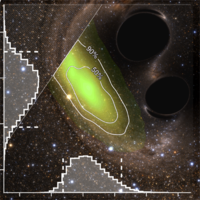
[Phys. Rev. Lett. 116, 241102] Published Tue Jun 14, 2016
These Experiments Are Building the Case to Terraform Mars
If we want to live on Mars, we need to make it warm and wet again.
Astronomers find first evidence of chiral chemistry in distant cosmic cloud
An organic (if toxic) alcohol could point the way toward finding more “handed” molecules — the kind that make up RNA, DNA, and other building blocks to life.
Newly discovered “Tatooine” is the largest ever found
Kepler-1647b, the largest exoplanet to orbit two suns has been found with an orbital period of 3 years
Ancient volcanos on Mars burned very, very hot
Curiosity has discovered a mineral that infers high-temperature volcanism occurred on the Red Planet.
Comment on ?Exact electromagnetic fields produced by a finite wire with constant current?
This comment addresses the Jim?nez et al paper (2008 Eur. J. Phys. 29 163?75
[http://dx.doi.org/10.1088/0143-0807/29/1/017] ). We correct these authors? expressions for the
electric field and the Poynting vector, and also correct their expressions fo…
Einstein in Nottingham
A correction to the book review of An Einstein Encyclopaedia (Marshall R 2016 Phys. Educ . 51
[http://dx.doi.org/10.1088/0031-9120/51/2/026001] 026001
[http://dx.doi.org/10.1088/0031-9120/51/2/026001] ).
Comment on ‘Exact electromagnetic fields produced by a finite wire with constant current’
This comment addresses the Jiménez et al paper (2008 Eur. J. Phys. 29 163–75
[http://dx.doi.org/10.1088/0143-0807/29/1/017] ). We correct these authors’ expressions for the
electric field and the Poynting vector, and also correct their expressio…
NASA Mars Rover Descends Plateau, Turns Toward Mountain
NASA’s Curiosity Mars rover has analyzed its 12th drilled sample of Mars. This sample came from mudstone bedrock, which the rover resumed climbing in late May after six months studying other features.