This paper reports the use of Tracker as a computer-based learning tool to support effective
learning and teaching of ?toss up? and free fall motion for beginning secondary three (15?year-old)
students. The case study involved ( N = 123) students from express pure physics classes at a
mainstream school in Singapore. We used eight multiple-choice questions pre- and post-test to gauge
the impact on learning. The experimental group showed learning gains of d = 0.79?????0.23 (large
effect) for Cohen?s d effect size analysis, and gains with a gradient of?< g >? total =
0.42?????0.08 (medium gain) above the traditional baseline value of?< g >? non interactive = 0.23
for Hake?s normalized gain regression analysis. This applied to all of the teachers and students who
participated in this study. Our initial research findings suggest that allowing learners to relate
abstract physics concepts to real life through coupling traditi…
An apparatus for constructing an electromagnetic plane wave model
In this paper we report on an activity aimed at building an electromagnetic wave. This was part of a
class on the concept of mass offered to a group of 20 pre-service Brazilian physics teachers. The
activity consisted of building a plane wave using a…
Low-cost educational robotics applied to physics teaching in Brazil
In this paper, we propose some of the strategies and methodologies for teaching high-school physics
topics through an educational robotics show. This exhibition was part of a set of actions promoted
by a Brazilian government program of incentive for …
Teaching the absorption of light colours using an artificial rainbow
This paper presents an experimental activity based on the absorption of light colours by pigments.
The activity is constructed using a stepwise design and offers an opportunity for students and
teachers to compare and generalize the interactions betw…
A conductive gel for the plotting of equipotential lines
This paper presents the development of a conductive gel that can be used to measure the electrical
potential differences on its surface, and has enough consistency to plot equipotential lines. It has
a gelation time of less than 10?min, and is suitab…
Thermal cameras in school laboratory activities
Thermal cameras offer real-time visual access to otherwise invisible thermal phenomena, which are
conceptually demanding for learners during traditional teaching. We present three studies of
students? conduction of laboratory activities that employ t…
Mathematical modeling is also physics?interdisciplinary teaching between mathematics and physics in Danish upper secondary education
Mathematics plays a crucial role in physics. This role is brought about predominantly through the
building, employment, and assessment of mathematical models, and teachers and educators should
capture this relationship in the classroom in an effort t…
Einstein versus the simple pendulum formula: does gravity slow all clocks?
According to the Newtonian formula for a simple pendulum, the period of a pendulum is inversely
proportional to the square root of g , the gravitational field strength. Einstein?s theory of
general relativity leads to the result that time slows down …
Cassini Sends Back Views After Zooming Past Dione
The rugged landscape of Saturn’s fracture-faced moon Dione is revealed in images sent back by NASA’s Cassini spacecraft from its latest flyby.
Jason-3 Satellite Arrives at California Launch Site
The newest addition to a venerable line of ocean-monitoring satellites has arrived at its launch site in California to prepare for its launch in August.
NASA Joins North Sea Oil Cleanup Training Exercise
A NASA aircraft joined a Norwegian oil spill cleanup exercise, testing a scientific instrument’s ability to recognize more and less damaging types of oil slicks.
Rydberg Electrons in a Bose-Einstein Condensate
Author(s): Jia Wang, Marko Gacesa, and R. Côté
Atoms in a condensate could be used to image the quantum wave function of an impurity charge.
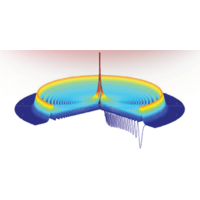
[Phys. Rev. Lett. 114, 243003] Published Thu Jun 18, 2015
Engineering a Spin-Orbital Magnetic Insulator by Tailoring Superlattices
Author(s): J. Matsuno, K. Ihara, S. Yamamura, H. Wadati, K. Ishii, V. V. Shankar, Hae-Young Kee, and H. Takagi
The magnetic ordering temperature of complex iridates decreases as SrTiO3 spacer layers are inserted between perovskite SrIrO3 layers. At a crticial number of spacers the material transitions from an insulator to a semimetal.
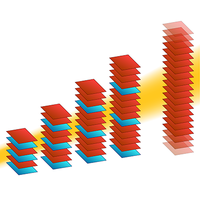
[Phys. Rev. Lett. 114, 247209] Published Thu Jun 18, 2015
Le Bourget in images

ESA at the Paris Air &Space Show – the week in images
Hot lava flows discovered on Venus
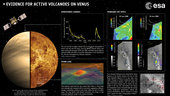
ESA’s Venus Express has found the best evidence yet for active volcanism on Earth’s neighbour planet.
Earth from Space

Join us Friday, 19 June, at 10:00 CEST for the ‘Earth from Space’ video programme. This week we explore the San Francisco Bay Area in the US state of California
From ESA: more than 300 new companies

ESA’s business incubators hit a milestone this month: they have now fostered 300 start-up companies – and more are joining all the time.
ALMA weighs supermassive black hole at center of distant spiral galaxy
Researchers determined that galaxy NGC 1097 harbors a black hole 140 million times more massive than our Sun.
Exoplanet smaller than Earth gets its size and mass measured
Kepler-138b is less than a tenth of Earth’s mass and half its size.
Invisible rain

Technology image of the week: VIP visitors to the ESA pavilion at Le Bourget peer into a ‘cloud chamber’, revealing otherwise invisible cosmic ray tracks
Le Bourget replays

Replays of key media briefings at the Paris Air & Space Show, 15-17 June
Enhancing the possibilities for learning: variation of disciplinary-relevant aspects in physics representations
In this theoretical article we propose three factors that can enhance the possibilities for learning
physics from representations, namely: (1) the identification of disciplinary-relevant aspects for a
particular disciplinary task, such as solving a p…
Using scaling to compute moments of inertia of symmetric objects
Moment of inertia is a very important property in the study of rotational mechanics. The concept of
moment of inertia is analogous to mass in the linear motion, and its calculation is routinely done
through integration. This paper provides an alterna…
Towards addressing transient learning challenges in undergraduate physics: an example from electrostatics
In this article we characterize transient learning challenges as learning challenges that arise out
of teaching situations rather than conflicts with prior knowledge. We propose that these learning
challenges can be identified by paying careful atten…
An equivalent spring for nonlinear springs in series
This work is concerned with nonlinear springs in series with the aim of obtaining the equivalent
spring and its characteristics. The case of two linear springs in series is presented first as a
basis for the extension to the cases of two purely nonli…
Gauge invariance in simple mechanical systems
This article discusses and explains the Hamiltonian formulation for a class of simple gauge
invariant mechanical systems consisting of point masses and idealized rods. The study of these
models may be helpful to advanced undergraduate or graduate stu…
All Systems Go for NASA’s Mission to Jupiter Moon Europa
Europa is considered one of the most promising places in the solar system to search for signs of present-day life, and a new NASA mission to explore this potential is moving forward.
International Spacecraft Carrying NASA’s Aquarius Instrument Ends Operations
Aquarius/SAC-D, an international Earth-observing mission that carries NASA’s Aquarius instrument, ended June 8 when an essential component of the spacecraft power and attitude control system stopped operating.
Optical Polarization of Nuclear Spins in Silicon Carbide
Author(s): Abram L. Falk, Paul V. Klimov, Viktor Ivády, Krisztián Szász, David J. Christle, William F. Koehl, Ádám Gali, and David D. Awschalom
An optical technique polarizes the spin of nuclei in silicon carbide, offering a potential new route to nuclear spin-based quantum memory.
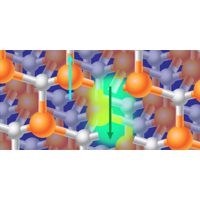
[Phys. Rev. Lett. 114, 247603] Published Wed Jun 17, 2015
Dissolving Titan
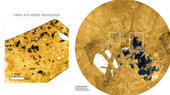
Saturn’s moon Titan is home to seas and lakes filled with liquid hydrocarbons, but what makes the depressions they lie in? A new study suggests that the moon’s surface dissolves in a similar process that creates sinkholes on Earth.
Rosetta replay
Watch the Rosetta mission press briefing held at Le Bourget on 17 June, including a status report on Philae lander
Best observational evidence of first-generation stars in the universe
A bright, distant galaxy shows evidence of harboring these massive, previously purely theoretical stars that were the creators of the elements necessary to forge the cosmos we see today.
Scientists find methane in Mars meteorites
The discovery hints at the possibility that methane could be used as a food source by rudimentary forms of life beneath the martian surface.
Sentinel-2A poised high
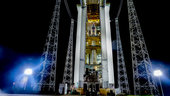
With less than a week to liftoff, the next Sentinel satellite for the Copernicus environmental monitoring programme is now in position high up in the launch tower at Europe’s Spaceport in Kourou, French Guiana.
Hot firing of world’s first 3D-printed platinum thruster chamber

The world’s first spacecraft thruster with a platinum combustion chamber and nozzle made by 3D printing has passed its baptism of fire with a series of firings lasting more than an hour and 618 ignitions.
Different faces of Pluto emerging in new images from New Horizons
The photos show an increasingly complex surface with clear evidence of discrete equatorial bright and dark regions.
Study: Third of Big Groundwater Basins in Distress
UC Irvine studies using NASA GRACE data find a third of Earth’s largest groundwater basins are being rapidly depleted by human use, despite little data about how much water remains.
NASA ‘Eyes’ Study Louisiana’s Changing Wetlands
NASA has completed an intensive study of Louisiana Gulf Coast levees and wetlands, using three advanced instruments on two research aircraft.
EDRS roundtable
Replay of discussion at the Paris Air Show on the European Data Relay System and its future services and business opportunities
IXV first results
Replay of media briefing at the Paris Air Show on the first results from the Intermediate eXperimental Vehicle
Rosetta briefing
Watch a briefing from the Rosetta team at ESA’s pavilion at Le Bourget, including the latest results and what lies ahead. Streaming starts 09:30 CEST.
ESA spaceplane on display

The February flight of ESA’s Intermediate eXperimental Vehicle is yielding invaluable insights and results for future reentry craft.
Strong Asymmetric Charge Carrier Dependence in Inelastic Electron Tunneling Spectroscopy of Graphene Phonons
Author(s): Fabian D. Natterer, Yue Zhao, Jonathan Wyrick, Yang-Hao Chan, Wen-Ying Ruan, Mei-Yin Chou, Kenji Watanabe, Takashi Taniguchi, Nikolai B. Zhitenev, and Joseph A. StroscioInelastic electron tunneling spectroscopy has mapped the phonon density …
Particle Dark Matter Searches Outside the Local Group
Author(s): Marco Regis, Jun-Qing Xia, Alessandro Cuoco, Enzo Branchini, Nicolao Fornengo, and Matteo Viel
The most sensitive limits on dark matter annihilation rate could be obtained by cross-correlating γ-ray emission from dark matter with their gravitational fingerprint in the distribution of low redshift galaxies.
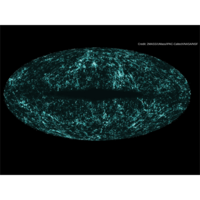
[Phys. Rev. Lett. 114, 241301] Published Tue Jun 16, 2015
Identification of Patient Zero in Static and Temporal Networks: Robustness and Limitations
Author(s): Nino Antulov-Fantulin, Alen Lančić, Tomislav Šmuc, Hrvoje Štefančić, and Mile Šikić
A new model could help narrow down the source of a disease outbreak.
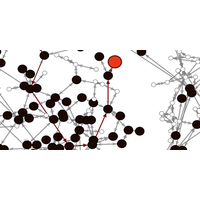
[Phys. Rev. Lett. 114, 248701] Published Tue Jun 16, 2015
Where Philae phones home
Human spaceflight and operations image of the week: Engineers in the Rosetta control room on watch for Philae signals
Lab mimicry opens a window to the deep interiors of stars and planets
A team of scientists used techniques to mimic stellar and planetary conditions to observe how noble gases behave in order to better understand the atmospheric and internal chemistry of these celestial objects.
ESA at Le Bourget
Watch key events in ESA’s pavilion at the Paris airshow: today, ESA IXV results and EDRS roundtable. Streaming starts at 15:00 CEST
Asteroid Icarus to Make Distant Pass Tuesday
Asteroid Icarus will safely pass by Earth more than 21 times the distance of Earth to the moon on June 16.
Rosetta’s Lander Philae Wakes From Comet Nap
Rosetta’s Philae lander wakes up from hibernation on comet 67P/Churyumov-Gerasimenko.
Saturn Spacecraft to Buzz Icy Moon Dione June 16
NASA’s Cassini spacecraft will make a close flyby of Saturn’s moon Dione on June 16, coming within 321 miles (516 kilometers) of the moon’s surface.
Replay DG briefing
Replay of the media briefing with ESA DG Jean-Jacques Dordain and his successor Johann-Dietrich Woerner at the Paris airshow on 15 June
Philae wake-up triggers intense planning

The receipt of signals from Rosetta’s Philae lander on 13 June after 211 days of hibernation marked the start of intense activity. In coordination with its mission partners, ESA teams are working to juggle Rosetta’s flight plan to help with renewed lander science investigations.
Observation of a Localized Flat-Band State in a Photonic Lieb Lattice
Author(s): Sebabrata Mukherjee, Alexander Spracklen, Debaditya Choudhury, Nathan Goldman, Patrik Öhberg, Erika Andersson, and Robert R. Thomson
Strong confinement of light in crystalline structures known as Lieb lattices opens up routes to developing new light-trapping schemes.
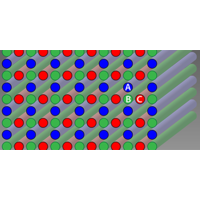
[Phys. Rev. Lett. 114, 245504] Published Mon Jun 15, 2015
Observation of Localized States in Lieb Photonic Lattices
Author(s): Rodrigo A. Vicencio, Camilo Cantillano, Luis Morales-Inostroza, Bastián Real, Cristian Mejía-Cortés, Steffen Weimann, Alexander Szameit, and Mario I. Molina
Strong confinement of light in crystalline structures known as Lieb lattices opens up routes to developing new light-trapping schemes.
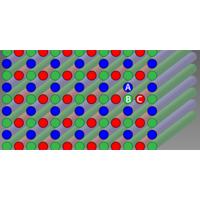
[Phys. Rev. Lett. 114, 245503] Published Mon Jun 15, 2015
Iridescent Mercury

Space Science Image of the Week: Although NASA’s Messenger mission has ended, ESA’s BepiColombo will continue the quest to understand mysterious Mercury
Helium-shrouded planets may be common in our galaxy
Researchers theorize that some “warm Neptune” exoplanets could have helium-enriched atmospheres after their hydrogen boiled off.
Rosetta’s lander Philae wakes up from hibernation
Rosetta’s lander Philae has woken up after seven months in hibernation on the surface of Comet 67P/Churyumov-Gerasimenko.
Philae wakes up!
Rosetta’s lander Philae wakes up from hibernation
Rosetta’s Philae lander wakes up from hibernation
It appears the lander also was awake once before on Comet 67P/Churyumov-Gerasimenko but couldn’t contact its team on Earth.
NASA Prepares for First Interplanetary CubeSats
When NASA launches its next mission on the journey to Mars – a stationary lander in 2016 – the flight will include the first two CubeSats sent to deep space.
Ultrasensitive Ultrafast Vibrational Spectroscopy Employing the Near Field of Gold Nanoantennas
Author(s): O. Selig, R. Siffels, and Y. L. A. Rezus
Micrometer-scale antennas made from gold may give chemists a peek into the dynamics of molecular bonds.
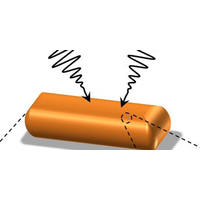
[Phys. Rev. Lett. 114, 233004] Published Fri Jun 12, 2015
Week In Images
Our week through the lens: 8-12 June 2015
Welcome home
ESA astronaut Samantha Cristoforetti back on Earth after 199 days in space
Le Bourget 2015
ESA at 51st Paris Air and Space Show
SPHERE reveals earliest stage of planetary nebula formation
These observations of the red giant star L2 Puppis also clearly show a close stellar companion.
The Hubble Telescope detects “sunscreen” layer on distant planet
The presence of a stratosphere can provide clues about the composition of a planet and how it formed.
Keeping energy clean and the countryside quiet
Thanks to expertise garnered building space telescopes powerful enough to see exoplanets, large wind turbines are now generating clean power without making a racket.
Landing highlights
ESA’s Samantha Cristoforetti, NASA’s Terry Virts and Russian commander Anton Shkaplerov exit their Soyuz after landing safely in the Kazakh steppe
Helium-Shrouded Planets May Be Common in Our Galaxy
The wacky world of exoplanets continues to surprise astronomers.
Landing replay
ESA’s Samantha Cristoforetti, NASA’s Terry Virts and Russian commander Anton Shkaplerov exit their Soyuz after landing safely in the Kazakh steppe
Emergent Spacetime Supersymmetry in 3D Weyl Semimetals and 2D Dirac Semimetals
Author(s): Shao-Kai Jian, Yi-Fan Jiang, and Hong YaoRenormalization group analysis demonstrates that space-time supersymmetry emerges at pair density wave transitions in 3D Weyl and 2D Dirac semimetals.[Phys. Rev. Lett. 114, 237001] Published Thu Jun 1…
Splitting of the Fermi Contour of Quasi-2D Electrons in Parallel Magnetic Fields
Author(s): M. A. Mueed, D. Kamburov, M. Shayegan, L. N. Pfeiffer, K. W. West, K. W. Baldwin, and R. Winkler
The two-dimensional Fermi surface for electrons confined in gallium arsenide quantum wells evolves, distorts and eventually splits in two from the presence of a strong in-plane magnetic field.
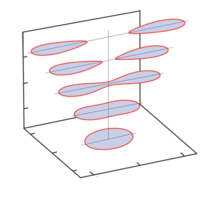
[Phys. Rev. Lett. 114, 236404] Published Thu Jun 11, 2015
Pauli-Heisenberg Oscillations in Electron Quantum Transport
Author(s): Karl Thibault, Julien Gabelli, Christian Lupien, and Bertrand ReuletTemporal correlations between electrons reveal that electrons crossing a conductor at low temperature cross it at a regular pace h/eV with a jitter h/kBT, thus providing a s…
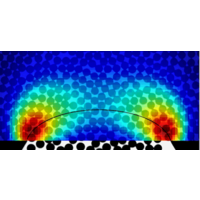
Disentangling the Free-Fall Arch Paradox in Silo Discharge
Author(s): S. M. Rubio-Largo, A. Janda, D. Maza, I. Zuriguel, and R. C. Hidalgo
The flow rate of grains from a silo depends on the stress field above the outlet and not on the free fall of grains from the bottom of the packed surface as had been previously thought.
[Phys. Rev. Lett. 114, 238002] Published Thu Jun 11, 2015
Position-Momentum Duality and Fractional Quantum Hall Effect in Chern Insulators
Author(s): Martin Claassen, Ching Hua Lee, Ronny Thomale, Xiao-Liang Qi, and Thomas P. DevereauxA first-quantized description of fractional Chern insulators is developed using the approach commonly employed in the quantum Hall effect.[Phys. Rev. Lett. …
ESA astronaut Samantha Cristoforetti back on Earth
ESA astronaut Samantha Cristoforetti, NASA astronaut Terry Virts and Russian commander Anton Shkaplerov landed safely today in the Kazakh steppe after a three-hour ride in their Soyuz spacecraft. They left the International Space Station a…
Earth from Space
Join us Friday, 12 June, at 10:00 CEST for the ‘Earth from Space’ video programme. This week, Sentinel-1A takes us over Indonesia’s Central Kalimantan province on the island of Borneo
Chandra finds evidence for serial black hole eruptions
The supermassive black hole in NGC 5813 has erupted at least three times, with the latest still occurring.
Bright spots shine in newest Dawn Ceres images
The spots consist of many individual bright points of differing sizes with a central cluster, but scientists still don’t know an explanation for them.
ESA invites ideas to cut space debris creation

Tomorrow’s satellites must evolve – because the space they operate in is changing. New regulations on cutting space debris are influencing satellite design, and ESA is reaching out to satellite builders.
Bright Spots Shine in Newest Dawn Ceres Images
New images of dwarf planet Ceres, taken by NASA’s Dawn spacecraft, show the cratered surface of this mysterious world in sharper detail than ever before.
Space Station tour teaser
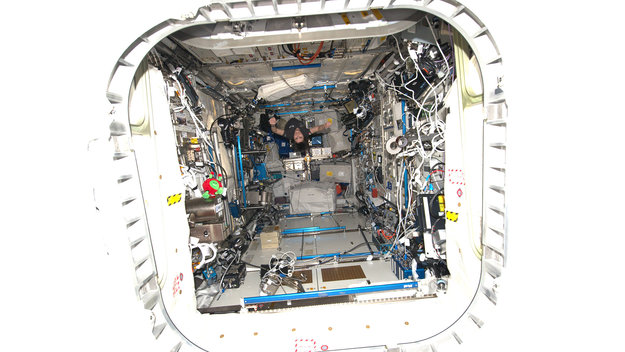
Explore ESA’s Columbus space laboratory in a new interactive panorama of the International Space Station. More modules will follow soon
Sand strike
Technology image of the week: this aluminium plate was ripped inwards by a single sand grain-sized fleck of aluminium oxide
Coherent Control of Bond Making
Author(s): Liat Levin, Wojciech Skomorowski, Leonid Rybak, Ronnie Kosloff, Christiane P. Koch, and Zohar AmitayA tailored laser pulse controls the formation of a molecular bond between two atoms.[Phys. Rev. Lett. 114, 233003] Published Wed Jun 10, 2015
Sunset jets on Rosetta’s comet
Researchers from the OSIRIS team believe that the increasing heating-up of Comet 67P is responsible for newly observed night activity.
Fly over Ceres in new video
The video is based on observations of Ceres that were taken from Dawn’s first mapping orbit.
Reply to Comment on ?The pedagogical value of the four-dimensional picture I: Relativistic mechanics of point particles?
In this reply, it is argued that the criticism against my derivation of the relativistic dynamical
law for a point particle (Kosyakov B P 2014 Eur. J. Phys. 35
[http://dx.doi.org/10.1088/0143-0807/35/2/025012] 025012 ) given in the ?Comment? by R?bil…
Amplitude response of a Fabry?Perot interferometer
The complex reflected and transmitted amplitudes from a Fabry?Perot interferometer are analysed
using a phase-space approach, in which the real and imaginary parts of those amplitudes are taken as
basic variables. As functions of the optical path len…
Comment on ?The pedagogical value of the four-dimensional picture: I. Relativistic mechanics of point particles?
A deductive approach to the relativistic law of motion presented by Kosyakov (2014 Eur. J. Phys. 35
[http://dx.doi.org/0143-0807/35/2/025012/] 025012 ) is critically analysed. We point out that the
Kosyakov argumentation is flawed and ineffective. On…
How online learning modules can improve the representational fluency and conceptual understanding of university physics students
The use of online learning resources as core components of university science courses is increasing.
Learning resources range from summaries, videos, and simulations, to question banks. Our study set
out to develop, implement, and evaluate research-b…
Entropy change for the irreversible heat transfer between two finite objects
A positive entropy change is verified for an isolated system of two blocks of different initial
temperatures and of different but finite heat capacities that are brought into contact with each
other and allowed to fully thermalize.
Comment on ‘The pedagogical value of the four-dimensional picture: I. Relativistic mechanics of point particles’
A deductive approach to the relativistic law of motion presented by Kosyakov (2014 Eur. J. Phys. 35
[http://dx.doi.org/0143-0807/35/2/025012/] 025012 ) is critically analysed. We point out that the
Kosyakov argumentation is flawed and ineffective. On…
Reply to Comment on ‘The pedagogical value of the four-dimensional picture I: Relativistic mechanics of point particles’
In this reply, it is argued that the criticism against my derivation of the relativistic dynamical
law for a point particle (Kosyakov B P 2014 Eur. J. Phys. 35
[http://dx.doi.org/10.1088/0143-0807/35/2/025012] 025012 ) given in the ‘Comment’ by R…
Rotational kinematics of a rigid body about a fixed axis: development and analysis of an inventory
We present the development, administration, and analysis of a focused inventory on the rotational
kinematics of a rigid body around a fixed axis. The inventory, which is made up of 13
multiple-choice questions, was developed on the basis of interacti…
Amplitude response of a Fabry–Perot interferometer
The complex reflected and transmitted amplitudes from a Fabry–Perot interferometer are analysed
using a phase-space approach, in which the real and imaginary parts of those amplitudes are taken as
basic variables. As functions of the optical path l…
NASA’s LDSD Project Completes Second Experimental Test Flight
Engineers are poring over the data following the second experimental landing technology test of NASA’s Low-Density Supersonic Decelerator (LDSD) project.
RoboSimian Drives, Walks and Drills in Robotics Finals
The ape-like RoboSimian robot, developed at JPL, took fifth place in the DARPA Robotics Challenge Finals.
Statistical Physics Methods Provide the Exact Solution to a Long-Standing Problem of Genetics
Author(s): Areejit Samal and Olivier C. MartinThe probabilities of obtaining genotypes with fixed alleles at specific locations via repeated inbreeding is generalized to cases involving four or more genes.[Phys. Rev. Lett. 114, 238101] Published Tue Ju…
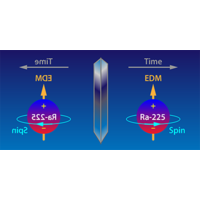
First Measurement of the Atomic Electric Dipole Moment of ^{225}Ra
Author(s): R. H. Parker, M. R. Dietrich, M. R. Kalita, N. D. Lemke, K. G. Bailey, M. Bishof, J. P. Greene, R. J. Holt, W. Korsch, Z.-T. Lu, P. Mueller, T. P. O’Connor, and J. T. Singh
Researchers have devised a new technique to look for evidence of a permanent electric dipole moment in atoms, which would signal new physics.
[Phys. Rev. Lett. 114, 233002] Published Tue Jun 09, 2015