
Just four days after being lofted into orbit, Europe’s Sentinel-2A satellite delivered its first images of Earth, offering a glimpse of the ‘colour vision’ that it will provide for the Copernicus environmental monitoring programme.
Elu, loodus, teadus ja tehnoloogia
Just four days after being lofted into orbit, Europe’s Sentinel-2A satellite delivered its first images of Earth, offering a glimpse of the ‘colour vision’ that it will provide for the Copernicus environmental monitoring programme.

A first glimpse of the Sentinel-2A satellite’s capabilities over northwestern Italy and the French Riviera
Read about the next ESA astronaut to head to the International Space Station: Andreas Mogensen’s iriss mission starts September
Last night marked the end of Sentinel-2A’s first three days in space, which saw teams on the ground working around the clock to ensure the spacecraft is ready for its ‘colour vision’ mission.
Author(s): Emanuele Berti, Richard Brito, and Vitor CardosoParticles orbiting near a spinning black hole might collide and get ejected with much more energy than previous calculations showed.[Phys. Rev. Lett. 114, 251103] Published Fri Jun 26, 2015
Author(s): Richard J. Fletcher, Martin Robert-de-Saint-Vincent, Jay Man, Nir Navon, Robert P. Smith, Konrad G. H. Viebahn, and Zoran Hadzibabic
A harmonically trapped atomic gas can transition from a BKT superfluid to a Bose-Einstein condensate by reducing the interaction strength between the atoms.
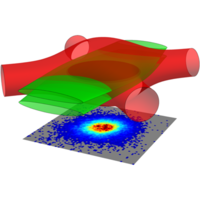
[Phys. Rev. Lett. 114, 255302] Published Fri Jun 26, 2015
Author(s): L. Adamczyk et al. (STAR Collaboration)A possible signature of chiral symmetry restoration, in the form of a chiral magnetic wave in the quark-gluon plasma, has been observed in heavy-ion collisions at RHIC.[Phys. Rev. Lett. 114, 252302] Pub…
Author(s): R. Betti, A. R. Christopherson, B. K. Spears, R. Nora, A. Bose, J. Howard, K. M. Woo, M. J. Edwards, and J. Sanz
Alpha particles would need to provide 50 kJ of heating to achieve a burning plasma regime – where more energy is released by the fusion reactions than is absorbed by the fuel – at the National Ignition Facility.
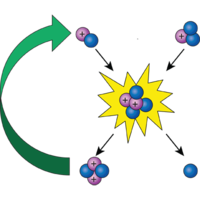
[Phys. Rev. Lett. 114, 255003] Published Fri Jun 26, 2015
Our week through the lens: 22-26 June 2015
A large sector of the giant elliptical galaxy’s outer halo now appears twice as bright as it would if the collision had not taken place.
The spiral waves around Beta Pictoris appear to account for many observed features in the planetary system.
In order to analyse in full detail the dynamics of a charged particle in the field of a magnetic
dipole, we propose to study the restricted motion of the particle in a spherical surface with the
dipole at its centre. This model can be considered as t…
In this article we have solved a hypothetical problem related to the stability and gross properties
of two-dimensional self-gravitating stellar objects using the Thomas–Fermi model. The formalism
presented here is an extension of the standard three…
We examine the theory of the hurricane balls toy. This toy consists of two steel balls, welded
together that are sent spinning on a horizontal surface somewhat like a top. Unlike a top, at high
frequency the symmetry axis approaches a limiting inclin…
We generalize the derivation of electromagnetic fields of a charged particle moving with a constant
acceleration Singal (2011 Am. J. Phys. 79 [http://dx.doi.org/10.1119/1.3620257] 1036 ) to a variable
acceleration (piecewise constants) over a small f…
We consider in this paper the motion of an inclined cylinder on an inclined plane. At low inclined
plane angles, the cylinder rolls without slipping across the incline, in a direction perpendicular
to its long axis. At steeper angles, long cylinders …
We obtain analytical expressions for the torques and angular speed of an induction motor with a
simple geometry, resembling the geometry of the first induction motor investigated by Arago in 1824.
The rotor is a conducting disc rotating between the m…
This article presents several simple experiments based on changing transverse vibration frequencies
in a cantilever beam, when acted on by an external attached mass load at the free end. By using a
mechanical wave driver, available in introductory un…
In order to analyse in full detail the dynamics of a charged particle in the field of a magnetic
dipole, we propose to study the restricted motion of the particle in a spherical surface with the
dipole at its centre. This model can be considered as t…
In this article we have solved a hypothetical problem related to the stability and gross properties
of two-dimensional self-gravitating stellar objects using the Thomas?Fermi model. The formalism
presented here is an extension of the standard three-d…
How can we design the shape of an object, in the framework of Newtonian gravity, in order to
generate maximum gravity at a given point in space? In this work we present a study on this
interesting problem. We obtain compact solutions for all dimensio…
NASA and Microsoft are teaming up to develop Sidekick, a new project using commercial technology to empower astronauts aboard the International Space Station (ISS).
Using a NASA satellite-based technique to measure urban growth, researchers found that Beijing, China, quadrupled in physical size between 2000 and 2009.
An under-ice rover prototype was tested at the California Science Center this week.
An older planet may have reclaimed its youthful glow, according to new evidence from NASA’s Spitzer Space Telescope.
Over the past week, ESA’s Integral satellite has been observing an exceptional outburst of high-energy light produced by a black hole that is devouring material from its stellar companion.

Join us Friday, 26 June, at 10:00 CEST for the ‘Earth from Space’ video programme. Discover the San Andreas Fault – horizontally shifting parts of California at up to 5 cm a year – in this week’s edition
Given this planet’s small size, it may offer clues to how hot super-Earths are born around other stars through the evaporation of their outer layers of hydrogen.
The find suggests that even though normal galaxies in the early cosmos were already brimming with carbon, they were not nearly as chemically evolved as similar galaxies seen a few billion years later.
The agencies will host a one-day event for up to 70 social media followers on Aug. 8, 2015, at Vandenberg Air Force Base, California.
Ristikuleht ujub päiksepaistelisel ilmaga mõne sentimeetri paksusel veekihil. Basseini põhjal paistab ristikulehe vari. Kas selle varju kuju üllatab?
Technology image of the week: spreading the word on ESA’s proposed Asteroid Impact Mission, ahead of next week’s Asteroid Day

Using the high-resolution science camera on board ESA’s Rosetta spacecraft, scientists have identified more than a hundred patches of water ice a few metres in size on the surface of Comet 67P/Churyumov-Gerasimenko.
While we don’t yet know what dark matter is, we do know it interacts with the rest of the universe through gravity, which means it must accumulate around supermassive black holes.
The results show that Circinus X-1 is located about 30,700 light-years from Earth and settles the difference in results published in prior studies.
More than 50 public events worldwide June 30 are set to increase education and awareness about asteroids and how to better detect them.
Scientists and engineers have a growing need for tools to help handle, explore and analyze big data. A new JPL/Caltech collaboration will help advance this important field.
Author(s): Jean-Baptiste Caussin and Denis BartoloIndividual birds flying in a flock do not fly in straight lines, but weave in and out of each other. Topological invariant braiding statistics shows that this weaving has a coherent rotation: the birds …
Author(s): Jakob Hammer, Sebastian Thomas, Philipp Weber, and Peter HommelhoffA new electron beam splitter that fits on a millimeter-sized chip could allow quantum optics experiments with free electrons.[Phys. Rev. Lett. 114, 254801] Published Tue Jun …
Author(s): Matteo Baggioli and Oriol Pujolàs
A quantum gravity holographic model can describe strongly correlated systems, in particular polaron quasiparticles, predicting a metal-insulator transition.
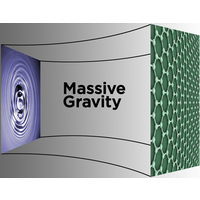
[Phys. Rev. Lett. 114, 251602] Published Tue Jun 23, 2015
Author(s): Shon Cook, Till Rosenband, and David R. LeibrandtCrystals doped with rare-earth ions, and cooled to 4 K, can be optically pumped so that they are transparent over narrow frequency ranges. Using these crystals as spectral windows could allow …
Author(s): A. P. Weber, Q. D. Gibson, Huiwen Ji, A. N. Caruso, A. V. Fedorov, R. J. Cava, and T. Valla
Topological-crystalline-insulators and strong-topological-insulator phases of matter can be present in a single system. This is demonstrated using photoelectron spectroscopy measurements and band structure calculations.
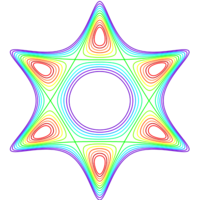
[Phys. Rev. Lett. 114, 256401] Published Tue Jun 23, 2015
Human spaceflight and operations image of the week: Mission control bringing Sentinel-2A through critical phases
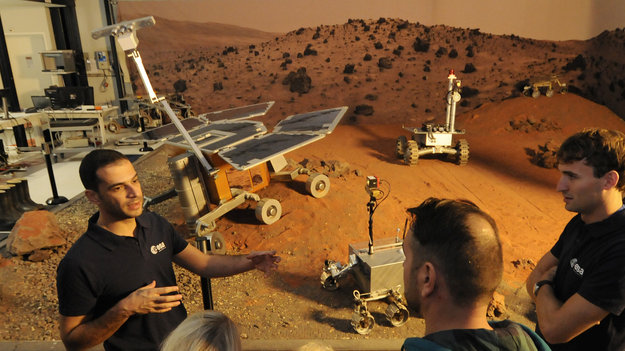
On 4 October ESA’s technical centre ESTEC will open its doors to the public – a must for all space enthusiasts
The new discovery of these galaxies suggests galaxy clusters as the key environment for the evolution of these mysterious dark galaxies.
Odyssey, which discovered widespread water ice just beneath the surface of the Red Planet, is still going strong today, serving as a key communications relay for NASA’s Mars rovers and making continued contributions to planetary science.
The adventure continues: ESA today confirmed that its Rosetta mission will be extended until the end of September 2016, at which point the spacecraft will most likely be landed on the surface of Comet 67P/Churyumov-Gerasimenko.

From ESA’s European Space Operations Centre in Germany, watch the replay of the event to celebrate the launch of the first satellite for the Sentinel-2 ‘colour vision’ mission
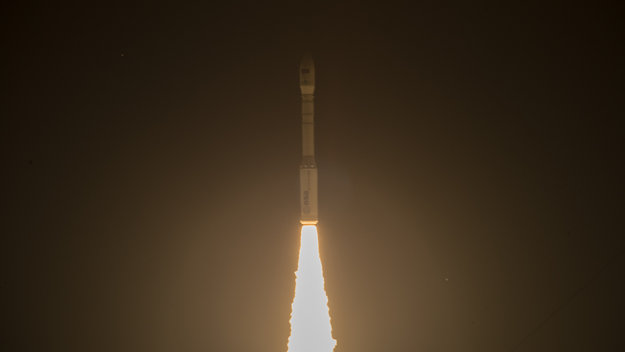
Watch the replay of the full Sentinel-2A launch coverage from Europe’s Spaceport in French Guiana on 23 June
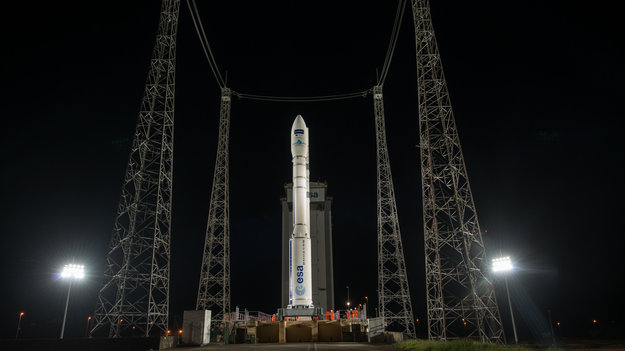
The ESA-developed Sentinel satellite – Sentinel-2A – was launched today, adding a high-resolution optical imaging capability to the European Union Copernicus environmental monitoring system

The ESA-developed Sentinel satellite – Sentinel-2A – was launched today, adding a high-resolution optical imaging capability to the European Union Copernicus environmental monitoring system.
The closer we get to Ceres, the more intriguing the distant dwarf planet becomes.

Watch the replay of the Sentinel-2A launch on a Vega rocket from Europe’s Spaceport in French Guiana
Author(s): M. P. Minitti, J. M. Budarz, A. Kirrander, J. S. Robinson, D. Ratner, T. J. Lane, D. Zhu, J. M. Glownia, M. Kozina, H. T. Lemke, M. Sikorski, Y. Feng, S. Nelson, K. Saita, B. Stankus, T. Northey, J. B. Hastings, and P. M. Weber
Femtosecond x-ray pulses image structural changes in a molecule.
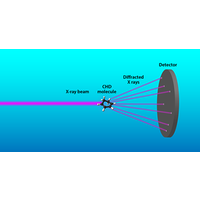
[Phys. Rev. Lett. 114, 255501] Published Mon Jun 22, 2015
The observations are definitely telling us that the peak of quasar activity in the early universe is driven by galaxies colliding and then merging together.
This study helps resolve some major questions about how galaxies form and evolve.

After a year in orbit, the three Swarm satellites have provided a first glimpse inside Earth and started to shed new light on the dynamics of the upper atmosphere – all the way from the ionosphere about 100 km above, through to the outer reaches of our protective magnetic shield.

Space Science image of the week: The housing for a free-floating test mass on LISA Pathfinder, ESA’s new fundamental physics mission
A recent study finds that an Earth-like process may be responsible for creating depressions resembling lakes in the surface of Saturn’s moon Titan.
Data from NASA’s MIRO instrument on board ESA’s Rosetta spacecraft have been used to generate maps of the distribution of water in the coma of 67P/Churyumov-Gerasimenko.
NASA’s Mars Odyssey spacecraft will reach a major milestone June 23, when it completes its 60,000th orbit since arriving at the Red Planet in 2001.
The complexity of digital and online education is becoming increasingly evident in the context of research into networked learning/participation. Interdisciplinary research is often proposed as a way to address complex scientific problems and enable re…
This paper reports on a literature review of the concept of “Digital Natives” and related terms. More specifically, it reports on the idea of a homogeneous generation of prolific and skilled users of digital technology born between 1980 and 1994. In all, 127 articles published between 1991 and 2014 were reviewed. On the basis of the findings, there appears to be no commonly-accepted definition of a “Digital Native”. The concept varies among individuals, societies, regions and nations, and also over time. Moreover, there are a number of variables other than age that may help us understand the nature of students’ use of digital technologies. The so-called “Digital Native” literature demonstrates that despite students’ high digital confidence and digital skills, their digital competence may be much lower than those of their “digital teachers”. Given the confusion surrounding “Digital Native” and its affiliates, we propose to unify them under the concept “digital learners”.
Distributed Massive Open Online Courses (MOOCs) are based on the premise that online learning occurs through a network of interconnected learners. The teachers’ role in distributed courses extends to forming such a network by facilitating communication that connects learners and their separate personal learning environments scattered around the Internet. The study reported in this paper examined who fulfilled such an influential role in a particular distributed MOOC – a connectivist course (cMOOC) offered in 2011. Social network analysis was conducted over a socio-technical network of the Twitter-based course interactions, comprising both human course participants and hashtags; where the latter represented technological affordances for scaling course communication. The results of the week-by-week analysis of the network of interactions suggest that the teaching function becomes distributed among influential actors in the network. As the course progressed, both human and technological actors comprising the network subsumed the teaching functions, and exerted influence over the network formation. Regardless, the official course facilitators preserved a high level of influence over the flow of information in the investigated cMOOC.
In an era of knowledge abundance, scholars have the capacity to distribute and share ideas and artifacts via digital networks, yet networked scholarship often remains unrecognized within institutional spheres of influence. Using ethnographic methods including participant observation, interviews, and document analysis, this study investigates networks as sites of scholarship. Its purpose is to situate networked practices within Boyer’s (1990) four components of scholarship – discovery, integration, application, and teaching – and to explore them as a techno-cultural system of scholarship suited to an era of knowledge abundance. Not only does the paper find that networked engagement both aligns with and exceeds Boyer’s model for scholarship, it suggests that networked scholarship may enact Boyer’s initial aim of broadening scholarship itself through fostering extensive cross-disciplinary, public ties and rewarding connection, collaboration, and curation between individuals rather than roles or institutions.
As online learning opportunities continue to grow it is important to continually consider instructor practices. Using case study methodology this study conceptualizes instructor presence, the intersection of social and teaching presence as defined within the Community of Inquiry literature, and is based in the implementation phase of online courses which is important to note since instructors often teach courses they did not design or develop. The investigation of the instructor presence behaviors of 12 online instructors and the emerging profiles of instructor presence provide a gateway to strategies for online instructors and offer a window into the ways instructional presence elements work together while providing insights into how to make the best use of online instructor time. In practical terms, the profiling method provides a useful way for practitioners to improve their own experiences.
This analysis is based upon enrolment and completion data collected for a total of 221 Massive Open Online Courses (MOOCs). It extends previously reported work (Jordan, 2014) with an expanded dataset; the original work is extended to include a multiple…
Although interaction is recognised as a key element for learning, its incorporation in online courses can be challenging. The interaction equivalency theorem provides guidelines: Meaningful learning can be supported as long as one of three types of int…
We interviewed eight University of Toronto (U of T) instructors who have offered MOOCs on Coursera or EdX between 2012 and 2014 to understand their motivation for MOOC instruction, their experience developing and teaching MOOCs, and their perceptions of the implications of MOOC instruction on their teaching and research practices. Through inductive analysis, we gleaned common motivations for MOOC development, including expanding public access to high quality learning resources, showcasing U of T teaching practices, and attempting to engage MOOC learners in application of concepts learned, even in the face of constraints that may inhibit active learning in MOOC contexts. MOOC design and delivery was a team effort with ample emphasis on planning and clarity. Instructors valued U of T instructional support in promoting systematic MOOC design and facilitating technical issues related to MOOC platforms. The evolution of MOOC support at U of T grew from a focus on addressing technical issues, to instructional design of MOOCs driven, first, by desired learning outcomes. Findings include changes in teaching practices of the MOOC instructors as they revised pedagogical practices in their credit courses by increasing opportunities for active learning and using MOOC resources to subsequently flip their classrooms. This study addresses the paucity of research on faculty experiences with developing MOOCs, which can subsequently inform the design of new forms of MOOC-like initiatives to increase public access to high quality learning resources, including those available through U of T.
In this exploratory study we used an intensive longitudinal approach to measure student engagement in a blended educational technology course, collecting both self-report and observational data. The self-report measure included a simple survey of Likert-scale and open-ended questions given repeatedly during the semester. Observational data were student activity data extracted from the learning management system. We explored how engagement varied over time, both at the course level and between students, to identify patterns and influences of student engagement in a blended course. We found that clarity of instruction and relevance of activities influenced student satisfaction more than the medium of instruction. Student engagement patterns observed in the log data revealed that exploring learning tools and previewing upcoming assignments and learning activities can be useful indicators of a successful learning experience. Future work will investigate these findings on a larger scale.
This study investigates online students’ acceptance of mobile learning and its influence on learning achievement using an information system success and extended technology acceptance model (TAM). Structural equation modeling was used to test the structure of individual, social, and systemic factors influencing mobile learning’s acceptance, and how said acceptance influences learning satisfaction and achievement. Unlike earlier TAM-related research that did not provide a broad view of technological acceptance and its impact on learning activities, the present study’s results highlight the relationship between behavioral intention/learning satisfaction and learning achievement. Additionally, this study tests the theoretical model of successful mobile learning by empirically accepting mobile learning management systems. The findings further imply that students at online universities have started to accept mobile technology as a new learning tool; consequently, its acceptance has influenced their learning achievement both directly and indirectly. These discoveries should facilitate a better understanding of students’ usage of mobile learning systems in higher education, and provide timely guidance for its development and implementation.
The present study aimed to examine distance learners’ goal profiles and their contrasting patterns of learning and achievements at three different points during an academic year, i.e. in the beginning of the course in relation to learners’ general orientations to learning, at the middle of the course in relation to learners’ completion of an assignment, and towards the end of the course in relation to learners’ preparation for course examination. Two hundred seventy-six adult distance learners completed three survey questionnaires that assessed their motivation and learning at these three learning points. Using person-centred analytical procedures, this study located four groups of learners based on different combinations of mastery and performance-approach goals. MANOVA results have shown that multiple-goal learners (High mastery/High performance, HH) who held strong mastery and performance-approach goals used more deep and regulatory strategies and showed a higher level of learning interest across three waves of surveys than did those focusing solely on mastery (HL) or performance-approach goals (LH). However, the multiple-goal learners did not have better achievement levels compared to those focusing solely on mastery goals (HL). Given that multiple goal learners learnt with a more engaged pattern, it is less likely that these motivated learners will drop out of distance learning courses and programs. Future studies should explore how these goals can be promoted simultaneously in distance learning.
The LINE application is often conceived as purely social space; however, the authors of this paper wanted to determine if it could be used for academic purposes. In this study, we examined how undergraduate students accepted LINE in terms of using it for classroom-related activities (e.g., submit homework, follow up course information queries, download materials) and explored the factors that might affect their intention to use it. Data were collected from 144 undergraduate students enrolled in an English course that utilized some activities based on LINE app using a questionnaire developed from TAM. Data were analyzed to see if relationships existed among factors when LINE was used to organize classroom experiences. The findings revealed that perceived usefulness and attitude toward usage had positive relationships with intention to use while perceived ease of use was positively related to perceived usefulness. In contrast with TAM assertions, this study did not find any relationship between perceived ease of use and attitude toward usage. Also, the number of social networking sites that students are using had no relationship with intention to use. The study also suggested some kinds of LINE-based learning activities preferred by students, which would be proposed for future courses. This study revealed several useful implications that TAM can be employed as a useful theoretical framework to predict and understand users’ intention to use new technologies in education.
The purpose of this paper is to investigate the current video collection of an open-access video website (TED-Ed). The research questions focus on its content as evidence of development, its viewership as evidence of use, and flipping as evidence of interaction in informal learning. In late September 2013, 686 video lessons were posted on the TED-Ed website that spanned 12 academic subject categories and 60 academic subject subcategories, as labeled and sorted on the TED-Ed website itself. The findings of the analysis of the TED-Ed video collection indicate several gaps in the humanities, social science, and natural science academic areas in terms of the number of video lessons and viewership. Despite the gaps in the numbers of video lessons and the viewership across those three academic areas, the areas have very similar averages of daily flipped lessons. The future research agenda should focus on the motivation of viewers to create flipped lessons as evidence of learning in an open learning environment.
Publication of research, innovation, challenges and successes is of critical importance to the evolution of more effective distance education programming. Publication in peer reviewed journal format is the most prestigious and the most widespread form …
Author(s): Eiichi Inami and Yoshiaki SugimotoA new technique in atomic force microscopy more accurately measures the electrostatic force between the probe and the surface.[Phys. Rev. Lett. 114, 246102] Published Fri Jun 19, 2015
Our week through the lens: 15-19 June 2015
On 23 June, a Vega launcher will loft the first of ESA’s dual Sentinel-2 satellites into orbit from Europe’s Spaceport in Kourou. For the mission control team, liftoff will mark the end of many months of careful preparations and the start …

Live from ESA’s Space Operations Centre in Germany: follow the event leading up to the launch of Sentinel-2A. Streaming begins at 01:00 GMT (03:00 CEST)

Follow the Sentinel-2A launch live from Europe’s Spaceport in French Guiana on 23 June. Streaming begins at 01:30 GMT (03:30 CEST), with liftoff scheduled at 01:52 GMT (03:52 CEST)
Scientists analyzing Venus Express observations have detected multiple “hot spots” on the planet with temperatures changing from day to day.
The instrument finally detected the long-sought radio emission coming from M32’s supermassive black hole.
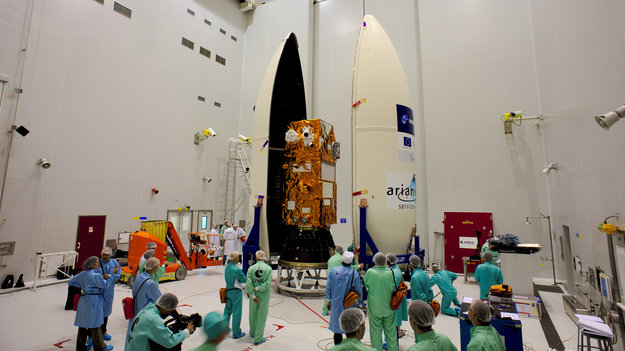
Sealed from view and poised high: watch the timelapse of Sentinel-2A’s encapsulation and integration on the Vega rocket
Research has shown that project-based learning promotes student interest in science and improves
understanding of scientific content. Fostering student motivation is particularly important in
accelerated science and technology programmes for talented…
Mathematics plays a crucial role in physics. This role is brought about predominantly through the
building, employment, and assessment of mathematical models, and teachers and educators should
capture this relationship in the classroom in an effort t…
This paper reports the use of Tracker as a computer-based learning tool to support effective
learning and teaching of ‘toss up’ and free fall motion for beginning secondary three (15 year-old)
students. The case study involved ( N = 123) students from express pure physics classes at a
mainstream school in Singapore. We used eight multiple-choice questions pre- and post-test to gauge
the impact on learning. The experimental group showed learning gains of d = 0.79 ± 0.23 (large
effect) for Cohen’s d effect size analysis, and gains with a gradient of < g > total =
0.42 ± 0.08 (medium gain) above the traditional baseline value of < g > non interactive = 0.23
for Hake’s normalized gain regression analysis. This applied to all of the teachers and students who
participated in this study. Our initial research findings suggest that allowing learners to relate
abstract physics concepts to real life through coupling traditi…
This article deals with a modern version of Kundt’s tube experiment. Using economic instruments and
a couple of smartphones, it is possible to ‘see’ nodes and antinodes of standing acoustic waves in a
column of vibrating air and to measure the …
The Billotron is a device designed and built by the LPC Caen to illustrate the methods with which
physicists are able to study the basic structure of matter, in particular the nucleus of the atom.
In everyday praxis we often need to demonstrate measuring devices?such as thermometers, manometers
and voltmeters? with large enough displays that they can easily be read from anywhere in the
classroom. In some cases, computers with a measurement int…
This article deals with a modern version of Kundt?s tube experiment. Using economic instruments and
a couple of smartphones, it is possible to ?see? nodes and antinodes of standing acoustic waves in a
column of vibrating air and to measure the speed …
Research has shown that project-based learning promotes student interest in science and improves
understanding of scientific content. Fostering student motivation is particularly important in
accelerated science and technology programmes for talented…
The electrostatic potential is a key element of the second semester of introductory physics.
Teaching about its gravitational analog in the first semester allows students to make more
connections between the two courses. The use of a simple thought e…
Centripetal acceleration, linear and angular speeds are three mathematical quantities that are of
primary interest to analyze the uniform motion of objects in circles. The formula of centripetal
acceleration is usually derived from the difference ? V…
Description unavailable
Like several scientists, Isaac Newton has been represented many times over many different periods,
and portraits of Newton were often commissioned by the scientist himself. These portraits tell us a
lot about the scientist, the artist and the cultura…
A simple experiment is presented in which the spacing and geometric pattern of pixels in mobile
displays is measured. The technique is based on optical constructive interference. While the
experiment is another opportunity to demonstrate wave interfe…
In this study, an easy and enjoyable activity to determine the type of electric charge is presented,
using a readymade electronic test screw. A four-way usage of the tester is explained with an
electroscope. In the activity, ebonite and glass rods ar…
How is the other side of frosted glass seen? In other words, how does frosted glass become
transparent?
Many students regard physics as an isolated, sophisticated and perhaps a boring branch of science.
Meanwhile, physics is embedded in most events and issues of society, culture and everyday life. To
find and include such relevant contexts is one of th…
