In a world first, the European Space Agency will launch and land an unmanned spaceplane February 11 that has no wings but instead features an aerodynamic shape that produces the lift to fly through the atmosphere.
Google helps Lick Observatory stay open with $1 million gift
A resurgence of support from the University of California and several large donations signal a turning of the tide for the world’s first permanent mountaintop observatory.
Google helps Lick Observatory stay open with $1 million gift
A resurgence of support from the University of California and several large donations signal a turning of the tide for the world’s first permanent mountaintop observatory.
Valmistati materjal, millel on negatiivne murdumisnäitaja nähtavas spektri piirkonnas

Ajakirja Nature väljaandest Scientific reports saime lugeda, et esmakordselt on saadud ja ära mõõdetud nähtavas piirkonnas negatiivset murdumisnäitajat omav materjal. Töö on tehtud Hiina teadlaste poolt ja selle rõhk on just materjali valmistamise meetodil. Ja õige ka – oleme ju siinsetelgi veergudel mitut puhku rääkinud, kui keeruline on spektri nähtavasse piirkonda sobivaid metamaterjale valmistada. Juuresolev […]
Retsept metamaterjalide valmistamiseks

Metamaterjalid on huvitavad, ei ole probleem neile rakendusi välja mõelda alates ideaalsest valguse neelajast lõpetades superläätsedega. Aga nende valmistamine on väga keeruline. Siiski, vahel on valmistamise protsess ja selle tulemus üsna lihtsalt hoomatav. Käesoleval juhul on Jaapani ja Taiwani teadlased valmistanud metamaterjali mis erinevalt varasematest on isotroopne, st selle omadused ei sõltu langeva valguse suunast […]
NASA Spacecraft Completes 40,000 Mars Orbits
NASA’s Mars Reconnaissance Orbiter has exceeded 40,000 trips around Mars and continues to study patterns of change on the Red Planet.
A sweet martian treat
Space Science Image of the Week: This surprising view of the Red Planet, courtesy of Mars Express, shows chocolate, caramel and cream-coloured swirls encircling the south pole
Composite-Light-Pulse Technique for High-Precision Atom Interferometry
Author(s): P. Berg, S. Abend, G. Tackmann, C. Schubert, E. Giese, W. P. Schleich, F. A. Narducci, W. Ertmer, and E. M. Rasel
By keeping its atomic components in the same state, a team was able to reduce one typical source of noise in a rotation-measuring device.

[Phys. Rev. Lett. 114, 063002] Published Mon Feb 09, 2015
Measuring the Transverse Spin Density of Light
Author(s): Martin Neugebauer, Thomas Bauer, Andrea Aiello, and Peter Banzer Under certain conditions the spin of photons can acquire an unusual transverse component. Using intensity differences in the far-field, the transverse spin density is experimen…
Synthesis of Programmable Reaction-Diffusion Fronts Using DNA Catalyzers
Author(s): Anton S. Zadorin, Yannick Rondelez, Jean-Christophe Galas, and André Estevez-Torres
Strands of DNA can be used to generate waves of chemical reactions with programmable shape and velocity.
[Phys. Rev. Lett. 114, 068301] Published Mon Feb 09, 2015
Watch IXV launch
Join us for the launch of Europe’s experimental spaceplane, scheduled for 13:00 GMT (14:00 CET) on 11 February. Streaming starts at 12:45 GMT (13.45 CET)
First pair of merging stars destined to become supernova found
A team of astronomers has discovered a close pair of white dwarf stars in a planetary nebula that have a total mass of about 1.8 times that of the Sun.
IXV mission timeline
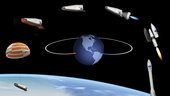
An annotated timeline of the most critical events during the IXV mission. ESA’s wingless spaceplane is set for liftoff on a Vega rocket from Kourou, French Guiana, 11 February 2015.
Söövitusmeetod aitab 2-D struktuuridest luua 3-dimensionaalseid

Tänapäevases kaugsides kannab valgus digitaalset informatsiooni kilomeetrite taha vaid sekunditega. Kohandatud optilised materjalid kontrollivad valgussignaale. Teadlased Berliini, Louvain’i ja Karlsruhe Tehnoloogia Instituutidest esitavad ajakirjas Advanced Functional Materials meetodit footonkristallide tootmiseks. Nende optilised omadused on paika pandud mikromeetri suuruste struktuuridega. Antud meetod on kiire, odav ja lihtne ning kasutab osaliselt iseorganiseeruvuse printsiipi. „Materjalide optilisi omadusi saab […]
Põgenevate kivide mõistatus lahendatud?

California ja Nevada kuivanud järvede põhjas vedelevate kivide taga on tihti pikad vaod, mis algavad kivi juurest ja võivad ulatuda kümneid meetreid üle kõvaks kuivanud kõrbepinnase. Kivid ise kaaluvad kuni 300 kilo. Mis neid jälgi tekitab? Kas kivid üritavad Las Vegase kasiinodesse murda? Või käib mõni veidrik neid lükkamas? Igal juhul peab jälgede tekitamine keeruline […]
Week In Images
Our week through the lens: 2-6 February 2015
Camera to record doomed ATV’s disintegration – from inside

Next Monday, ESA astronaut Samantha Christoforetti will float into Europe’s space ferry to install a special infrared camera, set to capture unique interior views of the spacecraft’s break-up on reentry.
Planck mission explores the history of our universe
The latest data release is providing insights on the first stars, dark energy, and cosmic structure.
Curiosity analyzing sample of martian mountain
Preliminary results suggest the area had acidic ancient conditions
Fluorestseeruvad nanotorud – uus aken aju ehitusse

Stanfordi Ülikooli teadlased töötasid hiljuti välja maailma esimese mitteinvasiivse pildistustehnoloogia, mis suudab tuvastada hiire aju veresoontes asuvaid kuni mikromeetrise läbimõõduga struktuure. Meetodis süstitakse hiire ajusse ühekihilisi süsiniknanotorusid (ingl. k. single-walled carbon nanotubes) ja detekteeritakse nende kiiratavat valgust. Veresoonte struktuuri ja seal oleva vere voolamist on erakordselt oluline teada näiteks insuldi, dementsuse ja ajukasvajate ravimisel. Tänapäeval tugineb ajust kujutise saamine peamiselt […]
Lisbon
Earth observation image of the week: a Sentinel-1 radar image of Portugal’s capital, also featured on the Earth from Space video programme
Latest Galileo satellites reach launch site

Another two Galileo satellites have touched down in French Guiana ready to take their place in Europe’s satellite navigation constellation.
What’s new about Europe’s reentry mission?

ESA’s experimental spaceplane, poised for liftoff on Vega, is set to showcase the latest technologies and critical systems to extend Europe’s capability for space exploration.
Dawn Gets Closer Views of Ceres
NASA’s Dawn spacecraft, on approach to dwarf planet Ceres, has acquired its latest and closest-yet snapshot of this mysterious world.
Planck Mission Explores the History of Our Universe
New data from Planck are helping scientists better understand the history and fabric of our universe, as well as our own Milky Way galaxy.
NASA’s Curiosity Analyzing Sample of Martian Mountain
NASA’s Curiosity Mars rover is analyzing a rock-powder sample collected by using the rover’s drill in a gentler manner than at previous drill targets.
Kuidas näevad välja tõelised laserkuulid?

Laserkuulid on ulmefilmides üsna sagedane nähtus. Aga tegelikkuses? Poola füüsikud T.Fok, Y.Stepanenko ja W.Wegrzynski on oma teravatise laseri justeerimise käigus võtnud vaevaks ja teinud video sellest, kuidas sellise ülivõimsa laseri tekitatud valgusimpulss (“valguskuul”) lendab. Video (vt allpool) näib üsna arusaadav – tõepoolest, midagi helendavat liigub piki koridori. Aga siin on nii mõndagi seletamist. Esiteks, ükskõik […]
Storage and Retrieval of THz-Bandwidth Single Photons Using a Room-Temperature Diamond Quantum Memory
Author(s): Duncan G. England, Kent A. G. Fisher, Jean-Philippe W. MacLean, Philip J. Bustard, Rune Lausten, Kevin J. Resch, and Benjamin J. Sussman
Diamond crystals enable new ways of storing single photons at room temperature and detecting their entanglement.
[Phys. Rev. Lett. 114, 053602] Published Thu Feb 05, 2015
Entangled Absorption of a Single Photon with a Single Spin in Diamond
Author(s): Hideo Kosaka and Naeko Niikura Diamond crystals enable new ways of storing single photons at room temperature and detecting their entanglement.[Phys. Rev. Lett. 114, 053603] Published Thu Feb 05, 2015
Earth from Space

Join us Friday, 6 February, at 10:00 CET for the ‘Earth from Space’ video programme. This week features a Sentinel-1 radar image over the metropolitan area of Portugal’s capital, Lisbon
A brand new sky

New Planck maps uncover the ‘polarised’ light from the early Universe, revealing that the first stars formed much later than previously thought
Hubble captures rare triple-moon conjunction
These so-called Galilean satellites complete orbits around Jupiter with durations ranging from two to 17 days.
The Lunar Reconnaissance Orbiter discovers lunar hydrogen more abundant on Moon’s pole-facing slopes
Explorers are excited because these deposits could be mined if they are sufficiently abundant.
New Horizons returns new images of Pluto
These are the first photos of the Pluto system for the spacecraft’s optical navigation phase of the mission.
NASA Aircraft, Spacecraft Aid Atmospheric River Study
NASA is part of a major field campaign studying intense atmospheric river storms from the ocean, land, air and space.
Glow in the Dark Matter: Observing Galactic Halos with Scattered Light
Author(s): Jonathan H. Davis and Joseph Silk The dark matter around galaxies might produce a detectable glow at infrared wavelengths.[Phys. Rev. Lett. 114, 051303] Published Wed Feb 04, 2015
Estonia joins ESA family

PR N° 5-2015: Estonia took a step further in its relations with ESA by signing the Accession Agreement to the ESA Convention on 4 February 2015, to become the 21st ESA Member State
Rosetta swoops in for a close encounter
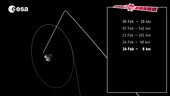
ESA’s Rosetta probe is preparing to make a close encounter with its comet on 14 February, passing just 6 km from the surface.
Meade appoints new president
Victor Aniceto, former vice president of sales and marketing, will succeed Joe Lupica.
New infrared view of the Trifid Nebula reveals new variable stars far beyond
They are the first such stars found that lie in the central plane of the Milky Way beyond its central bulge.
Rosetta swoops in for a close encounter
The February 14 flyby will allow the spacecraft to sample the innermost parts of Comet 67P/Churyumov-Gerasimenko’s atmosphere.
Füüsikaviktoriin Spekter

TÜ teaduskool koostöös TÜ koolifüüsika keskuse ja Eesti Füüsika Seltsiga korraldavad 8. aprillil 2015 veebipõhise füüsikaviktoriini „Spekter“. Viktoriin on pühendatud rahvusvahelisele valguse aastale ning sellest oodatakse osa võtma kõiki 8.-10. klasside õpilasi, kes soovivad oma füüsikateadmisi proovile panna. Võistlusest saab osa võtta arvuti, nutitelefoni või tahvelarvuti vahendusel. Viktoriini idee initsiaatori ja vedaja, TÜ teaduskooli haridustehnoloogi […]
Propeller katki?

Kui satute järgmisel korral propelleritega lennukiga sõitma, siis lõbustage ennast ja kaasreisijaid sellega, et pildistate või filmite oma nutitelefoniga lennuki propellerit. Sest tulemus arvatavasti üllatab – pildile võib jääda just selline täiesti mittesümmeetriline objekt. Võib isegi tekkida kartus, kas lennukiga on kõik korras. Sellise kõvera pildi põhjuseks ei ole siiski mitte katkine propeller vaid mobiiltelefoni […]
Mars Orbiter Spies Curiosity Rover at Work
NASA’s Mars Reconnaissance Orbiter recently caught a view of NASA’s Curiosity Mars rover studying an outcrop at the base of a Martian mountain.
Spaceship to ship

Human spaceflight and operations image of the week: A tracking station aboard Nos Aries will be the first to pick up IXV’s call home after reentry
Strange Nonchaotic Stars
Author(s): John F. Lindner, Vivek Kohar, Behnam Kia, Michael Hippke, John G. Learned, and William L. Ditto The ratio of the frequencies of a pulsating star is approximately the golden mean, a clue that the pulsing is fractal in time.[Phys. Rev. Lett. …
IXV: 100 minutes of critical teamwork

During its brief but crucial mission, experts on three continents and the high seas will work in close cooperation for ESA’s IXV spaceplane mission, monitoring its free flight in space, spectacular reentry and safe splashdown in the Pacific.
Plant power from above
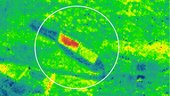
Field experiments have shown how ESA’s potential FLEX mission could identify vegetation that is suffering degrees of stress invisible to the naked eye.
Meteorite may represent “bulk background” of Mars’ battered crust
NWA 7034 has been shown to be a 4.4-billion-year-old chunk of the martian crust, the first such sample to make it to Earth.
“Live fast, die young” galaxies lose the gas that keeps them alive
A pilot study looking at galaxies that die young has found some might shoot out this gas early on, causing them to redden and kick the bucket prematurely.
IXV testing technologies
Find out how ESA’s cutting-edge spaceplane advances Europe’s ambition for autonomous landings from space
Arcadia High School Takes First Place at Science Bowl
Arcadia High School triumphed over 23 other teams at the National Science Bowl regional competition held at JPL on Jan. 31.
XLV Eesti füüsikapäevad ja XXXVII füüsikaõpetajate päevad

XLV Eesti füüsikapäevad ja XXXVII füüsikaõpetajate päevad toimuvad Tartus, uues TÜ Füüsikumis 20-21.03.2015. Programmi kuuluvad ülevaateettekanded, mis tutvustavad laiemalt nii füüsika kui ka füüsikaga piirnevate valdkondade arengut meil ja mujal maailmas, aga loomulikult ka meie füüsikute viimase aja uurimistulemusi ning füüsika õpetamisega seonduvat. Valguse aastale kohaselt on eriti oodatud fotoonika hetkeseisu ja tulevikuväljavaateid käsitlevad ettekanded. […]
Full Multipartite Entanglement of Frequency-Comb Gaussian States
Author(s): S. Gerke, J. Sperling, W. Vogel, Y. Cai, J. Roslund, N. Treps, and C. Fabre Researchers characterize the multiple ways of entanglement that exist between different frequency bands in a down-converted frequency comb.[Phys. Rev. Lett. 114, 05…
IXV and Vega united
ESA’s Vega rocket, with IXV on top, now awaits its fourth flight with liftoff on 11 February at 13:00 GMT (14:00 CET)
Cat scan of nearby supernova remnant reveals frothy interior
Astronomers have generated a new 3-D map of Cassiopeia A’s interior, using the astronomical equivalent of a CAT scan.
The telltale signs of a galactic merger
This galaxy has drifted too close to another nearby galaxy and the dramatic interaction has twisted its spiral arms out of shape.
Haunted stellar relic
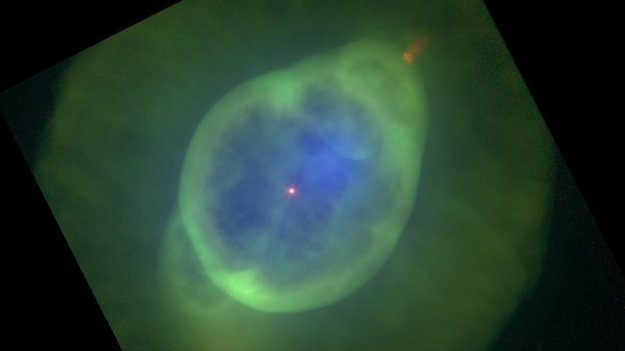
Space Science Image of the Week: A composite XMM-Newton and Hubble view of Jupiter’s Ghost planetary nebula
NASA Launches Groundbreaking Soil Moisture Mapper
NASA successfully launched its first Earth satellite designed to collect global observations of the vital soil moisture hidden just beneath our feet.
Gravitational Waves from Early Universe Remain Elusive
A joint analysis of data from Planck and the ground-based experiment BICEP2 has found no conclusive evidence of gravitational waves from the birth of our universe.
The search continues
Planck and Bicep2 join forces but gravitational waves remain elusive
Week In Images
Our week through the lens: 26-30 January 2015
Black hole chokes on a swallowed star
Extensive data analysis has led astronomers to believe they witnessed a giant black hole tear apart a star back in 2009.
Gravitational waves remain elusive, according to Planck
The satellite’s work with ground-based telescopes has shown that interstellar dust was actually the cause of more than half of the signal detection announced almost a year ago.
Black hole chokes on a swallowed star
Extensive data analysis has led astronomers to believe they witnessed a giant black hole tear apart a star back in 2009.
Cassini catches Titan naked in the solar wind
Observations suggest that unmagnetized bodies like Saturn’s moon might interact with the solar wind in the same basic ways regardless of their nature or distance from the Sun.
Charles H. Townes (28.07.1915 – 27.01.2015)

Laserite tähtsust teaduses ja tehnoloogias on raske üle hinnata. Neil päevil suri Charles H. Townes, üks laseri loojatest. Charles H. Townes on USA füüsik, sündinud Greenvilleys, Lõuna-Carolinas. Ta õppis Furmani ülikoolis (B.A. ja B.S. kraad 1935), Duke’i ülikoolis (M.A. kraad 1937) ja Kalifornia Tehnoloogiainstituudis (PhD, 1939). Lõpetanud õpingud, sai ta tööle firma Bell Telephone laboratooriumisse […]
NASA TV Coverage Reset for Launch of Newest Earth-Observing Mission
NASA’s SMAP mission is now scheduled for launch at 6:20 a.m. PST Friday, Jan. 30.
SMAP Earth Mission Launch No Earlier Than Saturday
The launch of NASA’s Soil Moisture Active Passive (SMAP) observatory has been delayed to a targeted launch date of Jan. 31.
Magnificent merger
Tell-tale signs of a dramatic encounter between galaxies are evident in this striking view captured by the Hubble Space Telescope
Hypothesis Testing with Open Quantum Systems
Author(s): Klaus Mølmer
Monitoring the emitted radiation and final state of an open quantum system could allow determination of the optimal Hamiltonian governing the system’s dynamics.
[Phys. Rev. Lett. 114, 040401] Published Thu Jan 29, 2015
IXV packed and ready
ESA’s IXV spaceplane is a snug fit inside Vega’s protective fairing and will soon be attached to the rocket in preparation for launch on 11 February
Earth from Space
Join us Friday, 30 January, at 10:00 CET for the ‘Earth from Space’ video programme. Ahead of World Wetlands Day, this week’s programme features the Ramsar sites on the island of Corsica
Some potentially habitable planets began as gaseous, Neptune-like worlds
Computer models show that tidal forces and atmospheric escape can transform certain exoplanets.
Dawn spacecraft captures best-ever view of dwarf planet
The images were taken 147,000 miles (237,000 kilometers) from Ceres and represent a new milestone for a spacecraft that soon will become the first human-made probe to visit a dwarf planet.
NASA’s SMAP Earth Mission Launches
NASA’s Soil Moisture Active Passive (SMAP) mission has launched from California into the early morning skies above the Pacific Ocean.
Cassini Catches Titan Naked in the Solar Wind
Researchers studying data from NASA’s Cassini mission have observed that Saturn’s largest moon, Titan, behaves much like Venus, Mars or a comet when exposed to the raw power of the solar wind.
Astronomers Discover Ancient System with Five Small Planets
The star system Kepler-444 is the oldest known to host terrestrial-sized planets.
Settling the Half-Life of ^{60}Fe: Fundamental for a Versatile Astrophysical Chronometer
Author(s): A. Wallner, M. Bichler, K. Buczak, R. Dressler, L. K. Fifield, D. Schumann, J. H. Sterba, S. G. Tims, G. Wallner, and W. Kutschera
A better measure of an iron isotope’s half-life may lead to new ways of dating astrophysical events that unfold over millions of years.
[Phys. Rev. Lett. 114, 041101] Published Wed Jan 28, 2015
Laser Cooling without Spontaneous Emission
Author(s): Christopher Corder, Brian Arnold, and Harold Metcalf Atom-light interactions using polychromatic laser fields permit energy and momentum exchange for laser cooling without spontaneous emission.[Phys. Rev. Lett. 114, 043002] Published Wed Jan…
Cubes with a view
Technology image of the week: Next year this ESA three-unit CubeSat will be probing largely unexplored layers of Earth’s atmosphere
Citizen scientists lead astronomers to mystery objects in space
Scientists analyzed the “yellow balls” that appeared in Spitzer data and figured out that they are a new way to detect the early stages of massive star formation.
Gigantic ring system around J1407b
The exoplanet’s ring system consists of over 30 rings, each of them tens of millions of miles in diameter.
Citizen Scientists Lead Astronomers to Mystery Objects in Space
“Hmm, what’s that?” Simply by asking the question, volunteers have led researchers to illuminate a little-known stage of massive star formation.
NASA’s Dawn Spacecraft Captures Best-Ever View of Dwarf Planet
NASA’s Dawn spacecraft has returned the sharpest images ever seen of the dwarf planet Ceres.
SMAP Readiness Review Gives ‘Go’ for Launch
Managers from NASA and United Launch Alliance (ULA) met Tues., Jan. 27, at Vandenberg Air Force Base to assess the status of NASA’s Soil Moisture Active Passive spacecraft and the ULA Delta II rocket that will boost SMAP into space.
…
Building a Better Weather Forecast? SMAP May Help
Soil moisture data from NASA’s SMAP mission will open a path to improved weather forecasts.
Arms that never tire
ESA astronaut Tim Peake and Rosetta Project Scientist Dr Matt Taylor talk robotics in space missions in a Google hangout. Watch the replay
Gigabar Spherical Shock Generation on the OMEGA Laser
Author(s): R. Nora, W. Theobald, R. Betti, F. J. Marshall, D. T. Michel, W. Seka, B. Yaakobi, M. Lafon, C. Stoeckl, J. Delettrez, A. A. Solodov, A. Casner, C. Reverdin, X. Ribeyre, A. Vallet, J. Peebles, F. N. Beg, and M. S. Wei
A two-step scheme for inertial confinement fusion generates gigabar shock pressures in a fuel target.
[Phys. Rev. Lett. 114, 045001] Published Tue Jan 27, 2015
IXV into position

ESA’s experimental spaceplane, in the final stages of preparation for launch, is mounted on the adapter that secures it to the Vega rocket
Kepler astronomers discover ancient star with five Earth-sized planets
This system tells us that planets were forming around stars nearly 7 billion years before our solar system.
Asteroid that flew past Earth has moon
Scientists have released the first radar images of asteroid 2004 BL86, which made its closest approach January 26.
Striking lightning
Human spaceflight and operations image of the week: lightning strike seen from the International Space Station
Asteroid That Flew Past Earth Has Moon
Radar Images from Goldstone indicate that asteroid 2004 BL86, which safely flew past Earth, has a moon.
SMAP Will Track a Tiny Cog That Keeps Cycles Spinning
Soil moisture, which keeps Earth’s interlocking cycles of water, carbon and energy turning in harmony, is the focus of NASA’s SMAP mission, launching Jan. 29.
Rosetta watches comet shed its dusty coat
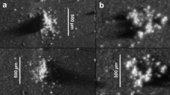
ESA’s Rosetta mission is providing unique insight into the life cycle of a comet’s dusty surface, watching 67P/Churyumov–Gerasimenko as it sheds the dusty coat it has accumulated over the past four years.
Observation of Generalized Optomechanical Coupling and Cooling on Cavity Resonance
Author(s): Andreas Sawadsky, Henning Kaufer, Ramon Moghadas Nia, Sergey P. Tarabrin, Farid Ya. Khalili, Klemens Hammerer, and Roman Schnabel A new scheme for cooling a mechanical oscillator in a cavity may allow the observation of quantum effects on m…
Satellites for peat’s sake

Satellites can help us to safeguard nature’s richest carbon storehouses – peatlands.
Rosetta watches comet shed its dusty coat
The mission is providing unique insight into the life cycle of Comet 67P/Churyumov-Gerasimenko’s dusty surface.
Hilltop panorama marks Mars rover’s 11th anniversary
Opportunity has driven 25.9 miles (41.7 kilometers) since it arrived at the Red Planet in 2004.