Description unavailable
Measuring the speed of sound in air using smartphone applications
This study presents a revised version of an old experiment available in many textbooks for measuring
the speed of sound in air. A signal-generator application in a smartphone is used to produce the
desired sound frequency. Nodes of sound waves in a g…
Scratch as a computational modelling tool for teaching physics
The Scratch online authoring tool, which features a simple programming language that has been
adapted to primary and secondary students, is being used more and more in schools as it offers
students and teachers the opportunity to use a tool to build …
Spreadsheet application showing the proper elevation angle, points of shot and impact of a projectile
This paper provides the formula for the elevation angle at which a projectile has to be fired in a
vacuum from a general position to hit a target at a given distance. A spreadsheet application that
models the trajectory is presented, and the problem …
The tablecloth pull revisited
A very old and well-known magical trick is the so-called tablecloth pull. A table is covered with a
tablecloth, on top of which are certain objects. The task is to remove the tablecloth while the
objects—which must not be touched—stay on top of …
Dynamics of a sliding ladder leaning against a wall
This study is about the dynamics of a sliding ladder leaning against a vertical wall. The results
are understood by considering the motion divided in two parts: (i) for ##IMG##
[http://ej.iop.org/images/0031-9120/50/3/329/ped510699ieqn001.gif] {$0leq tleq {{t}_{s}}$} with
one degree of freedom, and (ii) for ##IMG##
[http://ej.iop.org/images/0031-9120/50/3/329/ped510699ieqn002.gif] {$t>{{t}_{s}}$} with two degrees
of freedom, where the separation is determined by the instance ##IMG##
[http://ej.iop.org/images/0031-9120/50/3/329/ped510699ieqn003.gif] {${{t}_{s}},$} when the ladder
loses its contact with the wall. The observed experimental details are explained by appealing a
simple model based on elementary notions of mechanics. We emphasize some features, such as a maximum
of the x component of the velocity and of the acceleration of the centre of mass in the first part,
and a minimum of the normal react…
The International Year of Light and Light-based Technologies
I report on the opening ceremony of the International Year of Light and Light-based Technologies
2015 (IYL2015), which took place at the UNESCO headquarters in Paris, France, on 19–20 January 2015.
Over the two days, more than 1000 participants fro…
Special relativity in the school laboratory: a simple apparatus for cosmic-ray muon detection
We use apparatus based on two Geiger–Müller tubes, a simple electronic circuit and a Raspberry Pi
computer to illustrate relativistic time dilation affecting cosmic-ray muons travelling through the
atmosphere to the Earth’s surface. The experime…
Spinning tops on a gentle incline—the answer
In my article (Featonby 2015 Phys. Educ. 50 256), I looked at how the behaviour of a spinning top
differs when it is set to spin on a gentle incline.
News
Description unavailable
Musical intonation of wind instruments and temperature
Wind musical instruments are affected in their intonation by temperature. We show how to account for
these effects in a simple experiment, and provide results in languages accessible to both physics
and music professionals.
The pendulum wave machine
There are many examples on the internet of videos of ‘pendulum wave machines’ and how to make them
(for example, www.instructables.com/id/Wave-Pendulum/
[http://www.instructables.com/id/Wave-Pendulum/] ). The machine is simply a set of pendula of…
The puzzle of a marble in a spinning pipe
What trajectory does a marble follow if it is held inside a rotating pipe and then suddenly
released?
TÜ füüsika instituudi uus ilmajaam avatakse lennukalt

Tartu Ülikooli pressiteade: Sel nädalal lastakse üle maailma taevasse tuhandeid ise disainitud ja kaameratega varustatud aeroloogilisi õhupalle, mis lubavad Maad vaadata linnulennult. Esimest korda osalevad globaalsel õhupalliväljakutsel ka eestlased. Tartu Ülikooli meeskond laseb oma õhupalli lendu 24. aprillil, avades sellega füüsika instituudi katusel asuva uue ilmajaama. TÜ meteoroloogia ja klimatoloogia dotsendi Piia Posti sõnul osaleb […]
Mars Orbiter Views Curiosity Rover in ‘Artist’s Drive’
A view from NASA’s Mars Reconnaissance Orbiter on April 8, 2015, catches sight of NASA’s Curiosity Mars rover passing through a valley called “Artist’s Drive” on the lower slope of Mount Sharp.
Happy Earth Day
A snapshot of our home planet captured on the morning of Earth Day by the MSG-3 satellite
Clusters of monster stars lit up the early universe
Scientists find that the first stars could have clustered together in phenomenally bright groups, with periods when they were as luminous as 100 million Suns.
Pulsing light may indicate supermassive black hole merger
In a new study, astronomers present direct evidence of a pulsing quasar, which may substantiate the existence of black hole binaries.
Perseverance paves way for wind laser

Developing new satellite instruments is always challenging, but at times more head-scratching is needed to create something truly cutting-edge. ESA’s Aeolus mission may have caused a few headaches along the way, but its wind lasers are now ready and the task of putting the rest of the instrument together can begin so that it can be ready for launch in 2016.
Second Dragon, fruit flies and fresh coffee for Samantha
ESA astronaut Samantha Cristoforetti is nearing the end of her six-month Futura mission but her action-packed stay on the International Space Station is showing no signs of slowing down.
Light out of darkness
Technology image of the week: The darkened laser test bench of ESA’s Opto-Electronics Lab
NASA Soil Moisture Mission Produces First Global Maps
NASA’s new satellite mission to map the water in the soil under our feet has passed another key milestone by generating its first full global maps.
NASA RapidScat Proving Valuable for Tropical Cyclones
Forecasters are already finding NASA’s new ISS-RapidScat mission helpful as they keep watch on major storms around the globe.
NASA’s NExSS Coalition to Lead Search for Life on Distant Worlds
A new initiative is dedicated to the search for life on planets outside our solar system.
Jason-3 Will Add to Record of the Sea’s Rise and Fall

Jason-3 will add to a 23-year data set used to study climate change and ocean cycles like El Niño, as well as for hurricane forecasts, navigation and other ocean needs.
Decade-Spanning High-Precision Terahertz Frequency Comb
Author(s): Ian A. Finneran, Jacob T. Good, Daniel B. Holland, P. Brandon Carroll, Marco A. Allodi, and Geoffrey A. Blake A new scheme to generate terahertz frequency combs features unprecedented bandwidth and frequency accuracy.[Phys. Rev. Lett. 114, …
Spin service
Human spaceflight and operations image of the week: ESA astronaut Claude Nicollier working on the Hubble space telescope 600 km from Earth
Alma reveals intense magnetic field close to supermassive black hole
This new observation helps astronomers understand the structure and formation of these massive inhabitants of the centers of galaxies and the twin high-speed jets of plasma they frequently eject from their poles.
Astronomers probe young star and its planets
The planetary system HR8799, a young star only 30 million years old, was the first to be directly imaged with three planets found in 2008 and a fourth one in 2010.
603 km/h: uus rongide kiirusrekord

Jaapanis, Mount Fuji lähistel asuval eksperimentaalrajal (Yamanashi Maglev Test Line ) püstitati uus rongide kiirusrekord, uueks rekordiks on 603 km/h. Eelmine rekord oli 590 km/h. SCMaglev’iks nimetatav süsteem, kus rekord püstitati on täielikult elektromagnetiline – rongide sisse on paigutatud ülijuhtivad elektromagnetid ning “rööbasteks” on juhtmepoolid. Video sellest sündmusest leiate allpool. Mõned märksõnad: SCMaglev süsteemis sõidavad […]
Ceres’ Bright Spots Come Back Into View
The two brightest spots on dwarf planet Ceres, which have fascinated scientists for months, are back in view in the newest images from NASA’s Dawn spacecraft.
Ceres’ Bright Spots Come Back Into View
The two brightest spots on dwarf planet Ceres, which have fascinated scientists for months, are back in view in the newest images from NASA’s Dawn spacecraft.
Single-Electron Detection and Spectroscopy via Relativistic Cyclotron Radiation
Author(s): D. M. Asner et al. (Project 8 Collaboration)
An electron’s energy can be determined with high accuracy by detecting the radiation it emits when moving in a magnetic field.

[Phys. Rev. Lett. 114, 162501] Published Mon Apr 20, 2015
A cold cosmic mystery solved
A team of astronomers may have found an explanation for the existence of the Cold Spot, a larger-than-expected cold area of the sky.
Icy tendrils reaching into Saturn ring traced to their source
Scientists have been able to show that each unique tendril structure can be reproduced by particular sets of geysers on Enceladus’ surface.
Thor’s neon-hued helmet
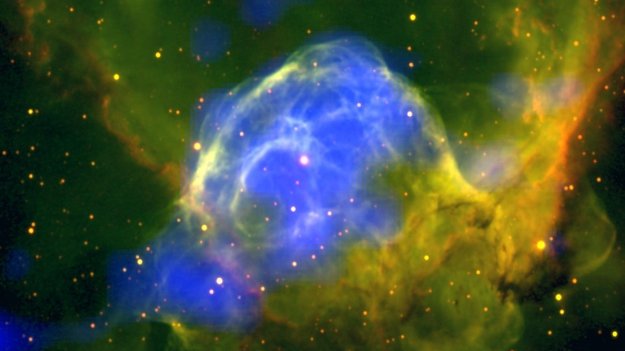
Space Science Image of the Week: Intense X-rays have sculpted bubbles, filaments and rippling outbursts within the Thor’s Helmet nebula, as seen by ESA’s XMM-Newton
Veetilk CD plaadil

Pildile on jäänud veetilk CD plaadi tagaküljel. Aga kus on valgusallikas? Ja mida me saame selle pildi põhjal öelda valgusallika kohta?
Week In Images
Our week through the lens: 13-17 April 2015
Fast-Moving Bacteria Self-Organize into Active Two-Dimensional Crystals of Rotating Cells
Author(s): Alexander P. Petroff, Xiao-Lun Wu, and Albert Libchaber Rotating bacteria suck other bacteria into a 2D crystal structure, an unprecedented pattern for living organisms.[Phys. Rev. Lett. 114, 158102] Published Fri Apr 17, 2015
Monoenergetic Positronium Emission from Metal-Organic Framework Crystals
Author(s): A. C. L. Jones, H. J. Goldman, Q. Zhai, P. Feng, H. W. K. Tom, and A. P. Mills, Jr.
A series of low-energy peaks are observed for positronium emitted by the metal-organic framework crystal ZIF-8.
[Phys. Rev. Lett. 114, 153201] Published Fri Apr 17, 2015
Signature of Anomalous Exciton Localization in the Optical Response of Self-Assembled Organic Nanotubes
Author(s): E. A. Bloemsma, S. M. Vlaming, V. A. Malyshev, and J. Knoester
Self-assembled tubular molecular aggregates are robust against exciton localization, and could therefore act as exciton wires.
[Phys. Rev. Lett. 114, 156804] Published Fri Apr 17, 2015
Fast access to CryoSat’s Arctic ice measurements now available

ESA’s ice mission has become the first satellite to provide information on Arctic sea-ice thickness in near-real time to aid maritime activities in the polar region.
NASA’s New Horizons nears historic encounter with Pluto
In an unprecedented flyby this July, our knowledge of what the Pluto system is really like will expand exponentially.
Dawn glimpses Ceres’ north pole
These images represent the highest-resolution views of Ceres to date.
Central/southern Italy

Earth observation image of the week: part of Italy’s Molise, Apulia and Campania regions are pictured in this radar composite image from Sentinel-1A
Veel üks põhjus suve oodata: kohtumine Pluutoga 14.juulil

Sellest on eestikeelses meedias juba ka mitut puhku juttu olnud – 14.juulil 2015 möödub endisest planeedist Pluuto vaid mõnekümne tuhande kilomeetri kauguselt New Horizon nime kandev NASA kosmosesond. Oodata on huvitavat pildimaterjali ning ohtralt andmeid teadlastele Kuiperi vöö objektide uurimiseks, vt näiteks: http://www.astronomy.com/news/2015/04/nasas-new-horizons-nears-historic-encounter-with-pluto http://www.astronoomia.ee/vaatleja/7286/new-horizons-teel-pluutole/ Ootame ka meie andmeid. Ja lisame siia pildi New Horizon asukohast. […]
NASA Nominated for 2015 Best-of-the-Web Honors
Fans of NASA can vote for the agency’s nominees in the 2015 Webby awards competition.
NASA’s Curiosity Rover Making Tracks and Observations
NASA’s Curiosity Mars rover is approaching a new geological unit and has surpassed 10 kilometers in total distance driven on Mars.
Dawn Glimpses Ceres’ North Pole
After spending more than a month in orbit on the dark side of dwarf planet Ceres, NASA’s Dawn spacecraft has captured several views of the sunlit north pole of this intriguing world.
Entanglement Entropy of Dispersive Media from Thermodynamic Entropy in One Higher Dimension
Author(s): M. F. Maghrebi and M. T. H. Reid
Entanglement entropy – an inherently quantum mechanical property – is related to classical thermodynamic entropy in one higher dimension.
[Phys. Rev. Lett. 114, 151602] Published Thu Apr 16, 2015
Identifying a Superfluid Reynolds Number via Dynamical Similarity
Author(s): M. T. Reeves, T. P. Billam, B. P. Anderson, and A. S. Bradley
Numerical simulations of a Bose-Einstein condensate flowing past an obstacle uncover a single dimensionless parameter that characterizes the onset of superfluid turbulence.
[Phys. Rev. Lett. 114, 155302] Published Thu Apr 16, 2015
High-Pressure Hydrogen Sulfide from First Principles: A Strongly Anharmonic Phonon-Mediated Superconductor
Author(s): Ion Errea, Matteo Calandra, Chris J. Pickard, Joseph Nelson, Richard J. Needs, Yinwei Li, Hanyu Liu, Yunwei Zhang, Yanming Ma, and Francesco Mauri The coupling of electrons to anharmonic crystal vibrations may explain the record high-temper…
Intermediate Band Solar Cell with Extreme Broadband Spectrum Quantum Efficiency
Author(s): A. Datas, E. López, I. Ramiro, E. Antolín, A. Martí, A. Luque, R. Tamaki, Y. Shoji, T. Sogabe, and Y. Okada
The spectral range over which intermediate band gap solar cell devices absorb is significantly increased, with absorption for wavelengths from 250 nm to 6000 nm. In these materials a photocurrent is produced when the material is irradiated with photons with energies below the bandgap of the material.
[Phys. Rev. Lett. 114, 157701] Published Thu Apr 16, 2015
Kupraatülijuhid ei ole enam rekordi hoidjad

Kui seni on kõige kõrgema kriitilise temperatuuriga (164K) ülijuhtideks olnud kupraadid, siis nüüd on sellele positsioonile tõusmas kõrgel rõhul (200GPa) vesiniksulfiid, mis muutub ülijuhiks juba 190K juures. Selline avastus on pikk samm toatemperatuursete ülijuhtivate materjalide poole. Uued teoreetilised arvutused näitavad, et vesiniksulfiidi ülijuhtivust on võimalik seletada tavapärase ülijuhtivuse teooria raames, st elektronide paaride moodustumise kaudu. Kui […]
Giant galaxies die from the inside out
Observations show that star formation shuts down in the centers of elliptical galaxies first.
Spitzer, Ogle spot planet deep within our galaxy
The discovery demonstrates that Spitzer can be used to help solve the puzzle of how planets are distributed throughout our flat, spiral-shaped Milky Way Galaxy.
GOCE helps tap into sustainable energy resources
Going far above and beyond its original mission objectives, results from the GOCE gravity satellite are now being used to produce maps for geothermal energy development.
Illustrating the quantum approach with an Earth magnetic field MRI
Teaching imaging of magnetic resonance (MR) today is still as challenging as it has always been,
because it requires admitting that we cannot express fundamental questions of quantum mechanics with
straightforward language or without using extensive …
Experimental study of viscous friction in undergraduate physics laboratory: introduction of phase diagrams to analyse dynamic equilibrium
In this work we propose using phase diagrams to explain the dynamical behaviour of simple mechanical
systems. First the motion of the system ##IMG##
[http://ej.iop.org/images/0143-0807/36/3/035033/ejp511562ieqn1.gif] {$x(t)$} is experimentally
measu…
A snapshot of online learners: e-Readiness, e-Satisfaction and expectations
The popularity of online programs that educational institutions offer is continuously increasing at varying degrees, with the major demand coming from adult learners who have no opportunity to access traditional education. These adult learners have to be sufficiently ready and competent for online learning, and have their own varied expectations from the online learning process. Hence, this mixed method study is conducted to explore the participants’ readiness and expectations at the beginning and their satisfaction levels at the end of an online learning experience. An e-readiness scale and an e-satisfaction scale was administered as quantitative measures, with open-ended questions gathering qualitative data. Participants of the research were registered to different e-learning programs at Ankara University Distance Education Center, Turkey, during the 2013-2014 academic year. Analysis of both quantitative and qualitative data revealed facts about online learners, which should prove useful to both e-instructors and e-program administrators.
Mobile learning: Moving past the myths and embracing the opportunities
Mobile learning (mLearning) in the open and distance learning landscape, holds promise and provides exciting new opportunities. In order to understand and embrace these opportunities within various contexts and circumstances it is imperative to underst…
A generic framework for extraction of knowledge from social web sources (social networking websites) for an online recommendation system
Mining social web data is a challenging task and finding user interest for personalized and non-personalized recommendation systems is another important task. Knowledge sharing among web users has become crucial in determining usage of web data and personalizing content in various social websites as per the user’s wish. This paper aims to design a framework for extracting knowledge from web sources for the end users to take a right decision at a crucial juncture. The web data is collected from various web sources and structured appropriately and stored as an ontology based data repository. The proposed framework implements an online recommender application for the learners online who pursue their graduation in an open and distance learning environment. This framework possesses three phases: data repository, knowledge engine, and online recommendation system. The data repository possesses common data which is attained by the process of acquiring data from various web sources. The knowledge engine collects the semantic data from the ontology based data repository and maps it to the user through the query processor component. Establishment of an online recommendation system is used to make recommendations to the user for a decision making process. This research work is implemented with the help of an experimental case study which deals with an online recommendation system for the career guidance of a learner. The online recommendation application is implemented with the help of R-tool, NLP parser and clustering algorithm.This research study will help users to attain semantic knowledge from heterogeneous web sources and to make decisions.
An item response theory analysis of the Community of Inquiry Scale
The aim of this study is to examine validity and reliability of Community of Inquiry Scale commonly used in online learning by the means of Item Response Theory. For this purpose, Community of Inquiry Scale version 14 is applied on 1,499 students of a distance education center’s online learning programs at a Turkish state university via internet. The collected data is analyzed by using a statistical software package. Research data is analyzed in three aspects, which are checking model assumptions, checking model-data fit and item analysis. Item and test features of the scale are examined by the means of Graded Response Theory. In order to use this model of IRT, after testing the assumptions out of the data gathered from 1,499 participants, data model compliance was examined. Following the affirmative results gathered from the examinations, all data is analyzed by using GRM. As a result of the study, the Community of Inquiry Scale adapted to Turkish by Horzum (in press) is found to be reliable and valid by the means of Classical Test Theory and Item Response Theory.
Influencing factors in OER usage of adult learners in Korea
Open Educational Resources (OER) is terminology that refers to educational resources (content and software) distributed through the Internet, free of charge and freely accessible, expanding learning opportunities for adult learners. This terminology first appeared around 2002, although its roots can be traced to the open architecture of the Internet. Until recently, OER development has focused more on quantity of contents rather than quality. In this study, we have examined the factors influencing the learning intention of adult learners in the OER context. Based on the relevant literature, we have identified a number of factors influencing a learner’s intention to use e-learning content. We have also developed a questionnaire for conducting a survey on such influencing factors. The survey results show that ease of use and relation to immediate workplace needs affect the intention of adult learners in using OER. The findings of this study can inform those developing and designing a learning environment that employs OER while also providing general guidance for developers and educators on how to design OER content.
Uptake of OER by staff in distance education in South Africa
Open Educational Resources (OER) emerged within the context of open education which is typically characterized by the sharing of knowledge and resources and the exchange of ideas. Unisa as a mega open distance learning (ODL) university has publicly com…
Linking learning styles and learning on mobile Facebook
With continued development of related technologies, Web 2.0 has become an important site of learning innovation. In particular, social networking sites such as Facebook, which have become popular, have the potential to function as an educational tool enabling peer feedback, interaction, and learning in a social context. Preparing appropriate environments for learners with different needs is essential to learning in general and online learning in particular. Yet, in order to create such learning environments, educators must understand differences in students’ learning styles. Although some research focuses on the effects of individual differences such as age and gender on the use of social networking sites, experimental research related to students’ learning styles is still limited. This study used Kolb’s Learning Style Model to investigate differences in student learning outcomes and satisfaction using mobile Facebook for learning, according to learning style. Results showed that participants with “Assimilating” and “Diverging” learning styles performed better than those with “Accomodating” and “Converging” learning styles did and had higher self-efficacy, observational modelling and habit strength toward learning in mobile Facebook. The paper also makes suggestions for integrating mobile Facebook into class and recommendations for future research.
A usability evaluation of a blended MOOC environment: An experimental case study
In the past few years, there has been an increasing interest in Massive Open Online Courses (MOOCs) as a new form of Technology-Enhanced Learning (TEL), in higher education and beyond. Recognizing the limitations of standalone MOOCs, blended MOOCs (bMOOCs) that aim at bringing in-class (i.e. face-to-face) interactions and online learning components together have emerged as an alternative MOOC model of teaching and learning in a higher education context. In this paper, we present the design, implementation, and evaluation details of a bMOOC course on “Teaching Methodologies” at Fayoum University, Egypt in cooperation with RWTH Aachen University, Germany, provided using the bMOOC platform L2P-bMOOC. In order to gauge the usability and effectiveness of the course, we employed an evaluation approach based on Conole’s 12 dimensions rubrics, ISONORM 9241/110-S as a general usability evaluation, and a custom effectiveness questionnaire reflecting the different MOOC stakeholder perspectives.
Guidelines towards the facilitation of interactive online learning programmes in higher education
The creation of online platforms that establish new learning environments has led to the proliferation of institutions offering online learning programmes. However, the use of technologies for teaching and learning requires sound content specialization, as well as grounding in pedagogy. While gains made by constructivism and observational learning are well documented, research addressing online practices that best encourage constructivist and observational learning in Open and Distance Learning (ODL) contexts is limited.
Using a phenomenological methodological approach, this research explored the lived experiences of online learning programme facilitators at an Open and Distance Learning higher education institution. The findings of this research study revealed that facilitators did not use constructivist and observational learning pedagogies to a large extent in their interaction with students. It is concluded that during the curriculum planning phase, facilitators should decide on methods and media to arouse the students’ attention and stimulating constructivist and observational learning amongst students during online courses. This also implies a more reasonable facilitator-student ratio because large numbers of students per facilitator proves not feasible in online learning. The paper concludes by providing guidelines for the facilitation of interactive online learning programmes.
Measuring disorientation based on the Needleman-Wunsch algorithm
This study offers a new method to measure navigation disorientation in web based systems which is powerful learning medium for distance and open education. The Needleman-Wunsch algorithm is used to measure disorientation in a more precise manner. The process combines theoretical and applied knowledge from two previously distinct research areas, disorientation and string-matching. String-matching algorithms provide a more convenient disorientation measurement than other techniques, in that they examine the similarity between an optimal path and learners’ navigation paths. The algorithm particularly takes into account the contextual similarity between partly relevant web-pages in a user’s navigation path and pages in an optimal path. This study focuses on the reasons and the required steps to use this algorithm for disorientation measurement. Examples of actual student activities and learning environment data are provided to illustrate the process.
Professional task-based curriculum development for distance education practitioners at master’s level: A design-based research
Curriculum development for distance education (DE) practitioners is more and more focusing on practical requirements and competence development. Delphi and DACUM methods have been used at some universities. However, in the competency-based development …
Coursera’s introductory human physiology course: Factors that characterize successful completion of a MOOC
Since Massive Open Online Courses (MOOCs) are accessible by anyone in the world at no cost, they have large enrollments that are conducive to educational research. This study examines students in the Coursera MOOC, Introductory Human Physiology. Of the 33,378 students who accessed the course, around 15,000 students responded to items on the pre-course survey about their age, educational background, proficiency in English, and plans for participating in the course. We categorized students who completed the pre-course survey into groups based on the number of exams completed and corresponding course achievement level. We used Chi-square goodness of fit tests to analyze the distribution of students’ responses on the pre-course survey and associated achievement level. Of the students who responded to the pre-course survey and passed with distinction, a larger percentage self-identified as fluent in English while a smaller percentage self-identified as beginners. Students with graduate degrees were more likely to pass the course or pass with distinction than students with only some college experience or a bachelor’s degree. Students who completed either some or all exams were more likely to self-report intention to complete all course activities than students who did not take any exams. A greater proportion of students who passed the course or passed with distinction posted two or more times on the course discussion forum. Understanding MOOC students and the characteristics that lead to their success will enable modification to courses for increased student achievement and may also inform teaching in the traditional classroom.
Student media usage patterns and non-traditional learning in higher education
A total of 2,338 students at German universities participated in a survey, which investigated media usage patterns of so-called traditional and non-traditional students (Schuetze & Wolter, 2003). The students provided information on the digital devices that they own or have access to, and on their usage of media and e-learning tools and services for their learning. A distinction was made between external, formal and internal, informal tools and services.
Based on the students’ responses, a typology of media usage patterns was established by means of a latent class analysis (LCA). Four types or profiles of media usage patterns were identified. These types were labeled entertainment users, peripheral users, advanced users and instrumental users. Among non-traditional students, the proportion of instrumental users was rather high. Based on the usage patterns of traditional and non-traditional students, implications for media selection in the instructional design process are outlined in the paper.
Online text processing: A study of Iranian EFL learners’ vocabulary knowledge
The internet has developed into an important source of knowledge in recent times. It is used not just for engaging and entertaining users, but also for promoting language learning, especially for English as a Second/Foreign Language (ESL and EFL) learners spending long hours using internet, 85% of all web pages are in English. This experimental research investigated EFL learners’ experiences of vocabulary learning while surfing and text processing. In this small-scale study, two homogeneous groups of EFL learners )N=19(, after taking a vocabulary test to ensure that their vocabulary knowledge differences were not significant, were randomly assigned to attend Interchange 3 class in two different groups – one as the Experimental and the other as the Control Group. Each session, there was a free discussion on special topics; while the Experimental Group surfed the internet, processed the online texts, shared and discussed their findings and beliefs on the internet, the Control Group did not use the internet and simply shared their opinions and discussed their personal beliefs. The results of the vocabulary pre- and post-tests indicated that the “internet users” significantly outperformed the “non-internet users”, that is, the Control Group. Based on the findings, internet creates a stimulating environment which helps learners effectively boost their vocabulary knowledge.
“Remember to hand out medals”: Peer rating and expertise in a question-and-answer study group
This article reports on an exploratory study of giving medals as part of a peer rating system in a question-and-answer (Q&A) study group on Python, a programming language. There are no professional teachers tutoring learners. The study aimed to understand whether and how medals, awarded to responses in a peer-based learning environment, can work as a mechanism to assess the value of those responses when traditional markers of expertise are not always clearly defined and identifiable. Employing a mixed-method approach, the analysis examined (a) the content of the answers that were awarded medals and their perceived immediate value and (b) the nature of the networked relationships resulting from participants’ interactions. The findings suggest that the peer rating system makes visible what the participants find immediately valuable and allocates a form of recognition that extends the “legitimation code”, which refers to the credentials that make someone competent and worthy of recognition.
Perceived usability evaluation of learning management systems: Empirical evaluation of the System Usability Scale
Perceived usability affects greatly student’s learning effectiveness and overall learning experience, and thus is an important requirement of educational software. The System Usability Scale (SUS) is a well-researched and widely used questionnaire for perceived usability evaluation. However, surprisingly few studies have used SUS to evaluate the perceived usability of learning management systems (LMSs). This paper presents an empirical evaluation of the SUS questionnaire in the context of LMSs’ perceived usability evaluation. Eleven studies involving 769 students were conducted, in which participants evaluated the usability of two LMSs (eClass and Moodle) used within courses of their curriculum. It was found that the perceived usability of the evaluated LMSs is at a satisfactory level (mean SUS score 76.27). Analysis of the results also demonstrated the validity and reliability of SUS for LMSs’ evaluation, and that it remains robust even for small sample sizes. Moreover, the following SUS attributes were investigated in the context of LMSs evaluation: gender, age, prior experience with the LMS, Internet self-efficacy, attitude towards the Internet and usage frequency of the LMS.
Asteroid Named for Nobel Prize Winner Joins Historic Lineup
An asteroid discovered by NASA’s NEOWISE spacecraft has a new designation: 316201 Malala, to honor Malala Yousafzai of Pakistan, who received the 2014 Nobel Peace Prize.
Glitter Cloud May Serve As Space Mirror
Space telescopes may one day make use of glitter-like materials to help take images of new worlds, according to JPL researchers.
No-Hair Theorem for Black Holes in Astrophysical Environments
Author(s): Norman Gürlebeck
The no-hair theorem was originally formulated to describe isolated black holes, but an extended version now describes the more realistic case of a black hole distorted by nearby matter.
[Phys. Rev. Lett. 114, 151102] Published Wed Apr 15, 2015
Tevatron Constraints on Models of the Higgs Boson with Exotic Spin and Parity Using Decays to Bottom-Antibottom Quark Pairs
Author(s): T. Aaltonen et al. (CDF Collaboration)†, D0 Collaboration)‡)
An analysis of data from the now-shuttered Tevatron excludes certain Higgs bosons with exotic properties.

[Phys. Rev. Lett. 114, 151802] Published Wed Apr 15, 2015
Asteroid touchdown
Technology image of the week: ESA’s Asteroid Impact Mission currently under study is set to include a surface lander
Dark matter may not be completely dark after all
Researchers observed four colliding galaxies and found that one dark matter clump appeared to be lagging behind the galaxy it surrounds.
Rosetta and Philae find comet not magnetized
The only magnetic field the instruments measured at Comet 67P/Churyumov-Gerasimenko was an external one.
Vaiguga süsinikdioksiidi püüdma

Klaus Lackner Arizona Riiklikust Ülikoolist tutvustas uudset sünteetilist materjali, mis seob süsinikdioksiidi tuhat korda efektiivsemalt kui puud. Arizona Riiklikus Ülikoolis on olemas spetsiaalne Negatiivse süsinikdioksiidi emissiooni keskus (Center for Negative Carbon Emission), mis just selle temaatikaga tegeleb. Töörühm loodab, et tulevikus hakatakse selliste materjalidega atmosfäärist süsinikdioksiidi eemaldama. Loodud materjal on küll odav, aga kas see […]
A Pad? approximant approach to two kinds of transcendental equations with applications in physics
In this paper, we obtain the analytical solutions of two kinds of transcendental equations with
numerous applications in college physics by means of the Lagrange inversion theorem. Afterwards we
rewrite them in the form of a ratio of rational polynom…
Stiffness properties of certain oscillatory systems: quantification and possibilities for corrections
This study is concerned with the use of energy methods to find the equivalent stiffness properties
of certain vibration models. The first class of models are one-degree-of-freedom oscillatory systems
that include several combinations of a main spring…
A Padé approximant approach to two kinds of transcendental equations with applications in physics
In this paper, we obtain the analytical solutions of two kinds of transcendental equations with
numerous applications in college physics by means of the Lagrange inversion theorem. Afterwards we
rewrite them in the form of a ratio of rational polynom…
NASA Celebrates Earth Day with Public Events, Online Activities
NASA will celebrate the 45th annual Earth Day April 17-22 with a variety of live and online activities to engage the public in the agency’s mission to better understand and protect our home planet.
NASA’s Spitzer Spots Planet Deep Within Our Galaxy
NASA’s Spitzer Space Telescope has teamed up with a telescope on the ground to find a remote gas planet about 13,000 light-years away, making it one of the most distant planets known.
Icy Tendrils Reaching into Saturn Ring Traced to Their Source
Long, sinuous, tendril-like structures seen near Enceladus originate directly from its geysers, according to scientists studying images from NASA’s Cassini spacecraft.
Cavity-Enhanced Field-Free Molecular Alignment at a High Repetition Rate
Author(s): Craig Benko, Linqiang Hua, Thomas K. Allison, François Labaye, and Jun Ye
A frequency comb can align an ensemble of molecules 150 million times per second.
[Phys. Rev. Lett. 114, 153001] Published Tue Apr 14, 2015
Root cause

Human spaceflight and operations image of the week: looking at the ‘root cause’ for plant growth in altered gravity
Mars’ rover’s weather data bolster case for brine
Perchlorate, identified in martian soil by the Curiosity mission, has properties of absorbing water vapor from the atmosphere and lowering the freezing temperature of water.
NASA-funded study explains Saturn’s epic tantrums
The tempests on Saturn, which can grow into bright bands that encircle the entire planet, are on a natural timer that is reset by each subsequent storm.
Rosetta and Philae find comet not magnetised

Measurements made by Rosetta and Philae during the probe’s multiple landings on Comet 67P/Churyumov-Gerasimenko show that the comet’s nucleus is not magnetised.
Valguse difraktsioon kolmes dimensioonis

Pildid on kahedimensionaalsed, loodus pigem ei ole. Kui me tahame seletada, milline näeb välja läbi väikese augu läinud laserivalgus, siis me joonistame või pildistame seda mingil kaugusel august. Aga mis toimub vahepeal ja mis saab edasi? Sellelt pildilt on rohkem näha – on üsna lihtne ette kujutada, missugune pilt jääks ekraanile, kui asetaksime selle erinevatele kaugustele […]
Kuidas jagada ainelainet?

Paul Hamilton ja tema kolleegid California Ülikoolist on leidnud uue mooduse, kuidas jagada aatomite ainelaineid kaheks koherentseks kimbuks. Uus meetod baseerub optilise resonaatori omadustel ning selle rakendamisel ei ole vaja kasutada suure võimsusega lasereid – avaldatud töös kasutatakse tseesiumi aatomite kaheks kimbuks jagamisel 90 mikrovatise väljundvõimsusega laserit. Kahe koherentse ainelaine interferents on kõige täpsem meetod […]
NASA Mars Rover’s Weather Data Bolster Case for Brine
Martian weather and soil conditions that NASA’s Curiosity rover has measured, together with a type of salt found in Martian soil, could put liquid brine in the soil at night.
NASA-funded Study Explains Saturn’s Epic Tantrums
The long-standing mystery of why Saturn seethes with enormous storms every 30 years may have been solved by scientists working with data from NASA’s Cassini mission.
Dawn’s Ceres Color Map Reveals Surface Diversity
A new color map of dwarf planet Ceres, which NASA’s Dawn spacecraft has been orbiting since March, reveals the diversity of the surface of this planetary body.
Linear Mode Stability of the Kerr-Newman Black Hole and Its Quasinormal Modes
Author(s): Óscar J. C. Dias, Mahdi Godazgar, and Jorge E. Santos
Kerr-Newman black holes – a general family of stationary asymptotically flat black holes – are shown to be linear mode stable. No instability exists for any of the gavito-electomagnetic modes.
[Phys. Rev. Lett. 114, 151101] Published Mon Apr 13, 2015