Author(s): Nigel R. Cooper and Steven H. Simon Fractional statistics of quantum particles could be measured in rotating droplets of atomic gasses by simply counting spectral lines, according to this theoretical proposal.[Phys. Rev. Lett. 114, 106802] P…
Interactions and Stress Relaxation in Monolayers of Soft Nanoparticles at Fluid-Fluid Interfaces
Author(s): Valeria Garbin, Ian Jenkins, Talid Sinno, John C. Crocker, and Kathleen J. Stebe The interactions between soft deformable colloids are measured for ligand coated nanoparticles trapped at an oil-water interface. The ligand layer is seen to do…
Joint Analysis of BICEP2/Keck Array and Planck Data
Author(s): P. A. R. Ade et al. (BICEP2/Keck and Planck Collaborations)
A signal in the cosmic microwave background thought to be evidence of inflation in the early Universe can be explained by interstellar dust.

[Phys. Rev. Lett. 114, 101301] Published Mon Mar 09, 2015
Thermonuclear supernova ejects galaxy’s fastest star
US 708 is a rapidly rotating, compact helium star likely formed by interaction with a close companion.
A vibrant veil
Space Science Image of the Week: Hubble image unveils the twisted shockwaves of an exploded star
Füüsika e-õpik, aga mitte ainult

Uuringud näitavad, et õppematerjalide korral pakendist ei sõltu eriti midagi, st ainuüksi arvutisse panemine ei tõsta õppematerjali efektiivsust. Kirjastajad jälle ütlevad, et sisu on kuningas. Kas kuningas on alasti? Pigem mitte – kõikvõimalikke e-õppe platvorme ja tarkvarasid toodetakse kümnete ja sadade kaupa. Miks siis Eesti füüsikud oma e-õpiku tarkvara programmeerivad? Sest meile tundub, et ükski […]
Kuidas peaks teadlane oma tööst rääkima?

William D. Phillips on füüsik, kes võitis 1997. aastal Nobeli füüsikapreemia (koos Claude Cohen-Tannoudji ja Steven Chu’ga), panuse eest laserjahutuse väljatöötamisel. Eesti Entsüklopeedia ütleb: “Laserjahutus on menetlus, millega saavutatakse gaasi aatomite või molekulide kaootilise soojusliikumise aeglustamine (keskmine kiirus 10 –2 m/s, temperatuur kuni 10 –7 K). Põhineb sellel, et valgus avaldab aatomikimbu liikumisele vasturõhku.” Allakirjutanul oli võimalus […]
NASA Spacecraft Becomes First to Orbit a Dwarf Planet
NASA’s Dawn spacecraft has become the first mission to achieve orbit around a dwarf planet.
Use of Rover Arm Expected to Resume in a Few Days
Managers of NASA’s Curiosity Mars rover mission expect to approve resumption of rover arm movements as early as next week.
NASA Media Telecon Today: First Spacecraft Successfully Enters Orbit Around a Dwarf Planet
NASA will host a media teleconference at 11 a.m. PST (2 p.m. EST) today to discuss the historic arrival of the agency’s Dawn spacecraft at the dwarf planet Ceres.
Supernoova gravitatsiooniläätses

Gravitatsiooniläätse tekkimist kirjeldab üldrelatiivsusteooria, sellest teooriast arusaamiseks tuleb omajagu vaeva näha. Aga me võime ka leppida analoogiaga ning uurida kosmoses toimuvat optikast pärit arusaamisega. Sest gravitatsioonilääts muudab valguse liikumise suunda sarnaselt, nagu seda teeb tavaline optiline lääts (vt esimest pilti). Füüsikalised mehhanismid on loomulikult erinevad – optikas murdub valgus reaalsetes, käegakatsutavates läätsedes, galaktikad kõverdavad oma […]
Week In Images
Our week through the lens: 2-6 March 2015
Functional Metamirrors Using Bianisotropic Elements
Author(s): V. S. Asadchy, Y. Ra’di, J. Vehmas, and S. A. Tretyakov
A mirror made with metamaterials reflects at a selected angle and only responds to radiation of a specific frequency, while being transparent to other radiation.
[Phys. Rev. Lett. 114, 095503] Published Fri Mar 06, 2015
NASA’s Chandra observatory finds cosmic showers halt galaxy growth
Researchers believe that gaseous precipitaton is key to understanding how giant black holes affect the growth of galaxies.
The planet that lost an ocean’s worth of water
About 4 billion years ago, Mars likely had an ocean that covered almost half of the planet’s northern hemisphere.
NASA spacecraft becomes first to orbit a dwarf planet
Dawn’s trajectory puts it on the side of Ceres that faces away from the Sun until mid-April.
Scanning Earth, saving lives
A high-speed camera for monitoring vegetation from space and combating famine in Africa is being adapted to spot changes in human skin cells, invisible to the naked eye, to help diagnose skin diseases like cancer.
Have you ever used a camera on board an interplanetary spacecraft?

In May, the ‘webcam’ on board Mars Express will be available for public imaging requests. We’re inviting schools, science clubs and youth groups to submit proposals for one of eight opportunities to image another planet.
Rover Examining Odd Mars Rocks at Valley Overlook
NASA’s Mars Exploration Rover Opportunity is investigating unusual rocks before reformatting the rover’s memory and continued driving toward “Marathon Valley.”
Prediction and Retrodiction for a Continuously Monitored Superconducting Qubit
Author(s): D. Tan, S. J. Weber, I. Siddiqi, K. Mølmer, and K. W. Murch
Predictions for a quantum measurement are improved by probing the system after the measurement and evolving a model backward in time.
[Phys. Rev. Lett. 114, 090403] Published Thu Mar 05, 2015
Earth from Space

Join us Friday, 6 March, at 10:00 CET for the ‘Earth from Space’ video programme. This week features a Sentinel-1A mosaic of Hungary
Hubble sees supernova split into four images by cosmic lens
The multiple images of the exploding star are caused by the powerful gravity of a foreground elliptical galaxy embedded in a massive cluster of galaxies.
One planet, four stars: the second known case of a planet in a quadruple star system
The discovery suggests that planets in quadruple systems might be less rare than once thought.
Sai valmis esimene Extreme Light Infrastructure (ELI) laser

2018.a. saab valmis Extreme Light Infrastructure (ELI) nime kandev taristu Tšehhis, Ungaris ja Rumeenias, kuhu koondatakse tipptasemel laserid teadusuuringute läbiviimiseks. Neil päevil anti teada, et Kalifornias asuvas Lawrence Livermore riiklikus laboratooriumis on kokku pandud üks neljast laserist, mis annab “esimese valguse” Prahasse ehitatava ELI kiirekanalite (ELI beamlines) kompleksi suure väljundvõimsusega laserikiirde. Milline see laser on? […]
Planet ‘Reared’ by Four Parent Stars
Astronomers have discovered the second known case of a planet in a quadruple star system.
Single Site on Mars Advanced for 2016 NASA Lander
NASA’s next mission to Mars, InSight, is on track to launch a year from today and to study the Red Planet’s interior to learn about how rocky planets like Earth evolved.
Magnetic Flattening of Stem-Cell Spheroids Indicates a Size-Dependent Elastocapillary Transition
Author(s): Francois Mazuel, Myriam Reffay, Vicard Du, Jean-Claude Bacri, Jean-Paul Rieu, and Claire Wilhelm Magnetic nanoparticles can be used to prepare and characterize multicellular aggregates that serve as model systems for biological tissues.[Phy…
Characterizing Quantum Dynamics with Initial System-Environment Correlations
Author(s): M. Ringbauer, C. J. Wood, K. Modi, A. Gilchrist, A. G. White, and A. Fedrizzi
Using an experimental photonic setup, a quantum system initially correlated with its environment is fully characterized for the first time.
[Phys. Rev. Lett. 114, 090402] Published Wed Mar 04, 2015
Current-Induced Forces and Hot Spots in Biased Nanojunctions
Author(s): Jing-Tao Lü, Rasmus B. Christensen, Jian-Sheng Wang, Per Hedegård, and Mads Brandbyge
Current-induced forces in nanoconductor junctions control the spatial heat dissipation in the conductor, leading to unexpected heat transport across the junction.
[Phys. Rev. Lett. 114, 096801] Published Wed Mar 04, 2015
Giant Enhancement of the Optical Second-Harmonic Emission of WSe_{2} Monolayers by Laser Excitation at Exciton Resonances
Author(s): G. Wang, X. Marie, I. Gerber, T. Amand, D. Lagarde, L. Bouet, M. Vidal, A. Balocchi, and B. Urbaszek A three-order of magnitude increase in the optical second-harmonic emission of WSe2 monolayers is detected by tuning the exciting laser beam…
Cooper Pair Splitting by Means of Graphene Quantum Dots
Author(s): Z. B. Tan, D. Cox, T. Nieminen, P. Lähteenmäki, D. Golubev, G. B. Lesovik, and P. J. Hakonen
A pair of quantum dots fabricated on graphene can split Cooper pairs providing a natural source of entangled electrons for quantum information solid state devices.
[Phys. Rev. Lett. 114, 096602] Published Wed Mar 04, 2015
Dynamically Controlled Resonance Fluorescence Spectra from a Doubly Dressed Single InGaAs Quantum Dot
Author(s): Y. He, Y.-M. He, J. Liu, Y.-J. Wei, H. Y. Ramírez, M. Atatüre, C. Schneider, M. Kamp, S. Höfling, C.-Y. Lu, and J.-W. Pan
A bichromatic laser can dynamically control the resonant optical emission of an InGaAs quantum dot demonstrating the complete cancellation of spontaneous emission spectral lines from the quantum dot for the first time.
[Phys. Rev. Lett. 114, 097402] Published Wed Mar 04, 2015
ESA experts assess risk from exploded satellite
After studying the recent explosive break-up of a US satellite, ESA space debris experts have concluded this event does not increase the collision risk to nearby ESA missions in any meaningful way.
OSIRIS catches glimpse of Rosetta’s shadow
With a resolution of 4 inches (11 centimeters) per pixel, these data from OSIRIS’ Narrow Angle Camera reveal highly detailed structures on Comet 67P’s surface.
Shimmering salt lake
Technology image of the week: ESA’s Proba-V minisatellite captures an Australian salt lake covered with water
Testing to Diagnose Power Event in Mars Rover
NASA’s Curiosity Mars rover is expected to remain stationary for several days for engineering analysis following an onboard fault-protection action on Feb. 27.
Accelerating Cosmological Expansion from Shear and Bulk Viscosity
Author(s): Stefan Floerchinger, Nikolaos Tetradis, and Urs Achim Wiedemann Shear viscosity can lead to an accelerating cosmological expansion without the assumption of a negative effective pressure.[Phys. Rev. Lett. 114, 091301] Published Tue Mar 03, …
Macroscopic Discontinuous Shear Thickening versus Local Shear Jamming in Cornstarch
Author(s): A. Fall, F. Bertrand, D. Hautemayou, C. Mezière, P. Moucheront, A. Lemaître, and G. Ovarlez
Discontinuous shear thickening (an abrupt increase in viscosity) of corn starch is accompanied by a change in structure. Density inhomogeneities develop with a low density flowing layer forming around a high density jammed region.
[Phys. Rev. Lett. 114, 098301] Published Tue Mar 03, 2015
Tuning Bulk and Surface Conduction in the Proposed Topological Kondo Insulator SmB_{6}
Author(s): Paul Syers, Dohun Kim, Michael S. Fuhrer, and Johnpierre Paglione Transport measurements in samarium hexaboride – a material expected to behave as a topological Kondo insulator – indicate an insulating bulk material with metallic surface sta…
Honing skills
Human spaceflight and operations image of the week: mission control team trains for Sentinel-2A launch
The rub with friction: Researchers uncover new rules of friction at microscopic level
Here’s the rub with friction—scientists don’t really know how it works. Sure, humans have been harnessing the power of friction since rubbing two sticks together to build the first fire, but the physics of friction remains largely in the dark.
Röntgen salvestas 3D pildi viirusest

Bioloogid tahavad teada, milline on nende uuritavate bioloogiliste objektide struktuur. Üks hea füüsikute poolt pakutav meetod on röntgenkristallograafia – kui valgustada röntgenkiirgusega suuri, korrapäraseid kristalle, siis tekivad difraktsioonipildid, mille põhjal on võimalik objekti struktuur kindlaks teha. Selliselt on teada saadud kümnete tuhandete proteiinide, nukleiinhapete jm bioloogiliste molekulide struktuur. Aga see meetod ei tööta, kui uuritavad […]
NASA spacecraft nears historic dwarf planet arrival
Dawn will be the first mission to successfully visit a dwarf planet when it enters orbit around Ceres on Friday, March 6.
Arcadia High School Takes First Place at Surf Bowl
Arcadia High School won out over 11 other teams at the Ocean Sciences Bowl regional competition held at NASA’s Jet Propulsion Laboratory on Feb. 28.
NASA Spacecraft Nears Historic Dwarf Planet Arrival
NASA’s Dawn spacecraft has returned new images captured on approach to its historic orbit insertion at the dwarf planet Ceres, scheduled for Friday, March 6.
Three-Dimensional Reconstruction of the Giant Mimivirus Particle with an X-Ray Free-Electron Laser
Author(s): Tomas Ekeberg et al. An x-ray laser has imaged the three-dimensional structure of the mimivirus by combining hundreds of measurements on single virus particles.[Phys. Rev. Lett. 114, 098102] Published Mon Mar 02, 2015
Earth from Space
Join us Tuesday, 3 March at 14:00 CET as Wolfgang Pitz from Airbus Defence and Space discusses testing the Sentinel-2A satellite
ALMA and VLT probe surprisingly dusty and evolved galaxy
This young and remote object provides tantalizing evidence for the rapid evolution of galaxies after the Big Bang.
Kui laser lõhub laseri

Laserikiir võib näppu kõrvetada. Sellistest näpueksperimentidest on ka hästi teada, et mida suurem intensiivsus, seda ohtlikum kiir. Samamoodi on laserikiire läbipaistvast keskkonnast läbiminekul – suurte intensiivsuste korral võib laserikiir keskkonda kahjusta. Vastavat teadust nimetatakse mittelineaarseks optikaks ning see on väga palju kordi keerulisem, kui koolist tuttav valgusõpetus. Nüüd alljärgnevast pildist: Näidatud on laseri südameks olev […]
Simulating space for JWST
Space Science Image of the Week: Instruments for JWST have been tested in a vacuum chamber to ensure they can withstand the intense cold of space
Energia kursuse õpik nüüd ka elektrooniliselt kättesaadav

Madis Reemanni õpik Energia ilmus juba eelmise aasta lõpul. Tegime nüüd avalikuks ka vastava e-õpiku. Sinna ei ole veel jõutud lisada tarvilikku interaktiivset materjali, aga vähemasti on tekst kõigile kättesaadav. Õpiku leiab aadressilt õpik.füüsika.ee.
Mis on pildil?

See pilt on tavaelust, aga natuke ka mitte. Proovige aru saada, milline on olnud stseen, mida fotograaf on pildistanud? Vihje on pildi allkirjas. Aga ära annab seletada ka kõik kõverused …
Week In Images
Our week through the lens: 23-27 February 2015
Living on the Edge: Stars Found Far from Galaxy Center
Data from NASA’s WISE mission have led to the discovery of two clusters of newborn stars thousands of light-years below the plane of our galaxy.
HAB (high altitude ballooning) – igamehe võimalus stratosfääri lennata

Heeliumipallid ei pruugi olla mingid mänguasjad – 100-200 euro eest on võimalik hankida komplekt, mis tõuseb rohkem kui kümne kilomeetri kõrgusele ning on varustatud raadiosaatja, juhtbloki, GPS’i ja sensoritega põhiliste atmosfääri parameetrite mõõtmiseks. Loomulikult saab heeliumipalliga üles lasta ka kaamera. Ja kui te arvate, allolev pilt on tehtud mõne satelliidi pealt, siis te eksite. Märksõnaks on […]
Astronomers find newborn stars at the edge of our galaxy
The scientists not only found giant molecular clouds thousands of light-years above and below the galactic disk, but also one of them unexpectedly contained two clusters of stars.
Chandra finds intriguing member of black hole family tree
NGC2276-3c has traits similar to both stellar-mass and supermassive black holes.
Brussels
Earth observation image of the week: a false-colour image of Belgium’s capital, also featured on the Earth from Space video programme
Üliõhukesed läätsed suudavad nüüd tekitada ka värvilisi kujutisi

Optilisi läätsesid me oleme kõik näinud. Fotoaparaadi objektiivis on nad suheliselt suured, mobiiltelefonides palju väiksemad. Juba mõnda aega on olemas ka üliõhukesed läätsed paksusega vaid mõned mikromeetrid (nimetagem neid tasaläätsedeks), mida on võimalik kasutada eriti miniatuursetes seadmetes. Seni jäid sellised läätsed hätta värvilise valgusega. Nüüd on suudetud valmistada tasaläätsed, mis suudavad koondada erineva lainepikkusega valgust […]
New NASA Space Cowboy Successfully Deploys Its ‘Lasso’
Like a cowboy at a rodeo, NASA’s newest Earth-observing satellite, the Soil Moisture Active Passive (SMAP), has triumphantly raised its “arm” and unfurled a huge golden “lasso” (antenna).
New NASA Earth Missions Expand View of Home Planet
Four new NASA Earth-observing missions are collecting data from space – with a fifth newly in orbit – after the busiest year of NASA Earth science launches in more than a decade.
Study of Atmospheric ‘Froth’ May Help GPS Communications
A new study of Earth’s ionosphere, a part of the upper atmosphere, could have applications for better GPS communications.
Search for Higgs Boson Pair Production in the γγbb[over ¯] Final State Using pp Collision Data at sqrt[s]=8 TeV from the ATLAS Detector
Author(s): G. Aad et al. (ATLAS Collaboration) A search for new physics in production of a pair of Higgs bosons finds a modest excess of events, 2.4 standard deviations above the background-only hypothesis.[Phys. Rev. Lett. 114, 081802] Published Thu …
Possible Indication of Momentum-Dependent Asymmetric Dark Matter in the Sun
Author(s): Aaron C. Vincent, Pat Scott, and Aldo Serenelli
The presence of a certain type of dark matter in the Sun’s core may solve discrepancies between standard solar models and observations.
[Phys. Rev. Lett. 114, 081302] Published Thu Feb 26, 2015
Observing Inflationary Reheating
Author(s): Jérôme Martin, Christophe Ringeval, and Vincent Vennin
Recently available high-precision measurements of the cosmic microwave background constrain the kinematic properties of the reheating era for most of the inflationary scenarios proposed so far.
[Phys. Rev. Lett. 114, 081303] Published Thu Feb 26, 2015
Earth from Space
Join us Friday, 27 February, at 10:00 CET for the ‘Earth from Space’ video programme. This week features a false-colour image of Brussels
Pockets of calm protect molecules around supermassive black hole
This is most likely due to dense areas of dust and gas that shield molecules from otherwise lethal radiation.
“Bright spot” on Ceres has dimmer companion
This may be pointing to a volcano-like origin of the spots, but Dawn scientists will wait for better resolution to make geologic interpretations.
CubeSats offered deep-space ride on ESA asteroid probe
Think of it as the ultimate hitchhiking opportunity: ESA is offering CubeSats a ride to a pair of asteroids in deep space.
‘Bright Spot’ on Ceres Has Dimmer Companion
Dwarf planet Ceres continues to puzzle scientists as NASA’s Dawn spacecraft gets closer to being captured into orbit around the object.
NASA’s Curiosity Mars Rover Drills at ‘Telegraph Peak’
Sample-collection drilling that NASA’s Curiosity Mars rover completed Tuesday will likely be the last before the rover departs “Pahrump Hills.”
Gravitational Casimir Effect
Author(s): James Q. Quach
Evidence that gravitational waves induce an attractive force between two closely spaced mirrors could confirm gravity’s quantum nature.
[Phys. Rev. Lett. 114, 081104] Published Wed Feb 25, 2015
Quantum Thermodynamics: A Nonequilibrium Green’s Function Approach
Author(s): Massimiliano Esposito, Maicol A. Ochoa, and Michael Galperin
A thermodynamic description for an open quantum system coupled to its surroundings is provided using nonequilibrium Green’s functions.
[Phys. Rev. Lett. 114, 080602] Published Wed Feb 25, 2015
Ancient super-bright quasar with massive black hole found
At a distance of 12.8 billion light-years from Earth, this quasar was formed only 900 million years after the Big Bang.
Physicists offer a solution to the puzzle of the origin of matter in the universe
Scientists propose that the matter-antimatter asymmetry could be related to the Higgs boson particle.
Improved vision for James Webb Space Telescope
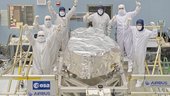
Key science elements of the James Webb Space Telescope have been upgraded ahead of the observatory’s launch in 2018.
Software satellite
Technology image of the week: Through daily software uploads, this miniature satellite will be a testbed for innovative control methods
Imeline teadus

Lõhe tavakodaniku ning mõnest spetsiifilisest valdkonnast arusaamiseks tarvilike teadmiste ja arusaamade vahel on tavaliselt üüratu. Ja mida aeg edasi, seda hullemaks läheb.
NASA Briefing to Discuss First Spacecraft Arrival at a Dwarf Planet
JPL will host a briefing Monday, March 2, about the March 6 arrival of NASA’s Dawn spacecraft at the dwarf planet Ceres. The event will be carried live on NASA TV and online.
Latest Selfie from NASA Mars Rover Shows Wide Context
NASA’s Curiosity Mars rover used the camera on its robotic arm to record the pieces of a portrait that shows the rover within a panorama of the area it is studying.
New NASA Soil Moisture Mapper Completes Key Milestone
Mission controllers at JPL today sent commands to unfurl the reflector antenna on NASA’s new Soil Moisture Active Passive (SMAP) observatory, launched Jan. 31.
Out of this world
Watch a replay of our ‘Out of this world’ Google hangout between ESA astronaut Tim Peake and pupils from Rode Heath Primary from Cheshire, UK
ESA’s spaceplane is coming home

ESA’s IXV spaceplane, launched on a Vega rocket on 11 February, is now on its way to Europe for detailed study in Italy.
Actin’ strange
Human spaceflight and operations image of the week: Human endothelial cells and nuclei stained and exposed under a microscope in preparation for space
Last look at Sentinel-2A

Before Sentinel-2A is packed up and shipped to French Guiana for its launch targeted on 12 June, media representatives and specialists got one last look at the second satellite for Europe’s Copernicus programme.
Calling on satellites in alpine rescues
Emergency services rescued 1780 people in the Austrian Alps last year. They can now count on satellites to access maps, send messages, give warnings and stay in contact.
Why comets are like deep-fried ice cream
Research shows that under a crystalline crust should still be very cold and contain more porous amorphous ice.
Laserrelvasüsteemide täiustamine jätkub

Laserrelva põhiidee on ju tegelikult iidvana – legend räägib, et juba Archimedes kasutas nõgusa peegliga koondatud päikeseenergiat, et vaenlase laevastikku hävitada. Mida üks laserrelvgi muud teha saab, kui koondada väga intensiivne valgus sihtmärgile, üritades seda sel teel kahjustada. Neil päevil tuli teade, et Boeing on võitnud 29,5 miljonit dollarit maksva lepingu laserrelva laserikiire stabiliseerimise süsteemi […]
NASA to Highlight Results from New Earth Missions
Over the past 12 months NASA has added five missions to its orbiting Earth-observing fleet. NASA scientists will share early observations during a media telecon Feb. 26.
Turbulent Black Holes
Author(s): Huan Yang, Aaron Zimmerman, and Luis Lehner A rapidly rotating black hole can have a horizon instability, where certain modes become excited and grow. The behavior is analogous to turbulence in high Reynolds number fluids.[Phys. Rev. Lett. 1…
Two Fermions in a Double Well: Exploring a Fundamental Building Block of the Hubbard Model
Author(s): Simon Murmann, Andrea Bergschneider, Vincent M. Klinkhamer, Gerhard Zürn, Thomas Lompe, and Selim Jochim
A simple system consisting of a pair of atoms in a two-site “minicrystal” is able to reproduce the physics of a widely used model of electrons in a solid.
[Phys. Rev. Lett. 114, 080402] Published Mon Feb 23, 2015
Scientific spring in isolated Antarctica

In Antarctica, the crew of the French–Italian Concordia research station are preparing for the winter. They have to survive six months of complete isolation – four in darkness because the Sun never rises above the horizon – while they perform science in one of the most barren places on Earth.
Does dark matter cause mass extinctions and geologic upheavals?
A university professor concludes that movement through dark matter may perturb the orbits of comets and lead to additional heating in Earth’s core, both of which could be connected with mass extinction events.
Colours in the cloud
Space Science Image of the Week: Herschel and Spitzer team up to explore the Small Magellanic Cloud, one of our nearest extragalactic neighbours
Kas teadsid, et ka neutronkiirgust kasutades saab asju pildistada?

Neutronkiirgus on vabade neutronite voog, mis tekib tuumalagunemise või tuumasünteesi (tekke) protsessi käigus ja reageerib ettejäävate tuumadega, moodustades uusi isotoope, mis omakorda võivad kiirgust tekitada. Neutronkiirgusega saab uurida üliväikeses mõõtkavas ainete ehitust (struktuuri)– objektilt väjunud neuronite energiate ja liikumissuundade järgi tehakse kindlaks mõõdetava objekti sisestruktuur (kasutatakse kristallograafias, vedelate- ja tahkete ainete füüsikas, bioloogias, tahkiste keemias, […]
Murphy seadustest ja inimvõimete piiridest

See võib tunduda uskumatu, kuid Murphy oli reaalne isik, kes elas Ameerika Ühendriikides kuni oma surmani 1990. aastal. Kapten Edward A. Murphy Jr. töötas õhujõudude insenerina. Kuigi ta osales oma karjääri jooksul paljudes projektides, pani Murphy seadusele aluse katse, kuhu ta sattus pea kogemata. Aastal 1949 tehti Californias asuvas Edwardsi sõjaväebaasis projekti MX981 katseid, et […]
Robert H. March’i “Füüsika võlu”, nüüd e-raamatuna

2000.aastal andis kirjastus Ilmamaa välja Robert H. March’i raamatu Physics for poets. Tõlkis Henn Käämbre, eestikeelseks pealkirjaks sai Füüsika võlu. Eesti Füüsika Selts on nüüd selle väärt teose uuesti välja andnud, e-raamatuna aadressi õpik.füüsika.ee. Lugemiseks tuleb küll keskkonda sisse logida, aga muus osas on selle kasutamine vaba. Legend räägib, et pealkirja otsetõlke – Füüsika poeetidele […]
Directional Antineutrino Detection
Author(s): Benjamin R. Safdi and Burkhant Suerfu
A proposed detector for low-energy antineutrinos would reveal the particles’ trajectories, potentially allowing more detailed studies of Earth’s radioactivity and of nuclear reactors.
[Phys. Rev. Lett. 114, 071802] Published Fri Feb 20, 2015
Week In Images
Our week through the lens: 16-20 February 2015
Hubble gets best view of a circumstellar debris disk distorted by a planet
The new images reveal the inner disk around Beta Pictoris and confirm structures predicted by computer simulations.